Global Employer of Record services enable companies to hire employees in international markets without establishing a local legal entity. As organizations expand across borders, EOR models help manage employment compliance, payroll, taxation, and statutory benefits while reducing regulatory risk.
This guide explains how global EOR services work, when organizations use them, and how HR leaders evaluate EOR solutions as part of a scalable global hiring strategy.
Table of Contents
ToggleGlobal Hiring Risk and Compliance Exposure
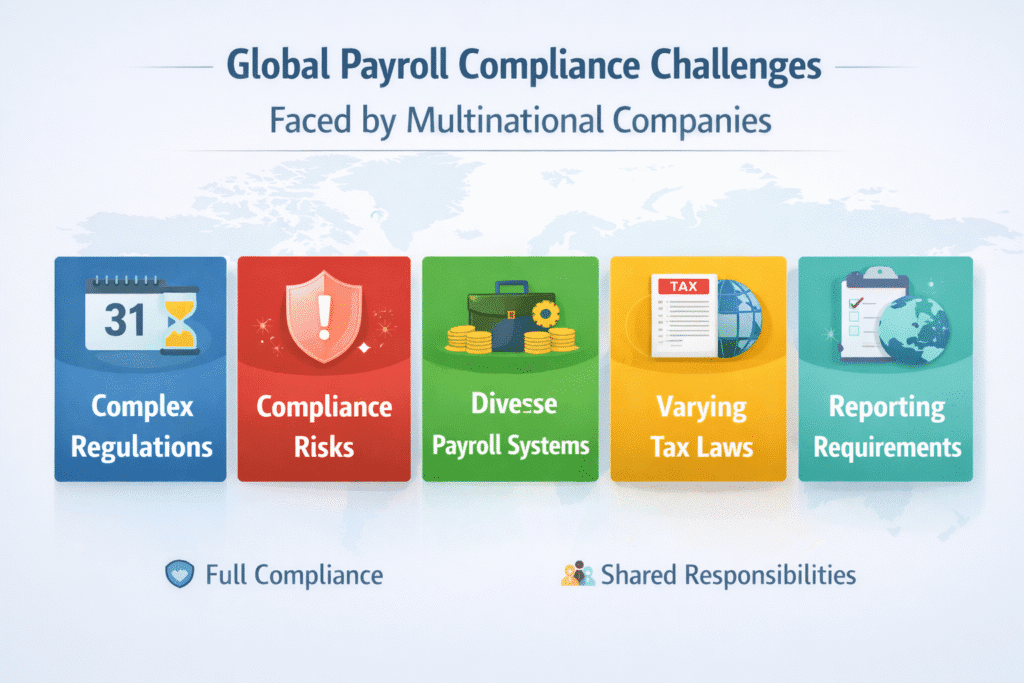
Expanding a workforce across borders introduces complex legal, tax, and compliance obligations that vary significantly by country. Employment misclassification, payroll errors, and non-compliance with local labor regulations can expose organizations to financial penalties, legal disputes, and reputational risk.
Global Employer of Record services are increasingly used by organizations to reduce cross-border employment risk, ensure regulatory compliance, and maintain governance standards while operating in multiple jurisdictions.
Why Organizations Use Global Employer of Record Services
Organizations adopt Global Employer of Record services to support international growth while maintaining compliance, operational efficiency, and workforce agility.
Enable compliant hiring without establishing local legal entities
Manage employment law obligations across multiple jurisdictions
Reduce legal and regulatory exposure in global workforce operations
Support international payroll, benefits, and statutory requirements
Maintain consistency in HR governance for distributed teams
What is an Employer of Record (EOR)?
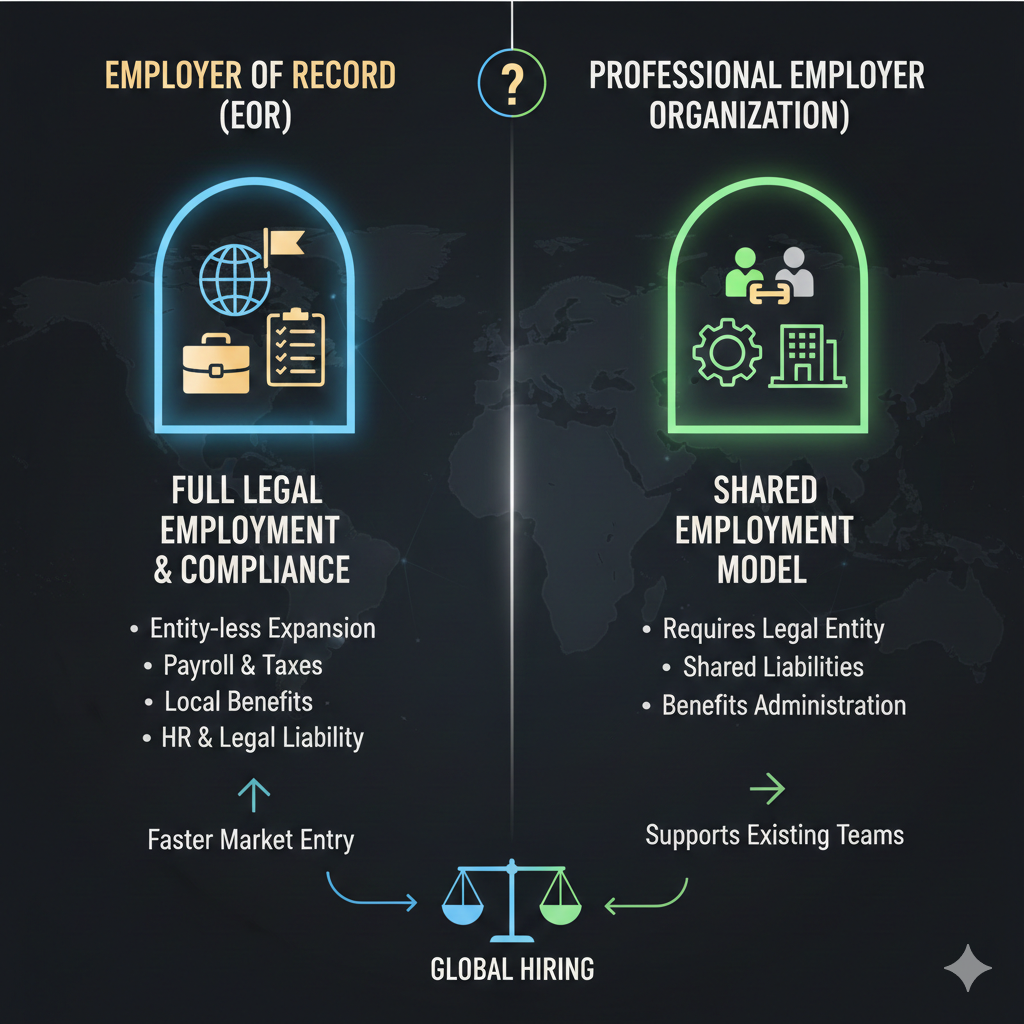
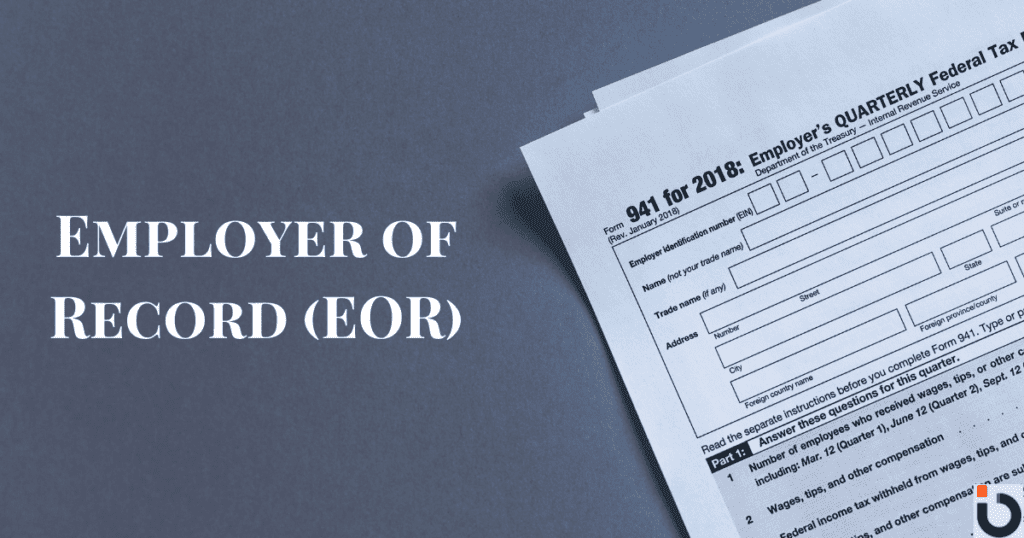
An Employer of Record is a third-party organization that legally employs workers on behalf of a company in a specific country. The EOR manages employment contracts, payroll, tax filings, statutory benefits, and labor law compliance, while the client company retains control over daily work and performance. This model allows organizations to hire internationally without establishing a local legal entity.
EOR as Part of a Global Workforce Strategy
For many organizations, Employer of Record services are not a permanent employment model but a strategic workforce solution. EOR enables companies to enter new markets, validate talent availability, and support global operations while retaining flexibility in long-term expansion decisions.
HR and leadership teams often integrate EOR services alongside internal HR systems, global payroll platforms, and compliance frameworks to support scalable international hiring.
EOR vs Traditional Entity Hiring Model
Traditional entity hiring requires companies to incorporate, register, and maintain legal subsidiaries in each country where they hire employees. This process is time-consuming and expensive. In contrast, Employer of Record services allow organizations to onboard talent quickly, with compliance managed by the EOR partner. HR leaders evaluate these models based on speed, cost, and long-term workforce strategy.
Core Services Provided by EOR Partners
Global EOR providers handle legal employment contracts, payroll processing, tax compliance, employee benefits administration, local labor law adherence, and often visa/work permit coordination. These services allow organizations to operate in multiple jurisdictions without maintaining separate HR infrastructures in each country.
How Employer of Record Services Work
Employer of Record services operate through locally registered entities that assume legal employer responsibilities. Once an employee is onboarded, the EOR handles payroll processing, statutory deductions, benefits administration, and regulatory reporting. HR teams coordinate with the EOR for compliance execution while maintaining operational oversight of the workforce.
Why is an Employer of Record Needed?
- Legal Compliance: Helps businesses comply with labor laws and tax regulations in foreign countries.
- Operational value: Reduces the need to set up legal entities in every country where you hire.
- Faster Hiring: Streamlines the onboarding process for global employees.
- Risk Mitigation: Minimizes compliance-related risks by ensuring adherence to local laws.
- Focus on Core Operations: Allows businesses to focus on growth while leaving administrative tasks to experts.
This is especially beneficial for businesses expanding internationally or hiring remote workers globally.
Compliance and Risk Management in Global Hiring
Compliance is the primary value driver of Employer of Record services. EOR providers manage employment contracts, payroll tax filings, statutory benefits, and labor law adherence according to local regulations. This reduces the risk of worker misclassification, regulatory penalties, and employment disputes, particularly in multi-country hiring scenarios.
Regulatory Complexity in Global Employment
Labor laws, tax requirements, and statutory benefits differ significantly across regions such as North America, the European Union, and the Gulf Cooperation Council. Organizations operating across these regions must navigate local employment contracts, termination regulations, social security contributions, and data protection standards.
Global Employer of Record services help organizations align with regional labor frameworks while maintaining centralized oversight of global employment practices.
When HR Leaders Should Use an Employer of Record Model
HR leaders typically use Employer of Record services during early-stage international expansion, remote hiring initiatives, and short- to mid-term market entry. As workforce presence grows, organizations may transition from EOR arrangements to local entities. The decision depends on hiring volume, compliance exposure, and operational timelines.
Strategic Impact of EOR on Global Workforce
Beyond compliance and payroll, EOR services support scalable workforce strategies by enabling consistent employment practices across borders, integrated HR and payroll reporting, and centralized compliance governance. Organizations with distributed teams can focus on business outcomes while leveraging EOR expertise to reduce administrative overhead.
Enterprise-Grade Global Employment Solutions
Organizations evaluating Global Employer of Record services often engage with enterprise workforce partners that support compliance, payroll, and international employment governance across multiple regions.
FAQs About Global Employer of Record Services
What does a Global Employer of Record do?
A Global Employer of Record acts as the legal employer on behalf of a company in a specific country. It manages employment contracts, payroll processing, tax filings, statutory benefits, and labor law compliance, while the hiring company retains control over day-to-day work and performance.
How does an Employer of Record help with international hiring?
An Employer of Record enables companies to hire employees in foreign markets without setting up local legal entities. This allows organizations to expand internationally faster while reducing regulatory complexity and compliance risk.
What is the difference between an Employer of Record and setting up a local entity?
Setting up a local entity requires legal registration, tax infrastructure, and ongoing regulatory management. An Employer of Record provides a faster and more flexible alternative by handling employment compliance through existing local entities.
How does an Employer of Record reduce compliance risk?
Employer of Record providers manage local labor laws, payroll taxes, statutory benefits, and employment documentation according to country-specific regulations. This reduces the risk of misclassification, penalties, and compliance failures for global employers.
When should HR leaders consider using an Employer of Record model?
HR leaders typically use an Employer of Record during early international expansion, remote hiring initiatives, or when entering new markets quickly. It is also useful when workforce size does not yet justify establishing a permanent local entity.
Can Employer of Record services support long-term global workforce strategies?
Yes. Many organizations use Employer of Record services as part of a phased global expansion strategy. As operations mature, companies may transition from EOR arrangements to direct entity-based employment while maintaining compliance continuity.
How does an Employer of Record differ from a PEO?
An Employer of Record becomes the legal employer in foreign countries, while a Professional Employer Organization typically operates through co-employment within the same country. EOR models are designed specifically for cross-border hiring and international compliance.
How does a Global Employer of Record support compliance at scale?
A Global Employer of Record assumes legal employment responsibility in each jurisdiction, ensuring that employment contracts, payroll processing, tax filings, and statutory benefits comply with local regulations. This model allows organizations to scale international hiring while reducing compliance exposure and administrative complexity.
Long-Term Workforce Governance and Risk Management
As organizations expand internationally, workforce governance becomes a critical component of operational risk management. Employer of Record services support standardized employment practices, documentation, and compliance reporting across regions, enabling HR leaders to maintain oversight while supporting global growth initiatives.
Partner With Interview Cracker
Interview Cracker publishes enterprise-focused content on global hiring, Employer of Record models, workforce compliance, and international employment strategy. Our readers include HR leaders, founders, and teams evaluating compliant global hiring approaches across the US, EU, Canada, and GCC markets.
We selectively collaborate with:
Employer of Record and global hiring platforms
Workforce compliance and mobility solution providers
International payroll and employment infrastructure services
Partnership opportunities include contextual brand mentions, sponsored thought leadership, and long-term content collaborations aligned with our HR & Hiring pillar.
📩 For partnership and sponsored placement inquiries, contact
knowledge@interviewcracker.com