
Overtime Calculator
💸 Getting paid in GBP or sending money internationally?
Use Wise to send or receive GBP at the real exchange rate — no hidden fees, no bank markups. Trusted by 16M+ people worldwide.
Open a free Wise account →Is Your Resume ATS-Ready?
11 free checkers for US, UK & Canada jobs. See if your resume passes ATS screening — before applying.
Overtime Calculator UK — 2026 Guide
In the UK, there is no legal right to enhanced overtime pay — your entitlement depends entirely on your employment contract. However, your total pay for all hours worked (including overtime) must never fall below the National Living Wage of £12.21/hour for workers aged 21 and over (2025/26 rate). Use the calculator above to check if your overtime pay is compliant.
UK National Minimum Wage Rates 2025/26
| Age Group | Hourly Rate | Time-and-a-Half | Double Time |
|---|---|---|---|
| 21 and over (NLW) | £12.21 | £18.32 | £24.42 |
| 18–20 | £10.00 | £15.00 | £20.00 |
| Under 18 | £7.55 | £11.33 | £15.10 |
| Apprentice | £7.55 | £11.33 | £15.10 |
*Source: GOV.UK — National Minimum Wage rates 2025/26. Effective April 2025.
Common UK Overtime Rates by Sector
| Sector | Weekday overtime | Saturday | Sunday / Bank Holiday |
|---|---|---|---|
| Manufacturing & Construction | Time-and-a-half (1.5×) | Time-and-a-half | Double time (2×) |
| Retail & Hospitality | Standard rate (1×) | Standard or 1.5× | Double time or 1.5× |
| Healthcare & NHS | Time-and-a-half | Time-and-a-half | Double time |
| Office / Corporate | TOIL or standard | TOIL or 1.5× | Double time or TOIL |
| Trades (plumbing, electrical) | Time-and-a-half | Time-and-a-half | Double time + callout fee |
UK Bank Holidays 2026 — When Double Time Typically Applies
Most UK employment contracts offer double time (2×) for working on Bank Holidays. England and Wales has 8 Bank Holidays in 2026:
- New Year’s Day — 1 January 2026
- Good Friday — 3 April 2026
- Easter Monday — 6 April 2026
- Early May Bank Holiday — 4 May 2026
- Spring Bank Holiday — 25 May 2026
- Summer Bank Holiday — 31 August 2026
- Christmas Day — 25 December 2026
- Boxing Day — 28 December 2026
Scotland and Northern Ireland have additional bank holidays. Always check your contract — bank holiday pay is not automatic by law in the UK; it must be specified in your employment terms.
UK Overtime Key Rules — Quick Reference
- ✅ No legal right to enhanced overtime pay — it’s contractual, not statutory
- ✅ 48-hour weekly limit — under the Working Time Regulations 1998, you cannot be required to work more than 48 hours per week on average (over a 17-week period) without a signed opt-out agreement
- ✅ NMW compliance is mandatory — your total pay divided by total hours must never fall below £12.21/hour (21+). Breaches carry HMRC fines of up to 200% of underpayment per worker
- ✅ Holiday pay must include regular overtime — following the Bear Scotland v Fulton ruling, regular and systematic overtime must be factored into holiday pay for the first 4 weeks of annual leave
- ✅ TOIL (Time Off In Lieu) — some employers offer equivalent time off instead of pay. For higher-rate taxpayers this can be worth 40–60% more in effective value than cash overtime
UK Overtime FAQs
What is the overtime rate in the UK?
There is no single legal overtime rate in the UK. The most common rate is time-and-a-half (1.5×) for weekday overtime and Saturdays, and double time (2×) for Sundays and bank holidays. However, your employer can legally pay standard rate for overtime as long as your total average pay doesn’t fall below the National Living Wage of £12.21/hour (2025/26).
Is overtime taxed differently in the UK?
No — overtime is taxed at your normal marginal rate through PAYE. It is added to your regular earnings and taxed accordingly. If your total earnings push you above £50,270, the excess is taxed at 40% (higher rate). National Insurance contributions also apply at 8% on earnings between £12,570 and £50,270.
What is double time in UK overtime?
Double time means you are paid 2× your normal hourly rate for hours worked. It is most commonly paid for Sundays, bank holidays, and emergency callouts in trades and healthcare. For example, if your standard rate is £15/hour, double time pays £30/hour. This is a contractual arrangement — not a legal requirement — so always check your employment contract.
Can my employer force me to work overtime in the UK?
Only if your employment contract includes a compulsory overtime clause. Even then, you cannot be required to work more than an average of 48 hours per week over 17 weeks without signing a written opt-out of the Working Time Regulations. If you have not signed an opt-out, your employer cannot require you to exceed this limit.
Does overtime count towards holiday pay in the UK?
Yes — following the Bear Scotland v Fulton (2014) ruling, regular and systematic overtime must be included when calculating holiday pay for the first 4 weeks of statutory annual leave. Occasional voluntary overtime that does not follow a regular pattern may not need to be included. If in doubt, contact ACAS on 0300 123 1100 for free guidance.
What is the 48-hour rule for overtime in the UK?
Under the Working Time Regulations 1998, most UK workers cannot be required to work more than an average of 48 hours per week, calculated over a 17-week reference period. You can voluntarily opt out by signing a written agreement. Young workers under 18 cannot opt out and are limited to 8 hours per day and 40 hours per week.
🚀 Negotiating a UK salary or job offer?
Use Merlin AI to research UK employer salary benchmarks, prep your interview answers and craft a cover letter for UK roles — free to start.
Try Merlin AI free →Payroll and Compliance Considerations
Payroll calculations must align with statutory requirements, tax regulations, and employment policies. Inaccurate payroll handling can create compliance risks for both employers and employees.
Our payroll and HR resources explore how organizations manage Payroll Accountant responsibilities, statutory deductions, and compliance across different employment models. For enterprise teams managing compensation at scale, explore our guide on Global Payroll Software Solutions and payroll governance.
How to Use Our Overtime Calculator
Our tool simplifies complex math:
Enter Regular Hourly Rate
Input Standard Weekly Hours
Add Monthly Overtime Hours
Select Multiplier (1.5x, 2x, or custom)
Pro Tip: Bookmark this page to:
Verify employer payroll calculations
Negotiate fair overtime compensation
Plan side income from part-time gigs
How to Calculate Overtime for Monthly Salary Employees
Understanding how to calculate overtime pay is crucial for both employees and employers. With labor laws varying by country and complex pay structures, our free Overtime Pay Calculator simplifies the math while this guide explains everything you need to know about overtime regulations, calculations, and maximizing your earnings.
What Is Overtime Pay?
Overtime pay refers to the additional compensation employees receive for working beyond their standard hours. In most Tier 1 countries like the US, Canada, and the UK, overtime is legally mandated at 1.5x the regular hourly rate (time-and-a-half), though some situations require 2x pay (double time).
Key Terms to Know:
Regular Hours: Standard working hours per week (typically 35-40 hours)
Overtime Threshold: The hour limit triggering overtime pay (e.g., >40 hours/week in the US)
Multiplier: The rate applied to base pay for overtime (1.5x, 2x, etc.)
FLSA: Fair Labor Standards Act (US overtime law)
Working Time Directive: EU/UK overtime regulations
How Overtime Pay is Calculated: The Formula Explained
Our overtime calculator uses this universal formula:
Total Overtime Pay = Overtime Hours × Hourly Rate × Multiplier
Step-by-Step Breakdown
Determine Hourly Rate
For salaried employees:
Hourly Rate = Annual Salary ÷ 52 Weeks ÷ Regular Hours/Week
Example: 60,000/year÷52÷40=60,000/year÷52÷40=28.85/hour
Identify Overtime Hours
Hours worked beyond the legal threshold (varies by country):
US/Canada: >40 hours/week
UK: >48 hours/week (opt-out required)
Australia: >38 hours/week
Apply the Correct Multiplier
Standard overtime: 1.5x hourly rate
Holidays/Sundays: 2x rate in many jurisdictions
California: Daily overtime (>8 hours/day = 1.5x, >12 hours/day = 2x)
Calculate Total Earnings
Total Pay = Regular Pay + (Overtime Hours × Hourly Rate × Multiplier)
For organizations, payroll accuracy is closely tied to compliance and governance. HR and payroll professionals must ensure that compensation calculations align with regulatory standards and internal payroll controls.
Double Time Pay Calculator
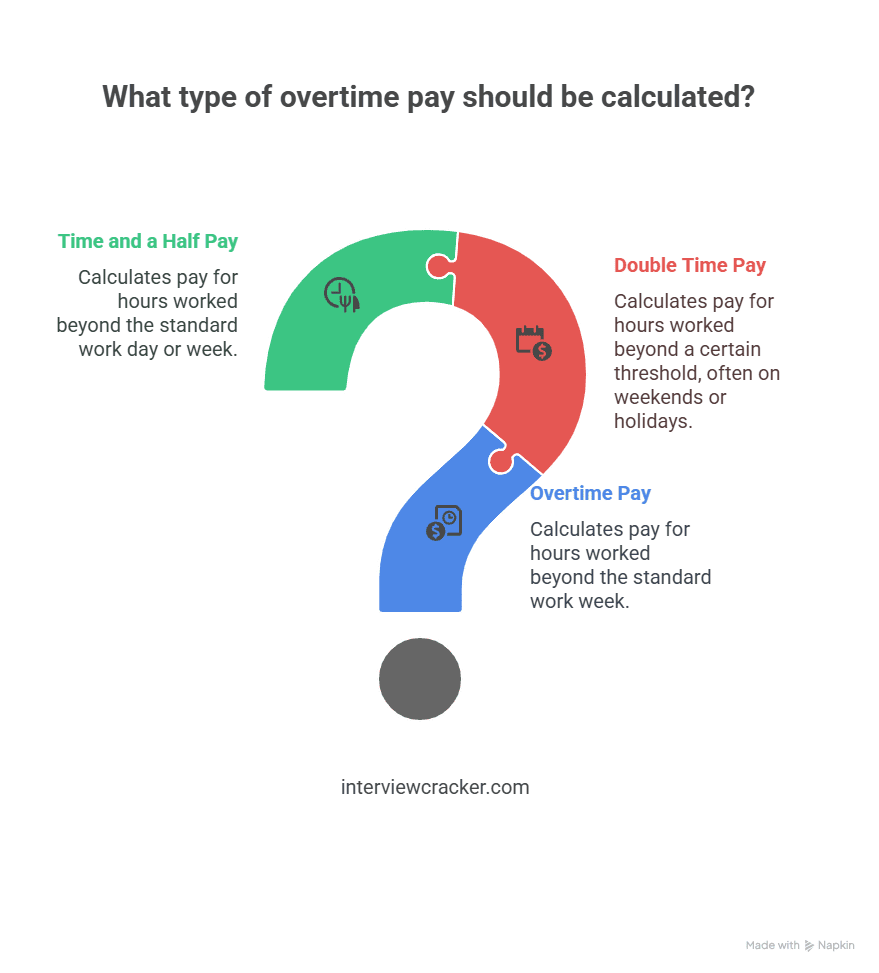
Double time pay is calculated when an employee works extra hours beyond standard overtime rules, such as during holidays or after a certain number of consecutive hours. The formula for double time pay is:
Double Time Pay = Double Time Hours × Hourly Rate × 2
This ensures that employees are compensated at twice their standard hourly wage for any double-time-eligible work.
Use multiplier = 2 in “Double Time Pay Calculator”
Time and a Half Calculator
Time and a half pay, commonly known as standard overtime pay, is given for hours worked beyond the normal workweek (usually 40 hours). The formula for calculating time and a half pay is:
Time and a Half Pay = Overtime Hours × Hourly Rate × 1.5
This calculation ensures that employees are fairly compensated for their additional effort during overtime hours.
Use multiplier = 1.5 in “Double Time Pay Calculator”
Country-Specific Overtime Laws
1. United States Overtime Rules
Under the FLSA:
1.5x pay for hours over 40/week
Exemptions: Salaried employees earning >$35,568/year
State Variations:
California: Daily overtime + 7th consecutive day = 1.5x/2x
Texas: No daily overtime requirement
Case Study: A Texas nurse earning $30/hour works 50 hours in a week:
Regular pay: 40 × 30=30=1,200
Overtime: 10 × 30×1.5=30×1.5=450
Total: $1,650
2. United Kingdom Overtime Rules
48-hour/week limit (unless employee opts out)
No legal overtime rate – determined by employment contracts
Typical practice: 1.25x-1.5x for nights/weekends
3. Canada Overtime Rules
Varies by province:
Ontario: 1.5x after 44 hours/week
Alberta: 1.5x after 8 hours/day or 44 hours/week
Federal: 1.5x after 40 hours
4. Australia Overtime Rules
1.5x for first 2 overtime hours
2x thereafter
Sundays/Public Holidays: Up to 2.5x pay
Common Overtime Scenarios (With Examples)
Scenario 1: Retail Worker (Weekly Overtime)
Hourly wage: $15 (USD)
Hours worked: 47 hours
Calculation:
Regular pay: 40 × 15=15=600
Overtime: 7 × 15×1.5=15×1.5=157.50
Total: $757.50
Scenario 2: Emergency Double Time (Healthcare)
Hourly wage: $45 (AUD)
Hours worked: 14-hour shift on Christmas
Calculation:
First 2 hours: 2 × 45×1.5=45×1.5=135
Next 12 hours: 12 × 45×2=45×2=1,080
Total Overtime: $1,215
Scenario 3: Tech Employee (Exempt vs. Non-Exempt)
Salaried developer: $120,000/year = No overtime
Hourly developer: 60/hour×50hours=60/hour×50hours=60×40 + (60×10×1.5)=∗∗60×10×1.5)=∗∗3,300**
5 Mistakes to Avoid When Calculating Overtime
Misclassifying Employees: Exempt vs. non-exempt status errors
Ignoring Daily Overtime: Used in CA, NV, and other states
Forgetting Non-Discretionary Bonuses: Must be included in “regular rate” calculations
Miscalculating Salaried Hourly Rates:
Incorrect: Monthly salary ÷ 4 weeksCorrect: Annual salary ÷ 52 weeks ÷ standard hoursOverlooking Meal Breaks: Unpaid 30-minute breaks may affect overtime thresholds
FAQs on Overtime Calculator
Q: Is overtime mandatory for employers?
A: In most Tier 1 countries, yes – once an employee crosses the legal hourly threshold.
Q: Do salaried employees get overtime?
A: Only if they earn below the exemption threshold ($35,568/year in the US).
Q: How is overtime taxed?
A: Taxed as ordinary income, though some countries have higher withholding rates for bonuses/overtime.
Q: Can I refuse to work overtime?
A: Generally yes, unless specified in your employment contract.
Maximizing Your Overtime Earnings
For Employees:
Track hours with apps like Toggl or Hubstaff
Understand company policies for holiday/weekend rates
Negotiate higher multipliers for undesirable shifts
For Employers:
Use automated payroll software (e.g., Gusto, ADP)
Audit classifications annually to avoid lawsuits
Consider “comp time” (time off instead of pay) where legal
Recent Changes in Overtime Laws
US (2024): Proposed raise of exemption threshold to $55,000/year
EU (2023): Right to disconnect laws reducing unpaid overtime
Australia (2024): “Same job, same pay” bill affecting casual worker overtime
Why Trust Our Overtime Calculator?
Our tool is:
✅ Updated for 2025 tax laws
✅ Customizable for country-specific rules
✅ Mobile-friendly for on-the-go calculations
✅ Used by 150,000+ employees and HR professionals
Try it now to instantly calculate your overtime pay and ensure you’re being paid fairly. Bookmark this page or share it with coworkers to spread financial literacy in your workplace!
Conclusion
Our Overtime Calculator ensures that you can accurately determine your additional earnings for overtime hours, whether they qualify for time and a half or double time pay. It’s a simple yet powerful tool to help you plan your finances and ensure you’re being compensated fairly for your extra effort.