A farm’s busiest season is rarely the best time to write a newsletter, answer every routine question or remind customers that a pickup window has changed. Marketing automation can handle some of that recurring communication, giving farmers and other rural business owners more time for animals, crops and customers. Used thoughtfully, it helps a small operation stay in touch without making its messages feel impersonal.
Quick Answer
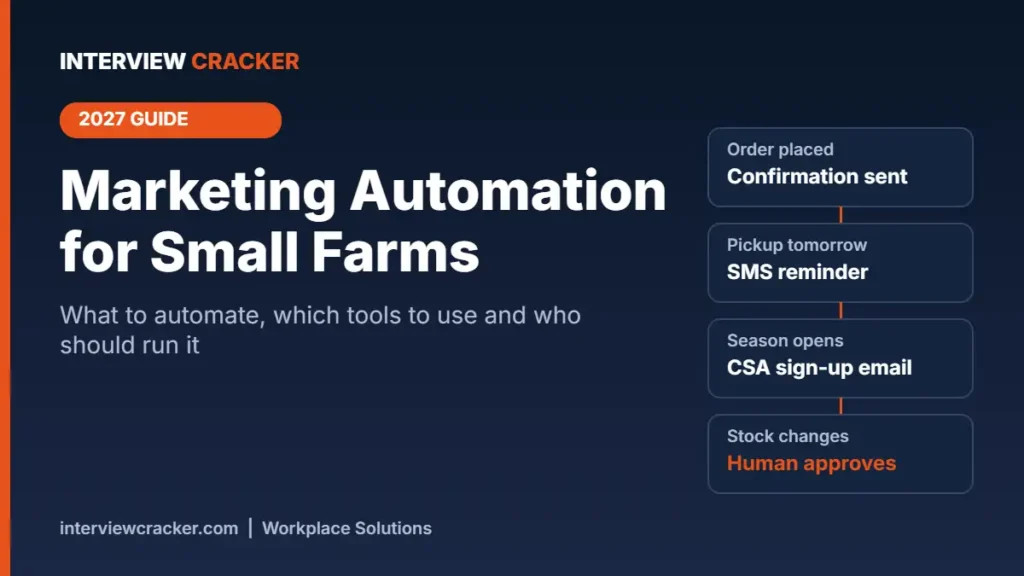
Marketing automation for a small farm means letting software send the messages that repeat on a schedule or after a customer action: order confirmations, pickup reminders, CSA sign-up announcements and care instructions. Start with one recurring task, keep a human review step for anything that changes with weather or stock, and measure orders and pickups rather than just opens.
- Best low-cost tools: Brevo (email + SMS), MailerLite, Mailchimp
- Automate fully: order confirmations, fixed pickup reminders, care instructions
- Keep a human check: weekly availability, delivery dates, anything weather-dependent
What automation can—and cannot—do
Marketing automation is software that carries out planned communications or tasks in response to a schedule or a customer’s actions. A farm might send an order confirmation automatically, follow up after a farm-stand purchase, or email subscribers when seasonal products become available. The system does the repetitive work; the business still decides what to say, whom to contact and when a human response is needed.
That distinction matters in agriculture and animal-related businesses, where trust is often built through personal relationships. A generic message sent at the wrong moment can do more harm than a delayed one. Automation should support the producer’s knowledge of the season and community, not replace it. For a broader look at how automated systems are changing marketing, this discussion of marketing on autopilot raises useful questions about where human judgment still belongs.
Start with one recurring task
There is no need to automate every part of a business at once. Begin with a task that happens regularly and has a clear purpose. Examples include:
- Order updates: Confirm a direct-to-consumer order and explain when the customer should expect another update.
- Pickup reminders: Send a reminder with the pickup time, location and any instructions customers need.
- Seasonal announcements: Let subscribers know when a CSA sign-up period opens, lambing tours are scheduled or a farm store changes its hours.
- Care information: After an animal-related service or product purchase, share relevant instructions and a way to ask follow-up questions.
Choose a workflow that saves time without requiring complicated exceptions. If every order needs a different explanation, a template may help, but a fully automatic message may not. Keep an easy route to a real person for questions, corrections and unusual situations.
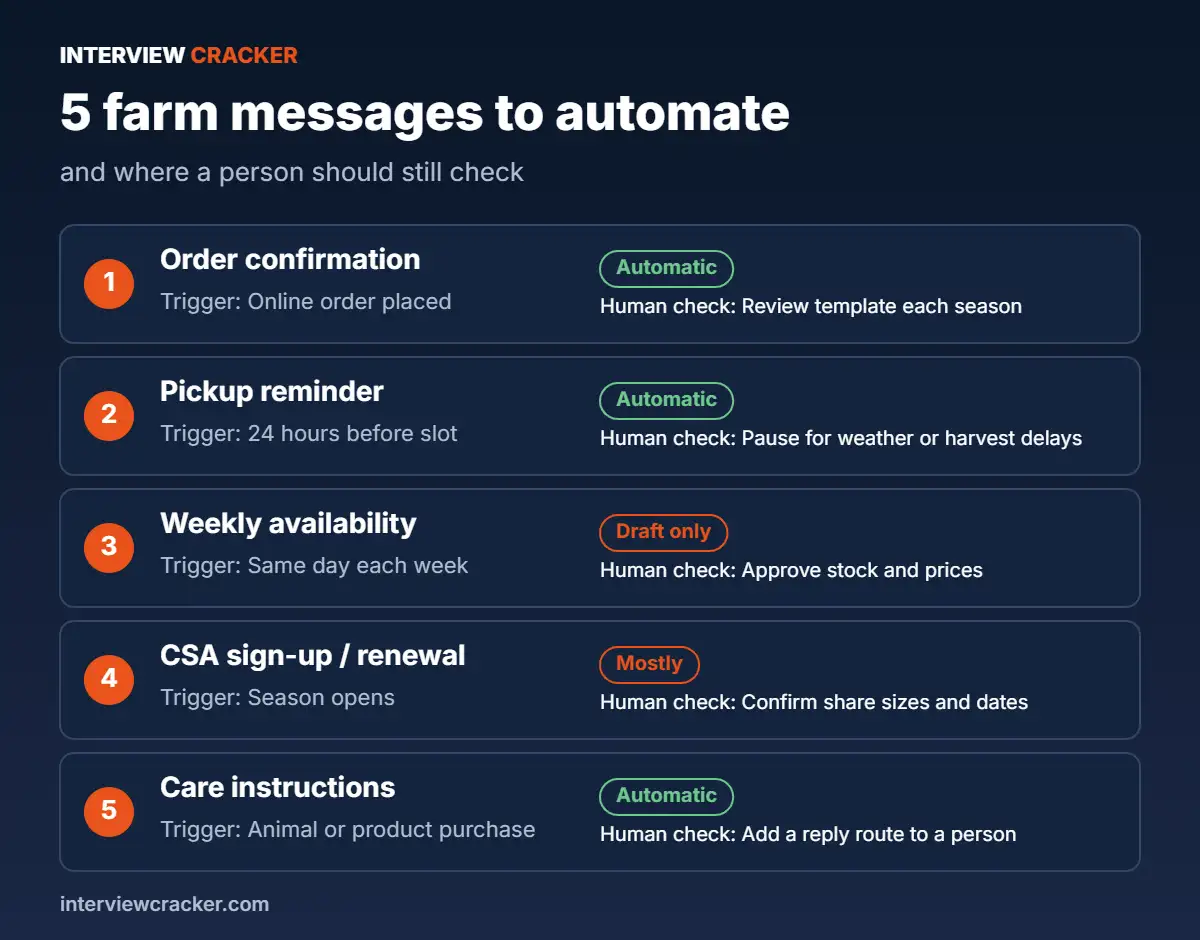
Which farm messages to automate, and where a person should check
| Message | What triggers it | Fully automatic? | Human check |
|---|---|---|---|
| Order confirmation | Online order placed | Yes | Review the template each season |
| Pickup reminder (email or SMS) | 24 hours before the pickup slot | Yes, if the slot is fixed | Pause when weather or harvest delays pickups |
| Weekly availability list | Same day each week | No, draft only | Approve stock and prices before sending |
| CSA sign-up or renewal | Season opens; renewal date approaches | Mostly | Confirm share sizes and dates |
| Care instructions | Animal or product purchase | Yes | Include a reply route to a real person |
Make the timing fit the work
Farm schedules are shaped by weather, harvests, animal care and labor availability. A campaign calendar should reflect those realities. Before setting an automated sequence, ask whether the message will remain accurate if a delivery is delayed, inventory runs out or a planned event changes. A reminder that cannot adapt to changing conditions may create extra work for the very people it is meant to help.
Use automation for stable information and build in a review step for details that can change. For example, a standard order confirmation can go out immediately, while a weekly availability email can be drafted automatically but approved by a person before sending. Set aside time to pause or update messages during emergencies and seasonal disruptions.
Email, SMS or WhatsApp: picking the right channel for reminders
Email suits newsletters, CSA announcements and anything customers may want to keep. Short, time-sensitive messages such as “your box is ready at the north gate until 6 pm” are often read faster as SMS or WhatsApp. Many email tools now include SMS, so one system can send both. If you message customers on WhatsApp, keep the tone polite and businesslike; our guide to writing a formal WhatsApp message has ready-to-adapt templates. For gentle nudges by email, such as an unpaid invoice or a missed pickup, see these gentle reminder email examples.
Whichever channel you use, get clear consent before sending marketing messages, include an easy opt-out, and keep transactional reminders (order and pickup details) separate from promotions.
Keep customer information organized
Useful automation depends on reliable records. Collect only the information needed to serve customers, explain how they will receive updates, and make it straightforward to unsubscribe from marketing emails. Separate audiences when their interests differ: a wholesale buyer may need availability and delivery details, while a farm-stand customer may prefer event news or recipes.
Small businesses should also keep marketing and financial records distinct but coordinated. Knowing which campaigns bring orders can help with planning, while accurate accounts show whether those sales are profitable. Osdire’s guide to bookkeeper costs in 2026 offers a useful budgeting reference. A bookkeeper can record transactions, reconcile payment activity and help keep financial information organized, leaving owners with clearer figures to compare against campaign results. If you are deciding what to hand over, our bookkeeper job description lists the duties a bookkeeper normally covers.
Best marketing automation tools for small farms in 2027
Most small farms do not need an enterprise platform. An email tool with a sign-up form, simple automations and optional SMS covers the tasks above. Prices are per month in US dollars and change often, so check the vendor’s pricing page before you commit.
| Tool | Free plan | Paid plans from | Best for |
|---|---|---|---|
| Brevo | Yes, 300 emails a day | About $9 | Email plus SMS pickup reminders on a tight budget |
| MailerLite | Yes, small lists only | About $10–$12 | Simple newsletters and CSA sign-up landing pages |
| Mailchimp | Yes, 250 contacts | About $13 | Farms that want familiar templates and many integrations |
| ActiveCampaign | No (free trial) | About $15 (billed yearly) | Larger operations with multi-step sequences |
| HubSpot | Yes, free tools for 2 users | About $7 per seat (billed yearly) | Farms with wholesale buyers to track in a CRM |
A simple rule: if pickup reminders are your main job, start with a tool that includes SMS. If you mainly send a seasonal newsletter, a free email plan is usually enough until your list grows. If customers often ask the same questions, a basic website chat can help too; see our overview of customer service chatbots before adding one.
Who should run marketing automation on a small farm?
Someone has to own the system: write the templates, check the dates and pause messages when plans change. Small farms usually choose one of three options.
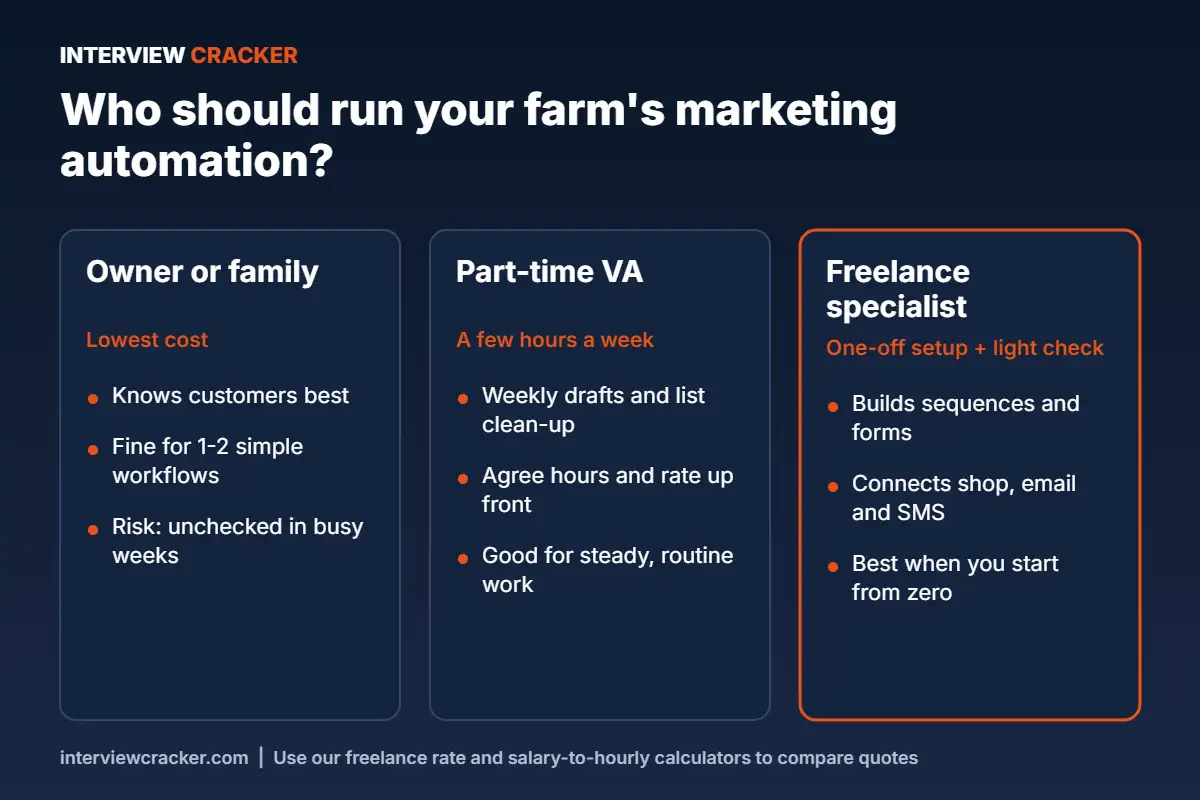
- The owner or a family member: Cheapest, and the person who knows the customers best. Works well for one or two simple workflows. The risk is that messages go unchecked in the busiest weeks.
- A part-time virtual assistant: Handles weekly drafts, list clean-up and replies for a few hours a week. Agree the hours and an hourly rate up front; our salary to hourly calculator helps you compare an hourly quote with a salaried role.
- A freelance marketing automation specialist: Best for a one-off setup of sequences, forms and integrations, then a light monthly check. Specialists use our freelance rate calculator to price this kind of work, and it is a useful way to sense-check a quote.
For context on cost, a full-time marketing automation specialist in the US earns an average base salary of about $75,000 a year, according to Payscale. In the UK, Robert Half puts the national range at roughly £31,500 to £40,500. That is why most small farms buy a few hours of freelance or VA time instead of hiring. If you are on the other side of this and want to do the work, it is one of the remote-friendly roles that small rural businesses increasingly hire for, and Google’s free digital marketing and e-commerce course is a low-cost place to start learning.
Measure what helps you decide
Open rates and clicks can provide clues, but they are not the whole story. Track practical outcomes: how many people placed an order, renewed a subscription, showed up for an event or asked to stop receiving messages. Compare results with the time and cost required to run the campaign. A modest email that reliably helps customers find a pickup location may be more valuable than a high-click promotion that generates little business.
Review automated messages at least once each season, and whenever prices, policies, products or operating hours change. Check links, dates and instructions, and read the copy as if you were a new customer. Ask whether the message is still useful and whether it sounds like the business you want to run. For ideas on turning interest into repeat orders, see our tips to convert leads into sales.
Automate the routine, protect the relationship
The best use of marketing automation is not to make a farm sound bigger or more polished than it is. It is to deliver accurate information consistently, reduce avoidable administrative work and make it easier for customers to stay connected. Begin with a small, dependable workflow, keep a person responsible for oversight, and expand only when the first system is genuinely helping. The technology can handle the reminder; the relationships, decisions and care behind the business remain human.
More guides for small teams and HR leaders are in our Workplace Solutions section.
Frequently Asked Questions (FAQs)
What is marketing automation for a small farm?
It is software that sends planned messages automatically, such as order confirmations, pickup reminders and seasonal announcements, based on a schedule or a customer action. The farmer still decides what is said and when a person needs to step in.
What is the best email marketing tool for a small farm?
For most small farms, a low-cost tool such as Brevo, MailerLite or Mailchimp is enough. Choose Brevo if you want email and SMS pickup reminders together, and a CRM such as HubSpot only if you manage many wholesale buyers.
How much does marketing automation cost for a small farm?
Many tools have a free plan for small lists, and paid plans typically start at roughly $9 to $15 a month. Setup help from a freelancer or virtual assistant is usually the bigger cost, so start with one simple workflow.
Should farm pickup reminders go by email, SMS or WhatsApp?
Use email for newsletters and anything customers may want to keep, and SMS or WhatsApp for short, time-sensitive pickup details. Always get consent and give customers an easy way to opt out.
Which farm messages should not be fully automated?
Anything that depends on weather, harvest, stock or animal care, such as weekly availability lists or delivery dates. Draft these automatically, but have a person approve them before they are sent.

Himani Joshi
Himani Joshi is a Senior Business Manager at Interview Cracker, working at the intersection of careers, hiring, and skill development. She writes about interview strategy, job market trends, and professional growth, helping readers turn opportunities into outcomes. She also writes for HR and hiring professionals, offering insights on recruitment, talent strategy, and evolving workplace dynamics.
Free tools from Interview Cracker
Planning your next career move? Try these free tools