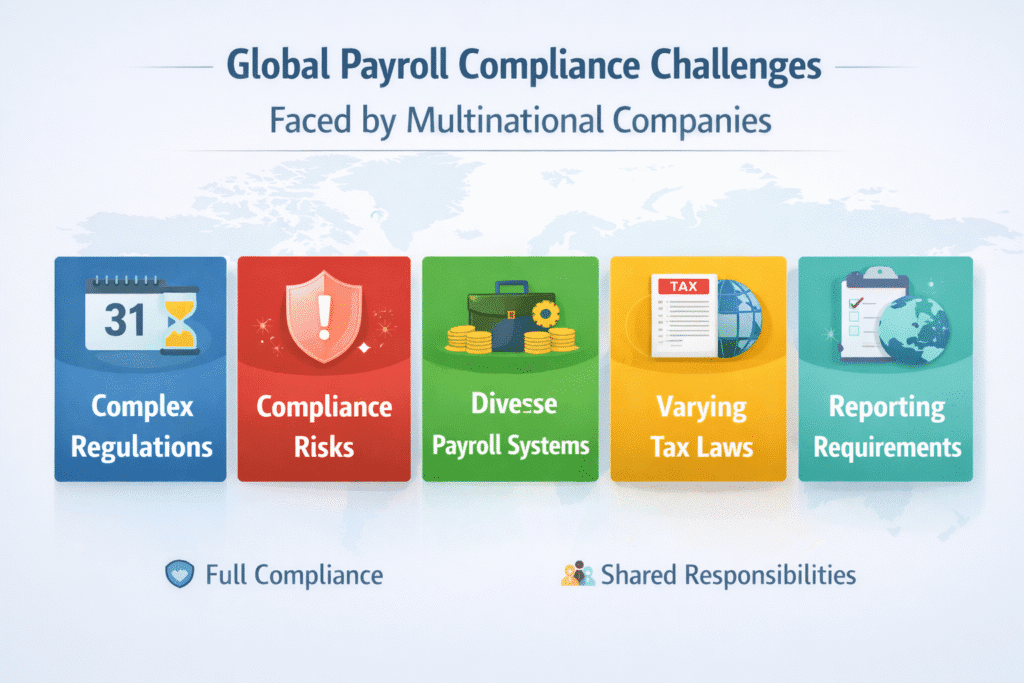
Managing payroll across multiple countries presents consistent compliance challenges for multinational companies. Each jurisdiction applies its own labor laws, tax systems, reporting standards, and employee protection rules, making payroll far more complex than a single-country operation.
For organizations operating in the US, Canada, Europe, and the Middle East, even small compliance gaps can lead to penalties, employee disputes, or regulatory scrutiny. Global payroll compliance is not only an administrative function but also a legal responsibility that directly affects workforce stability and financial accuracy.
This article outlines the most common payroll compliance challenges multinational companies encounter and why these issues persist across regions.
Table of Contents
ToggleVariations in Local Labor and Tax Regulations
One of the primary challenges in global payroll compliance is managing differences in labor laws and tax regulations across countries. Each location defines its own income tax rates, social security contributions, minimum wage rules, overtime policies, and statutory deductions. These requirements can change frequently, sometimes with limited transition periods.
Multinational companies must ensure payroll calculations align with local regulations while maintaining internal consistency. Errors often occur when global policies are applied uniformly without sufficient localization. In regions such as the EU and Middle East, regulatory expectations may differ significantly even between neighboring countries. Keeping payroll systems updated with current legal requirements requires continuous monitoring and reliable local expertise.
UK Payroll Compliance: PAYE, RTI and Statutory Obligations
The United Kingdom operates one of the most structured and strictly enforced payroll compliance frameworks in the world. UK payroll compliance is administered by HMRC (His Majesty’s Revenue and Customs) and The Pensions Regulator, with automatic penalty systems for non-compliance that apply regardless of whether errors were deliberate or accidental.
Real Time Information (RTI) — The Core UK Compliance Obligation
Since April 2013, all UK employers have been required to submit payroll data to HMRC in real time through the RTI system. A Full Payment Submission (FPS) must reach HMRC on or before every payday — not monthly, not quarterly, but on or before each individual pay date. This applies to employers of any size, from a single employee to 50,000 employees.
The FPS reports: every employee paid in the period; their gross pay; Income Tax (PAYE) deducted; employee and employer National Insurance contributions; statutory payments made (SSP, SMP etc.); and student loan deductions. An Employer Payment Summary (EPS) is submitted in periods with no employee payments, or to reclaim statutory payments from HMRC, or to claim Employment Allowance.
Automatic RTI late filing penalties apply from the first missed submission: £100 per month for employers with 1–9 employees, rising to £400 per month for employers with 250 or more employees. In-year interest applies to late PAYE payments. Persistent non-compliance can trigger HMRC employer compliance reviews.
For multinational companies operating a UK payroll alongside payrolls in other jurisdictions, RTI represents a distinctly different compliance model from most other countries — real-time submission per pay event rather than periodic filing. Global payroll platforms must be configured to handle UK RTI submissions correctly alongside other countries’ filing cadences.
PAYE — Pay As You Earn
All UK employers must operate PAYE — deducting Income Tax from employee salaries before payment and remitting to HMRC. PAYE operates through a tax code system: each employee has an individual tax code (e.g., 1257L) reflecting their Personal Allowance and any adjustments for benefits, previous underpayments, or other factors. HMRC issues tax code changes via P6 and P9 notices throughout the year, which employers must action on the next available payroll run.
New starters must be processed using either a P45 from their previous employer or a starter declaration (A, B, or C), which determines the opening tax code. Emergency tax codes (1257L W1/M1) are used when starter information is incomplete and must be resolved as soon as the correct code is confirmed. Leavers must receive a P45 on or before their leaving date.
Year-end obligations include: P60 certificates to all employees on the payroll at 5 April, issued by 31 May; P11D reporting of expenses and benefits in kind by 6 July; and Class 1A NI on reportable benefits, payable by 19 July (22 July for electronic payment).
National Insurance Contributions
UK National Insurance is a dual contribution — employees pay primary Class 1 NI on earnings above the Primary Threshold (£12,570/year in 2025/26) and employers pay secondary Class 1 NI on employee earnings above the Secondary Threshold (£9,100/year) at 13.8%. NI contributions are calculated per pay period, not annually, creating potential over or under-deduction for employees with variable pay. Correct NI category letter assignment (A, B, C, H, J, M, Z etc.) is essential — errors affect both employee deductions and employer liability.
Employers with annual employer NI bills under £100,000 may be eligible for Employment Allowance (£5,000 in 2025/26), reducing their employer NI liability. Employment Allowance must be claimed via EPS — it is not applied automatically.
Auto-Enrolment — The Pensions Regulator
All UK employers must automatically enrol eligible workers into a qualifying workplace pension and make minimum contributions of 3% employer and 5% employee (8% total) on qualifying earnings. Auto-enrolment assessment must be carried out on every payroll run. Workers aged 22–State Pension Age earning above £10,000 per year are eligible for auto-enrolment. Workers aged 16–21 or State Pension Age to 74 earning above the Lower Earnings Limit (£6,396) must be enrolled if they request it.
Employers must re-enrol previously opted-out workers every three years and submit a re-declaration of compliance to The Pensions Regulator. Non-compliance penalties are substantial: fixed penalty notices (£400), escalating penalty notices of £50–£10,000 per day depending on employer size, and public naming on The Pensions Regulator’s website.
For multinational companies with UK operations, auto-enrolment compliance is frequently overlooked when UK payroll is managed by a global platform without a dedicated UK compliance module. The Pensions Regulator has significantly increased its enforcement activity since 2022 and multinational employers are not exempt from penalties.
IR35 and Off-Payroll Working
The IR35 off-payroll working rules require medium and large UK businesses and all public sector organisations to assess whether contractors working through personal service companies (PSCs) should be treated as employees for tax purposes. Where IR35 applies, the fee-payer must deduct PAYE and employee NI from contractor payments and pay employer NI — the same as for employees. This represents a significant compliance obligation for multinational companies using contractor workforces in the UK. Status Determination Statements (SDS) must be produced and retained for each contractor engagement assessed.
GDPR and UK Payroll Data
Post-Brexit, the UK operates under the UK GDPR (the retained EU GDPR with UK-specific modifications) and the Data Protection Act 2018. Payroll data is special category personal data under UK GDPR — it includes financial information, health data (for SSP and SMP processing), and information about trade union membership (for union dues deductions). Multinational companies must ensure UK payroll data transfer to non-UK jurisdictions is covered by an appropriate transfer mechanism (adequacy decision, standard contractual clauses, or binding corporate rules). Payroll data retention periods must comply with HMRC requirements (minimum 3 years from the end of the tax year for most payroll records, longer for pension records) while respecting data minimisation principles.
Employee Classification and Contract Compliance
Correctly classifying workers is another major compliance challenge. Countries apply different definitions for full-time employees, part-time staff, contractors, and temporary workers. Misclassification can trigger retroactive tax liabilities, penalties, and employee benefit claims.
Employment contracts must also meet local legal standards, including mandatory clauses related to working hours, termination notice, benefits, and leave entitlements. Multinational companies often use standardized templates, which may overlook country-specific requirements. Payroll compliance depends on accurate contract terms, as salary structure, allowances, and statutory benefits directly influence payroll calculations and reporting obligations.
Cross-Border Payroll Data Management and Reporting
Payroll compliance is closely tied to accurate data handling and reporting. Multinational companies must manage employee data across borders while complying with local record-keeping and data protection laws. Regulations such as GDPR in Europe impose strict rules on how payroll data is stored, transferred, and accessed.
In addition, countries impose different payroll reporting schedules and formats. Some require monthly filings, while others mandate quarterly or annual submissions. Missing deadlines or submitting incorrect data can result in fines and audits. Coordinating these reporting obligations across multiple jurisdictions increases administrative complexity and compliance risk.
Currency, Exchange Rate, and Payment Challenges
Paying employees in different currencies introduces additional compliance considerations. Exchange rate fluctuations can affect net pay accuracy, tax withholding, and statutory contribution amounts. Some countries restrict how salaries can be paid, requiring local bank accounts or domestic currency payments.
Multinational companies must ensure payroll amounts align with contractual terms and local regulations despite currency movements. Inconsistent exchange rate application can lead to underpayment or overpayment, both of which carry compliance implications. Managing these factors requires clear payroll policies and precise financial controls.

Ongoing Regulatory Changes and Audit Exposure
Payroll compliance is not static. Governments frequently update tax thresholds, contribution rates, and reporting rules. Multinational companies face ongoing pressure to adapt payroll processes without disrupting employee pay cycles.
Audits are another concern, particularly in countries with strict enforcement practices. Inconsistent documentation, incomplete filings, or delayed payments can trigger investigations. Without centralized visibility and local compliance awareness, organizations may struggle to respond efficiently to audit requests.
For organisations building the payroll governance infrastructure to manage these compliance obligations, our guide to Global Payroll Software Solutions covers the leading platforms for UK, US, Canadian and international payroll compliance. UK payroll professionals managing these obligations can explore career development pathways in our Payroll Administrator Career Guide and Payroll Manager Job Description.
Payroll Governance and Compliance Oversight
Managing global payroll compliance requires more than understanding local employment laws. Organizations must establish payroll governance frameworks that ensure accuracy, regulatory adherence, and consistent reporting across jurisdictions.
Payroll teams and finance leaders often rely on structured systems and defined roles to manage statutory deductions, tax filings, and audit readiness. To understand how organizations approach payroll infrastructure at scale, explore our guide on Global Payroll Software Solutions.
Payroll compliance is also closely linked to accounting accuracy and internal controls. Learn more about the responsibilities involved in managing statutory deductions and regulatory reporting in our overview of the Payroll Accountant role.
For a broader workforce and compliance perspective, see our HR & Hiring: Global Workforce Strategy, Compliance, and Talent Management .
Conclusion
Global payroll compliance remains a persistent challenge for multinational companies due to regulatory diversity, operational complexity, and frequent legal changes. Issues such as worker classification, data protection, currency management, and reporting accuracy require sustained attention across all regions of operation.
Compliance risks increase as companies expand into new markets without fully localized payroll processes. Addressing these challenges begins with understanding where payroll compliance typically breaks down and recognizing that global payroll requires ongoing coordination rather than one-time setup. A clear awareness of these challenges supports more informed hiring and workforce management decisions.