The perception of degrees has changed, and so has hiring. The problem with degrees is that they can indicate what a person has accomplished, but not what they’re skilled at now. So they aren’t always helpful for finding the right person for a role. This is where skill-based hiring comes into play, offering a more effective approach.
A better approach, that many recruiters and organizations now employ, is to look at the skillset instead of academic qualifications to establish a good fit for new roles. The reason for this shift is job market demands, the prevalence of remote work, and the need for adaptable talent that can complete many different types of tasks.
This article explores the decline of degree-first thinking, what employers look for now, how job platforms are shaping this shift, and how employers are rethinking employment formats and flexibility.
Table of Contents
ToggleThe Decline of Degree-First Thinking
As a business leader or recruiter, you may have noticed while doing research on how organizations recruit staff that job role specs don’t list a four-year degree as a requirement. This marks a dramatic shift from the past, when employers wanted candidates to have a degree in their chosen field to show they held theoretical knowledge on how to do tasks.
But that has all changed. It’s easiest to see in tech, design, and digital roles, because these are roles that need current, hands-on knowledge to complete tasks for a role, as well as being adaptable to how the role changes over time.
The key point here is that degrees are not everything. They speak about what academic qualification a candidate completed, but not where they are now. Employers want a system that reflects job-readiness and real-world ability. The only way to achieve this is by finding what they need by assessing the current skillset of a candidate.

What Employers Look for Now
It’s essential for employers to know exactly what they are looking for in their candidates and how to find it.
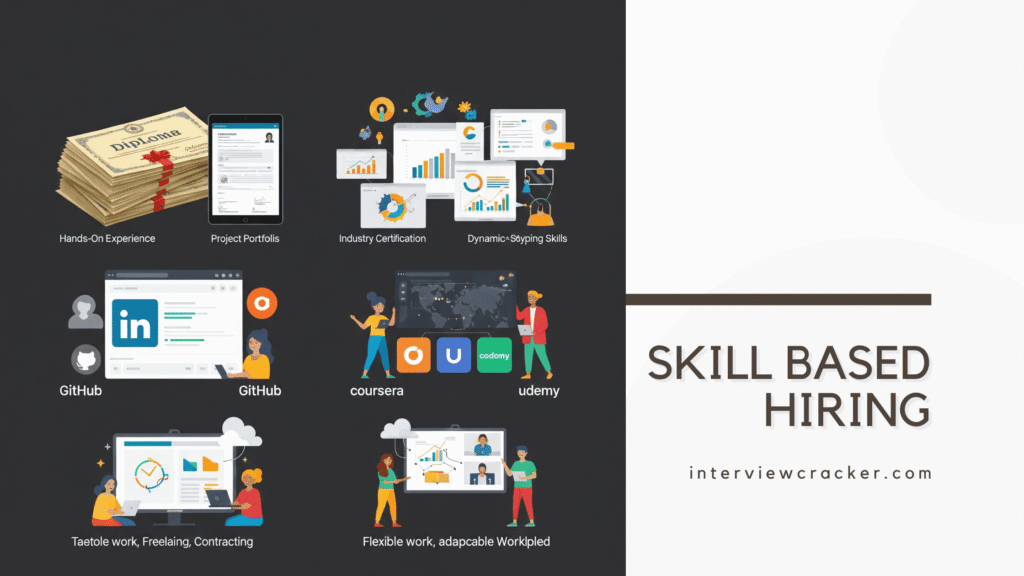
Employers today look for these sources of information to see the value and relevance of a candidate:
Hands-On Experience
Real-world experience shows a candidate can apply their skills in practical settings. Employers value it more than theoretical learning because it proves capability, adaptability, and familiarity with workplace tools and challenges.
Project Portfolios
Portfolios showcase completed work, creativity, and consistency. They offer direct evidence of talent and execution, making them far more revealing than a degree, which rarely shows output or individual contribution.
Certifications
Industry-recognized certifications validate up-to-date knowledge in specialized areas. Unlike degrees, which may become outdated, certifications are often role-specific and prove that the candidate meets current job requirements and technical standards.
Problem-Solving Skills
Problem-solving reflects critical thinking and autonomy. Employers prize this trait because it signals initiative and the ability to handle complexity—skills that aren’t always developed or measured in traditional academic programs.
Other Places For Employers To Find Candidate Data
The best places for employers to find information on technical candidates, outside of degrees and resumes, are to look online. Professional sites like GitHub, LinkedIn, and any endorsements they might have, as well as Coursera or Udemy certificates, all provide more up-to-date proof of eligibility for a role than a degree.
Another tool employers use to get a detailed analysis of a candidate is to ask them to complete custom skills assessments during the hiring process.
Skills-based hiring relies heavily on accurate resume data extraction. Resume parsing software enables recruiters to identify skills, experience, and role relevance more effectively than manual resume reviews, supporting fairer and more consistent hiring decisions.

How Job Platforms Are Shaping This Shift
Job platforms are helping to shape how this shift is encouraging employers to look for relevant, up-to-date data on people applying for jobs to ensure they get the right person.
For example, LinkedIn uses skills badges and micro-certifications that allow users to show off their skills in niche topics relevant to specific roles.
GitHub, on the other hand, can act as a living resume that automatically changes over time as users complete projects. Behance can be used in the same way.
Sites that offer online learning courses like Coursera, Skillsoft, and others often choose to partner with companies to give them job-aligned credentials, which help them choose the right person for roles.
Rethinking Employment Formats and Flexibility
Flexible work is one of the key drivers of skills-first hiring. The more skills you have, the easier you will find it to do a variety of jobs in your role and adjacent roles.
Many companies today are choosing to fill skill gaps with contractors, freelancers, and contingent workers to get the workloads completed with flexibility. But it can be challenging to decide what to pay these workers. When evaluating contingent worker vs contractor salary, employers weigh project length, specialization, and legal considerations.
Skills-based hiring makes it easier to source the right people for the right work model.
How to Implement a Skill-Based Recruitment Strategy for Modern Hiring Success
Implementing a skill-based recruitment strategy requires a deliberate shift from traditional degree-focused hiring to prioritizing what candidates can actually do. This process involves several key steps to ensure you attract, assess, and retain the right talent for a dynamic workforce.
First, begin by redefining your job roles based on specific skills and competencies rather than generic qualifications. This means conducting a thorough skills audit for each position, identifying the core technical, cognitive, and interpersonal abilities essential for success now and in the future. Once these critical skills are pinpointed, redesign your job descriptions to clearly articulate these skill requirements and the expected outcomes, minimizing or even removing unnecessary degree mandates.
Next, integrate robust skills assessment tools into your hiring funnel. Beyond resumes and traditional interviews, utilize practical assessments like technical challenges, work sample tests, portfolio reviews, and behavioral interviews to truly evaluate a candidate’s real-world capabilities. It’s also crucial to train your entire hiring team on this new approach, equipping them with the knowledge to identify and mitigate biases, conduct skill-focused interviews, and objectively interpret assessment data.
Finally, leverage technology and data analytics to streamline the process, using applicant tracking systems that can filter by skills and maintain a comprehensive skills inventory. Crucially, integrate your recruitment efforts with your learning and development programs. This holistic approach not only helps you hire talent with current relevant skills but also allows you to identify potential, foster internal mobility, and continually upskill your existing workforce to meet evolving organizational needs. By following these steps, you can build a more agile, diverse, and highly capable team that thrives on demonstrable talent.
Conclusion
The future of work demands a workforce built on relevant, adaptable skills. By consciously shifting to a skill-based recruitment strategy, you’re not just improving your hiring outcomes; you’re building a more resilient, innovative, and inclusive organization ready to thrive in the modern landscape. It’s time to prioritize proof over paper and invest in what truly matters: a candidate’s ability to drive your business forward.
FAQs on Skill-Based Hiring
1. What are the main challenges when implementing a skill-based hiring strategy, and how can technology help?
Implementing a skill-based recruitment strategy, while transformative, can present hurdles such as initial organizational resistance to change, the complexity of accurately defining and consistently measuring skills, and integrating new processes with existing HR workflows. However, these challenges are significantly mitigated by leveraging the right HR technology solutions. Modern skills assessment platforms and talent intelligence software can automate skill identification, standardize evaluations, and provide data-driven insights, ensuring a smoother transition and more objective hiring decisions. Investing in specialized recruitment software designed for skill-matching can also streamline the entire process from candidate sourcing to onboarding.
2. How does a skill-based approach to recruitment impact a company’s ROI and overall workforce agility?
Adopting a skill-based recruitment strategy has a direct and positive impact on a company’s Return on Investment (ROI) and significantly enhances workforce agility. By focusing on demonstrable abilities, organizations can reduce time-to-hire and cost-per-hire because they spend less time sifting through irrelevant credentials and more time identifying truly job-ready candidates. This leads to higher quality hires who are better equipped for their roles, reducing costly turnover and improving overall productivity. Furthermore, a workforce built on a clear understanding of individual and collective skills, often facilitated by talent management systems, is inherently more agile. It enables better internal mobility, strategic upskilling, and a quicker response to evolving market demands and skill gaps, ultimately strengthening the organization’s competitive advantage and bottom line.
3. Which specific types of skills assessment tools are most effective for evaluating candidates in a modern skill-based hiring process?
Effective skill-based hiring relies heavily on precise assessment tools that go beyond traditional resumes. The most effective types include technical skill assessments (e.g., coding challenges, data analysis tasks, design tests) that directly measure job-specific proficiencies. Behavioral assessments and situational judgment tests are crucial for evaluating soft skills like problem-solving, collaboration, and adaptability. Many companies also utilize work sample tests or project portfolios to see real-world output. For comprehensive evaluation, pre-employment testing platforms that offer a combination of these assessments, often powered by AI, are proving invaluable. These tools, often integrated within broader talent acquisition software, provide objective data points that ensure candidates genuinely possess the skills required for success.


Himani Joshi
Himani Joshi is a Senior Business Manager at Interview Cracker, working at the intersection of careers, hiring, and skill development. She writes about interview strategy, job market trends, and professional growth, helping readers turn opportunities into outcomes. She also writes for HR and hiring professionals, offering insights on recruitment, talent strategy, and evolving workplace dynamics.