Human Resources and hiring functions have evolved from operational support roles into strategic drivers of organizational growth. As organizations expand across borders, HR leaders are responsible for far more than recruitment. They oversee workforce governance, employment compliance, payroll accuracy, risk management, and the long-term sustainability of global talent operations.
In international markets such as the United States, Canada, the European Union, and the GCC, HR and hiring decisions directly influence legal exposure, employee experience, and business continuity. This pillar explores how modern organizations design HR and hiring strategies that support global growth, regulatory compliance, and scalable workforce operations.
Table of Contents
ToggleThe Strategic Role of HR and Hiring in Global Organizations
HR is no longer limited to administrative execution. In global organizations, HR leaders act as stewards of compliance, culture, and workforce structure. Hiring decisions shape not only team capability but also regulatory obligations and cost exposure across jurisdictions.
A modern HR and hiring strategy must address:
Cross-border employment regulations and labor laws- check Employer of Record Services
Workforce scalability without excessive legal or operational risk
Alignment between talent strategy and business expansion goals to keep the Career Growth Roadmap in mind.
Governance frameworks that ensure consistency across regions
As global hiring models become more distributed, HR functions increasingly operate at the intersection of law, finance, technology, and leadership.
Global Hiring and Talent Acquisition Strategy
Hiring internationally introduces complexity beyond sourcing talent. Each country imposes distinct requirements around employment contracts, worker classification, notice periods, and statutory benefits. HR leaders must balance speed of hiring with long-term compliance and operational control.
Key considerations in global hiring strategy include:
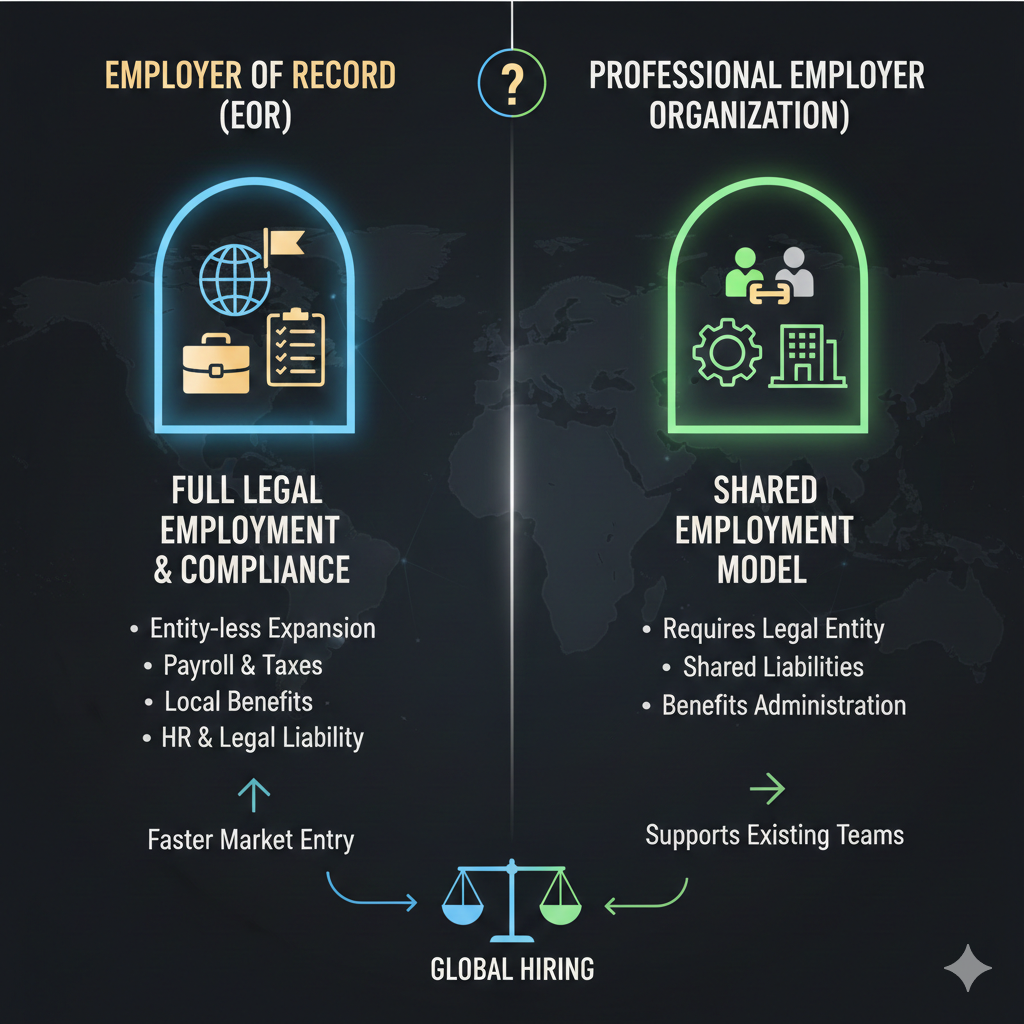
Choosing the right employment model for each geography
Managing remote and distributed teams across time zones
Aligning hiring decisions with long-term market entry plans
Reducing exposure to misclassification and regulatory violations
Organizations that succeed in global hiring treat talent acquisition as a risk-aware strategic function, not a transactional process.
Employment Compliance and Workforce Risk Management
Employment compliance is one of the highest-risk areas for organizations operating internationally. Labor laws vary significantly across regions, and non-compliance can result in penalties, legal disputes, and reputational damage.
HR leaders must navigate:
Country-specific labor laws and employment standards
Termination regulations and employee protections
Statutory benefits, leave policies, and social security obligations
Data protection and employee information governance
Effective HR and hiring strategies embed compliance into workforce planning rather than treating it as an afterthought. This approach enables organizations to expand with confidence while maintaining regulatory alignment.
International employment standards and labor regulations are guided by frameworks published by the International Labour Organization (ILO), which many HR leaders reference when designing compliant global workforce policies.
Payroll, Compensation, and Workforce Administration
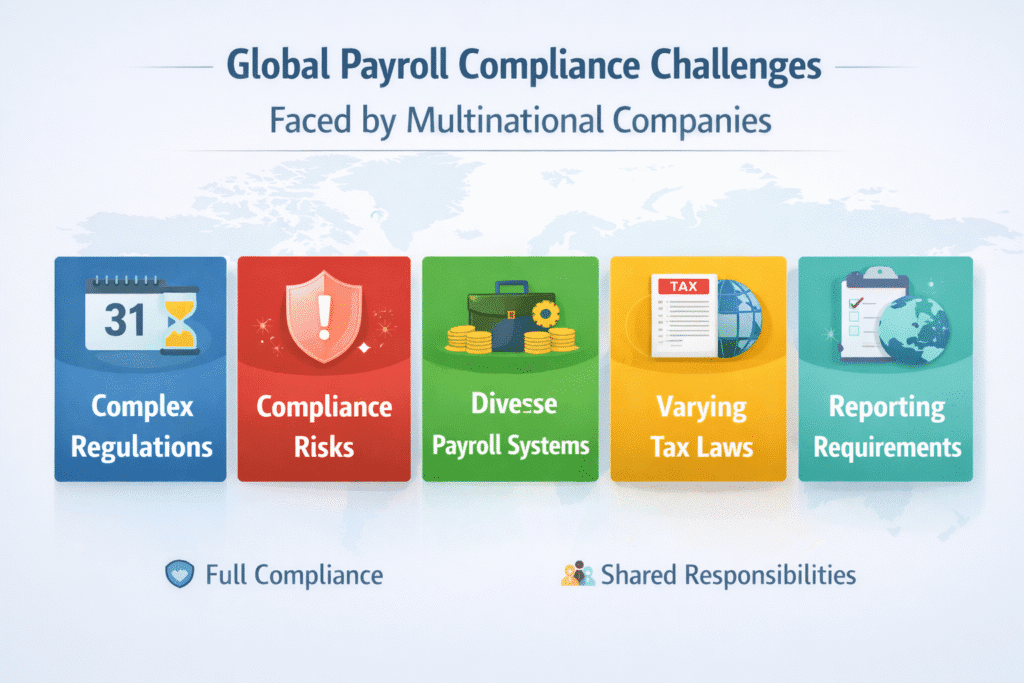
Payroll accuracy is central to employee trust and regulatory compliance. In global organizations, payroll operations extend beyond salary payments to include tax withholdings, statutory deductions, benefits administration, and regulatory reporting across multiple jurisdictions.
To manage payroll accurately across multiple jurisdictions, many organizations rely on Global Payroll Software Solutions that support tax compliance, statutory reporting, and centralized workforce payroll governance.
Key payroll and compensation challenges include:
Managing multi-country payroll cycles and currencies
Ensuring accurate tax and statutory deductions
Aligning compensation structures across regions
Maintaining transparent payroll governance
HR and finance teams increasingly collaborate to ensure payroll systems support both compliance and workforce scalability in international environments.
In global organizations, the Payroll Administrator plays a critical role in coordinating payroll operations, maintaining data accuracy, and ensuring consistent payroll execution across regions.
From a compliance perspective, the Payroll Accountant is responsible for managing statutory deductions, payroll tax calculations, and regulatory reporting in accordance with local employment laws.
HR Leadership and Global Workforce Operations
As organizations grow internationally, HR leadership roles expand in scope and responsibility. HR executives and people operations leaders are expected to align talent strategy with business objectives while maintaining compliance and workforce cohesion.
Modern HR leadership responsibilities include:
Workforce planning aligned with growth strategy
Governance of hiring, payroll, and compliance processes
Oversight of employee experience across regions
Coordination between HR, legal, finance, and operations teams
HR leaders operate as strategic partners, guiding organizations through complex workforce decisions that impact long-term performance.
In globally distributed organizations, the HR Executive plays a central role in aligning hiring strategy, workforce compliance, and people operations with long-term business objectives across regions.
Workforce Technology and HR Infrastructure
Technology underpins modern HR and hiring operations. Global organizations rely on integrated systems to manage recruitment, employee data, payroll, compliance, and workforce analytics across regions.
Key aspects of HR infrastructure include:
Centralized employee data management
Integration between payroll, compliance, and HR systems
Automation of routine HR and administrative tasks
Workforce analytics for informed decision making
Well-designed HR technology ecosystems improve efficiency while supporting compliance and governance requirements across jurisdictions.
HR and Hiring in International Expansion
International expansion places additional pressure on HR and hiring functions. Entering new markets requires careful consideration of employment laws, talent availability, and workforce structure.
HR plays a critical role in:
Supporting market entry without excessive legal exposure
Enabling rapid hiring while maintaining compliance
Establishing consistent HR policies across regions
Managing workforce risk during expansion and restructuring
Organizations that integrate HR early into expansion planning reduce operational friction and create more sustainable global operations.
Enterprise Workforce Solutions and Strategic Partnerships
Organizations managing global teams often engage enterprise workforce partners to support hiring, payroll compliance, and employment governance across regions. These partnerships enable HR teams to focus on strategy while maintaining regulatory alignment.
Related HR Resources
Frequently Asked Questions on HR & Hiring
How does HR support global workforce expansion
HR supports global expansion by aligning hiring strategies with compliance requirements, workforce governance, and long-term growth objectives across regions.
What are the biggest risks in international hiring
Key risks include employment misclassification, non-compliance with labor laws, payroll errors, and inconsistent workforce policies across jurisdictions.
How do organizations maintain compliance across multiple countries
Organizations rely on standardized HR frameworks, compliant employment models, integrated payroll systems, and local regulatory expertise to manage compliance.
What role does payroll play in workforce governance
Payroll ensures accurate compensation, statutory compliance, and regulatory reporting, making it a foundational component of workforce governance.
Why is HR leadership critical in global organizations
HR leaders balance talent strategy, compliance, culture, and operational efficiency, making them central to sustainable international growth.
Building a Scalable and Compliant HR Function
As organizations expand across borders, HR and hiring functions become central to managing complexity, risk, and growth. A well-designed HR strategy integrates compliance, payroll governance, technology, and leadership to support long-term workforce sustainability.
Partner With Interview Cracker
Interview Cracker publishes enterprise-focused content on HR strategy, global hiring, workforce compliance, payroll governance, and talent operations for organizations managing distributed and international teams.
Our readers include CHROs, HR leaders, payroll professionals, founders, and decision makers evaluating HR systems, global hiring models, and workforce compliance frameworks across the US, Canada, EU, and GCC markets.
We selectively collaborate with:
HR and workforce technology platforms
Payroll and compliance solution providers
Employer of Record and global hiring services
Enterprise HR consultants and service firms
Partnership opportunities include contextual brand mentions, sponsored thought leadership, and long-term content collaborations aligned with our HR & Hiring pillar.
📩 For partnership and sponsored placement inquiries, contact
knowledge@interviewcracker.com