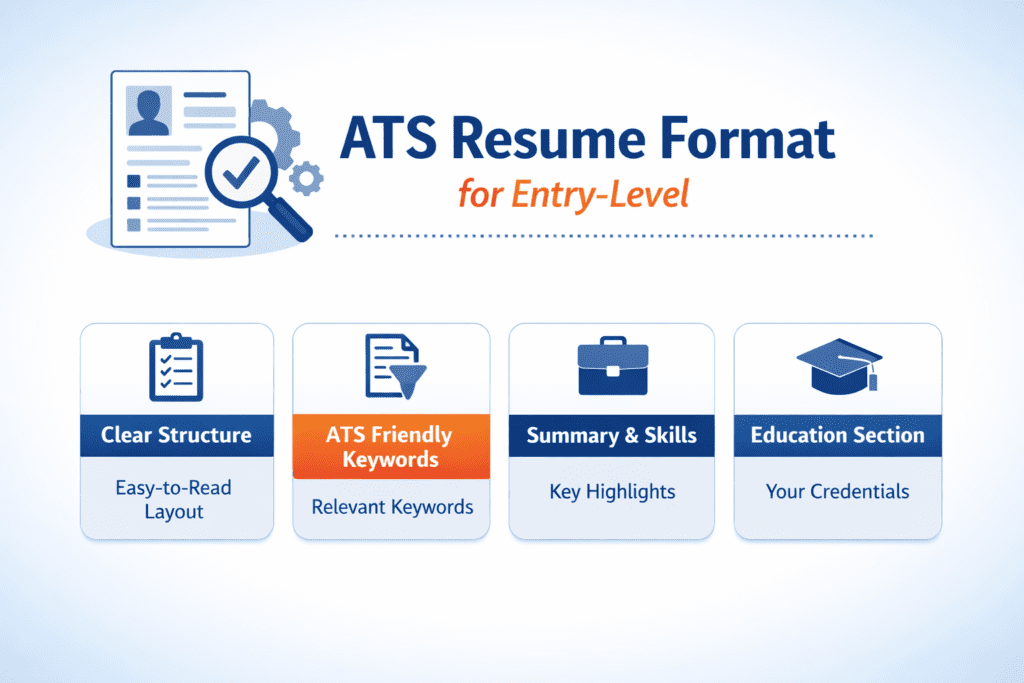
🍁 Canadian Resume Format 2026 — Quick Reference
Resume Length
1–2 pages
Never 3–5 pages like international CVs
Photo / DOB / Declaration
Never include
Remove all three — Canadian law protects against bias
Opening Section
Professional Summary
Not a Career Objective — use role keywords
Layout
Single column only
No tables, columns, or text boxes — ATS will fail
Bullet Point Format
Action + Result
Numbers, %, dollar amounts — always quantify
Date Format
Jan 2020 – Mar 2023
Month + year always — never year only
📌 What you'll find below: Why Canadian resume is different · Section-by-section format guide · Copy-paste resume example · Canadian vs US vs Indian vs SA resume comparison · ATS tips for newcomers · Tips for writing a winning Canadian resume · FAQ answers for immigrants
A Canadian resume in 2026 follows specific formatting rules that differ significantly from resumes in India, South Africa, the Philippines, UK, and most other countries. Canadian employers — and the ATS systems used by 90%+ of Canadian companies — expect a clean single-column format, no personal photos, quantified bullet points, and Canadian job title terminology.
For skilled immigrants and newcomers, getting the resume format right is the single most important step before applying for jobs. This guide covers the exact Canadian resume format with a copy-paste template, what to include and remove, Canadian vs US differences, and salary expectations by province so you can negotiate confidently once you land interviews.
Table of Contents
ToggleWhy a Canadian Resume is Different?
A Canadian resume differs from other countries, such as the USA, due to its emphasis on skills and achievements rather than personal details. Unlike CVs, which may be used in other regions, a Canadian resume is succinct, targeted, and focuses on your qualifications relevant to the role.
Here’s how the Canadian resume format stands out:
- No photos: Canadian employers value privacy, so they avoid resumes with pictures.
- Personal information limited to essentials: Only include your name, contact information, and address (if necessary).
- Focus on skills and experience: Resumes should clearly highlight your professional expertise.
Canadian Resume Format For 2026 - What all you Should Include
1. Contact Information
Start with your full name, phone number, email address, and LinkedIn profile. You can include your city and province but avoid excessive details like marital status or nationality.
Example:
- Name: John Doe
- Phone: +1 (123) 456-7890
- Email: john.doe@email.com
- LinkedIn: linkedin.com/in/johndoe
2. Resume Objective or Summary
A well-crafted resume summary grabs attention within seconds. Keep it focused on your core skills, work experience, and how you can add value to the company. For students or those with little experience, use an objective statement outlining your career goals.
Example:
“Detail-oriented financial analyst with over 5 years of experience in budget analysis, cost forecasting, and data management. Seeking to leverage my skills in strategic financial planning to drive business growth for ABC Corporation.”
3. Work Experience
Your work experience section should highlight your relevant roles, achievements, and the impact you’ve had in previous jobs. Follow the reverse-chronological order, starting with your most recent job.
Each entry should include the following:
- Job Title
- Company Name
- Dates Employed
- Key Responsibilities
- Notable Achievements (use quantifiable results where possible)
Example:
Financial Analyst
XYZ Corp, Toronto, ON | June 2019 – Present
- Analyzed company budgets, identifying 15% cost reduction opportunities
- Led data-driven financial models to optimize operations, saving $100K annually
- Collaborated with senior executives to present quarterly financial reports
4. Education
For education, list your degree(s), institution(s), and graduation dates. If you’re a recent graduate, highlight any relevant projects, internships, or courses that align with the job you’re applying for.
Example:
Bachelor of Business Administration
University of Toronto, Toronto, ON | Graduated: May 2018
- Specialized in financial management and data analysis
5. Skills Section
Tailor your skills section to the job description. Include both hard and soft skills that are relevant. Use bullet points to make it easy for recruiters to scan.
Examples:
- Financial Modeling
- Data Analysis & Reporting
- Budgeting & Forecasting
- Cross-functional Team Collaboration
- Critical Thinking & Problem Solving
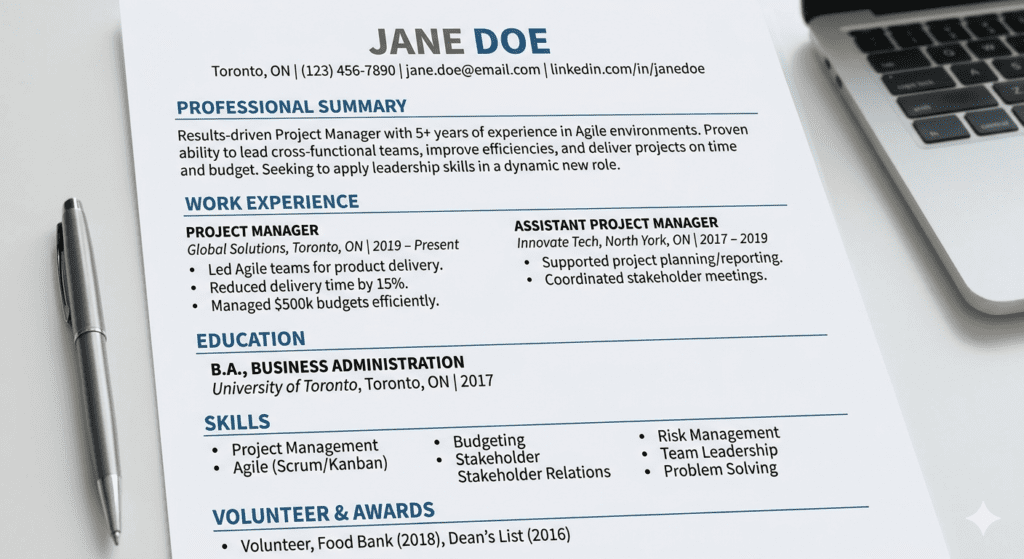
6. Certifications (Optional)
If you have additional qualifications or certifications that are relevant to the job, include them here.
Example:
- Certified Financial Analyst (CFA) – Level 2
7. Volunteer Work or Extracurricular Activities (Optional)
If you’re a student or new to the workforce, highlight any volunteer work, school clubs, or projects that showcase leadership, teamwork, or dedication.
Example:
Volunteer Treasurer
Local Food Bank, Toronto, ON | Jan 2022 – Present
- Managed financial records, oversaw budgeting and ensured compliance with regulations

Tips for Writing a Winning Canadian Resume
Customize for Each Job
Tailor your resume to match the job description. Use keywords from the job posting to ensure your resume passes through Applicant Tracking Systems (ATS).Quantify Achievements
Whenever possible, use numbers to show the impact you’ve made. For example, “Increased sales by 20%” is more compelling than “Responsible for sales growth.”Keep it Concise
Limit your resume to one or two pages. A succinct, well-organized resume is more effective in grabbing a recruiter’s attention than a lengthy document.Use Action Verbs
Start bullet points with strong action verbs like “led,” “managed,” “developed,” or “analyzed” to highlight your active role in tasks and projects.Proofread Thoroughly
Errors in spelling, grammar, or formatting can undermine your professionalism. Proofread your resume multiple times, and consider having someone else review it as well.Include a Cover Letter
A tailored cover letter strengthens your application. Address it to a specific person and explain how your experience and skills make you the right fit for the job.
Before you start applying, know what Canadian employers pay — our Canada Minimum Wage & Salary Guide 2026 → covers salary benchmarks by profession and province so you negotiate from an informed position.
Canadian Resume vs. US Resume
While Canadian resumes are quite similar to U.S. resumes, there are a few subtle differences:
- Spelling Variations: Use Canadian spelling (e.g., “labour” instead of “labor”).
- No GPA: Unlike some U.S. resumes, including your GPA is not necessary unless specified by the employer.
- Cultural Fit: Emphasize teamwork, collaboration, and adaptability as these are highly valued by Canadian employers.
Canadian Resume — Summary Box 2026
🍁 Canadian Resume — Key Rules at a Glance
Length
1–2 pages max
Never 3–5 pages like international CVs
Photo
Never include
Canadian law prohibits photo-based discrimination
Opening Section
Professional Summary
Not a Career Objective — keywords required
Layout
Single column only
No tables, columns, or text boxes
Bullet Points
Action + Result
Numbers, percentages, dollar amounts required
Declaration
Never include
Remove — wastes space, not used in Canada
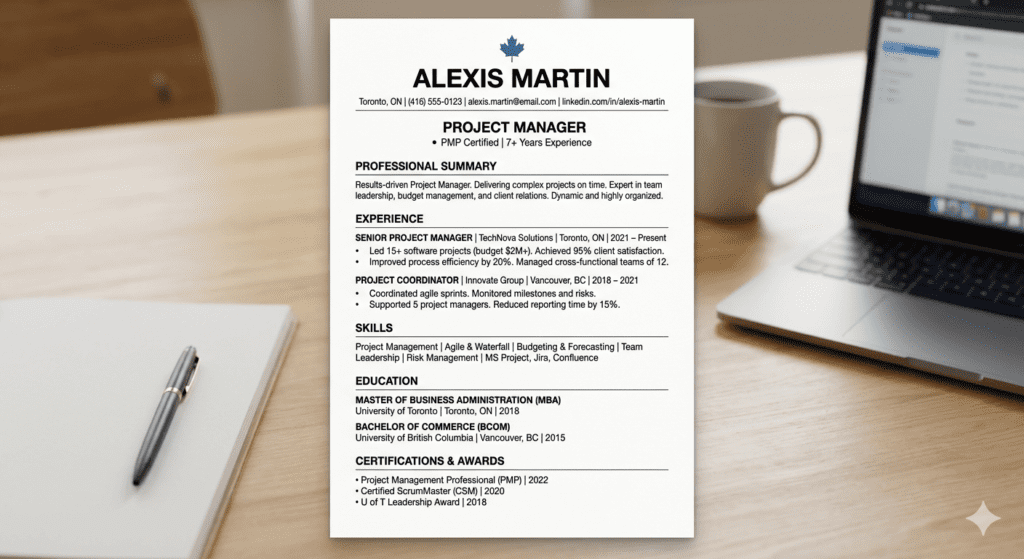
Example of a Canadian Resume (2026)
Below is an example that illustrates the ideal Canadian resume structure:
John Doe
Toronto, ON
+1 (123) 456-7890 | john.doe@email.com | linkedin.com/in/johndoe
Resume Summary
Skilled financial analyst with over 5 years of experience in budget management, financial modeling, and cross-departmental collaboration. Seeking to contribute to the financial strategy of ABC Corporation.
Experience
Financial Analyst
XYZ Corp, Toronto, ON | June 2019 – Present
- Developed and maintained financial models, improving accuracy by 30%
- Conducted quarterly budget reviews, identifying areas of overspending
- Collaborated with teams to streamline reporting processes, cutting review time by 15%
Education
Bachelor of Business Administration
University of Toronto | May 2018
Skills
- Budgeting & Forecasting
- Financial Analysis
- Team Leadership
- Advanced Excel
- Report Writing
Certifications
- Certified Financial Analyst (CFA) – Level 2
Internship Resume For the Canadian Market
For those setting their sights on internships in Canada, understanding the nuances of the Canada resume format is paramount. The Canadian market places a strong emphasis on certain features that set its resume expectations apart from traditional formats.
Understanding the Canada Resume Format: Showcasing Skills and Achievements
Canadian-style resumes prioritize skills and achievements. Focus on creating a dedicated skills section that encompasses both technical proficiencies and valuable soft skills. Skills such as teamwork, communication, and adaptability are highly regarded in the Canadian market. Use bullet points to succinctly illustrate your capabilities.
Multilingual and Bilingual Skills: A Valuable Asset
Canada’s multicultural landscape values language diversity. If you possess bilingual or multilingual skills, showcase them proudly. Proficiency in multiple languages is a valuable asset that demonstrates adaptability and an ability to engage with a diverse audience.
By understanding and adhering to the Canadian resume format, you position yourself as a candidate who understands and appreciates the country’s unique professional culture, enhancing your appeal to potential employers.
The Canadian job market has its unique nuances, and understanding the distinctions between a Canadian-style resume and CV can significantly enhance your job search success. While both documents showcase your qualifications, the key difference lies in their purpose and level of detail.
Resume: Canadian-style resumes are typically shorter (1-2 pages) and emphasize key skills, accomplishments, and experiences. They focus on demonstrating your immediate fit for a specific job or internship by showcasing relevant qualifications.
CV (Curriculum Vitae): A CV is more comprehensive, detailing your academic and professional history in depth. It’s commonly used in academia and research-oriented fields to provide a comprehensive overview of your accomplishments.
Tailoring Your Resume for the Canadian Job Market
To make your resume resonate with Canadian employers, tailor it to align with their expectations:
Highlight Relevant Skills: Emphasize both technical skills (e.g., software proficiency) and soft skills (e.g., teamwork, communication) that align with the job requirements. Use specific examples to demonstrate how you’ve applied these skills.
Focus on Achievements: Rather than simply listing job duties, emphasize your accomplishments and quantifiable results. Highlight how your contributions positively impacted past roles.
Adapt to the Canadian Format: Consider using a functional or combination resume format, which places a strong focus on skills and achievements. This format enables you to highlight transferable skills even if you lack extensive work experience.
Highlighting Volunteer Work, Community Involvement, and Part-Time Jobs
Incorporating your volunteer work, community involvement, and part-time jobs is an integral part of the Canadian approach. Canadian employers value candidates who contribute to their communities and display a well-rounded background. These experiences demonstrate your character, work ethic, and dedication beyond your academic achievements.
Be sure to:
Specify Responsibilities: Describe your roles in volunteer work or part-time jobs, highlighting responsibilities that align with the internship you’re pursuing.
Quantify Impact: If possible, quantify the impact of your contributions. For instance, mention how you increased event attendance through your marketing efforts during a community event.
Emphasize Transferable Skills: Identify and emphasize the transferable skills you’ve gained, such as communication, problem-solving, time management, and teamwork.
Canadian Resume vs Indian Resume vs South African Resume - Key Differences
The most common mistakes come from candidates formatting their resume the way they would in their home country. Here’s exactly what changes by origin:
| Element | India / South Asia | South Africa | ✅ Canada |
|---|---|---|---|
| Length | 3–5 pages | 3–4 pages | 1–2 pages maximum |
| Photo | Common / expected | Sometimes included | Never — remove completely |
| Declaration | Standard at bottom | Rarely included | Never — remove completely |
| Opening | Career Objective | Profile/Objective | Professional Summary with keywords |
| Personal info | DOB, religion, marital status | ID number, DOB sometimes | Name, phone, email, LinkedIn, city only |
| Bullet style | Responsibility lists | Responsibility lists | Action verb + task + measurable result |
Once your resume is in the right format, test it against actual Canadian job descriptions using our Free ATS Resume Checker → before applying to any role.
Also see our full ATS Tips for Professionals Moving to Canada → for province salary benchmarks, minimum wage by province, and the best Canadian job portals for newcomers.
Conclusion
A well-structured and targeted Canadian resume can significantly boost your chances of landing a job in 2025. By following these formatting tips, tailoring your resume for each application, and highlighting measurable achievements, you’ll stand out from the competition. Keep it concise, professional, and aligned with Canadian employer expectations for the best results.
Good luck with your job search!
FAQs on Canadian Resume
What is the Difference between Canadian Style vs. Traditional Resume
When it comes to resume formats, there are various options to consider. For those applying for internships in Canada or seeking to adhere to the Canadian job market standards, the Canadian resume style offers a unique approach. It prioritizes your skills, achievements, and qualifications, placing them at the forefront to grab the reader’s attention.
In contrast, traditional formats may include a chronological resume, which lists your experiences in reverse chronological order, or a functional resume, which focuses on your skills and accomplishments rather than a strict timeline. Choosing the right format depends on your background and the specific internship you’re pursuing.
For Canadian-style resumes, emphasize your soft skills such as teamwork, adaptability, and communication, in addition to technical skills. Use bullet points and concise language to convey your achievements effectively.
Recent Posts

Himani Joshi
Himani Joshi is a Senior Business Manager at Interview Cracker, working at the intersection of careers, hiring, and skill development. She writes about interview strategy, job market trends, and professional growth, helping readers turn opportunities into outcomes. She also writes for HR and hiring professionals, offering insights on recruitment, talent strategy, and evolving workplace dynamics.