You meet the experience requirements.
You match the skills.
You have relevant achievements.
Yet you never hear back.
In 2026, one of the biggest reasons qualified candidates get rejected is not lack of ability — it’s failure to pass Applicant Tracking Systems (ATS).
Before a recruiter reviews your resume, it is often scanned and ranked by software. If your resume does not meet specific technical and keyword criteria, it may be filtered out automatically — even if you are perfectly suited for the role.
This guide explains why ATS rejects resumes, the hidden technical reasons behind screening failures, and what you can do to fix it.
What Is an ATS and How Does It Work?
An Applicant Tracking System (ATS) is software used by employers to:
Collect job applications
Store resumes in a database
Scan resumes for keywords
Rank candidates based on match score
Filter out low-ranking applications
Most medium and large companies use ATS platforms such as:
Workday
Taleo
iCIMS
Greenhouse
SAP SuccessFactors
When you apply online, your resume is parsed — meaning the system extracts text and organizes it into categories like skills, job titles, and experience.
If your resume format is not ATS-friendly or lacks required keywords, it may receive a low match score. For a complete breakdown of how applicant tracking systems score resumes, read our detailed ATS-friendly resume guide before applying.
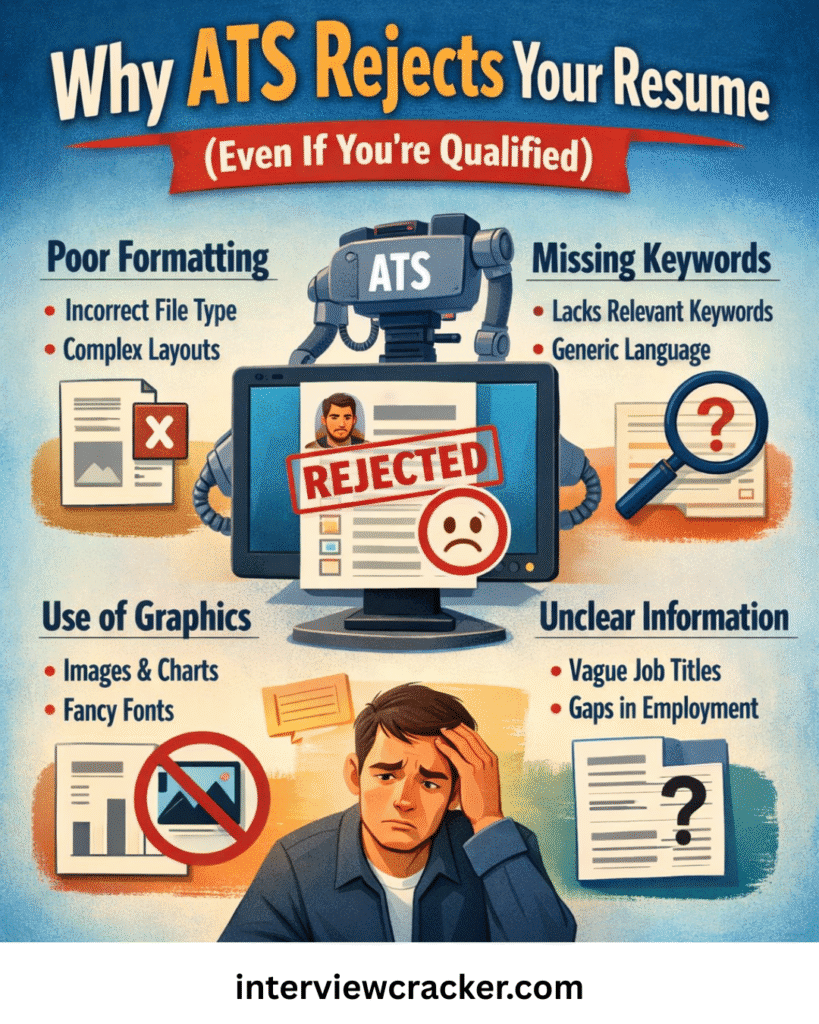
10 Reasons ATS Rejects Your Resume
Even strong candidates get filtered out for technical reasons.
Let’s break down the most common ones.
1️⃣ Your Resume Doesn’t Match the Exact Job Title
If the job description says:
“Business Development Manager”
And your resume headline says:
“Sales Growth Specialist”
The ATS may not recognize you as a match.
Most systems prioritize exact phrase matching.
Fix:
Mirror the job title exactly in your resume if your experience aligns.
2️⃣ You’re Missing Critical Keywords
Recruiters often copy keywords directly from the job description into ATS search filters.
If the job description repeatedly mentions:
Stakeholder management
CRM systems
Revenue forecasting
And your resume doesn’t contain those exact phrases, your ranking drops.
Even minor wording differences can matter. Many candidates fail ATS screening because their resumes don’t align with how these systems score keywords. Our detailed guide to passing ATS resume screening explains how recruiters and algorithms evaluate applications.
Fix:
Extract keywords from the job description and integrate them naturally into your experience bullets. You can review industry-specific examples in our guide on top resume keywords that beat ATS in 2026 to strengthen your application.
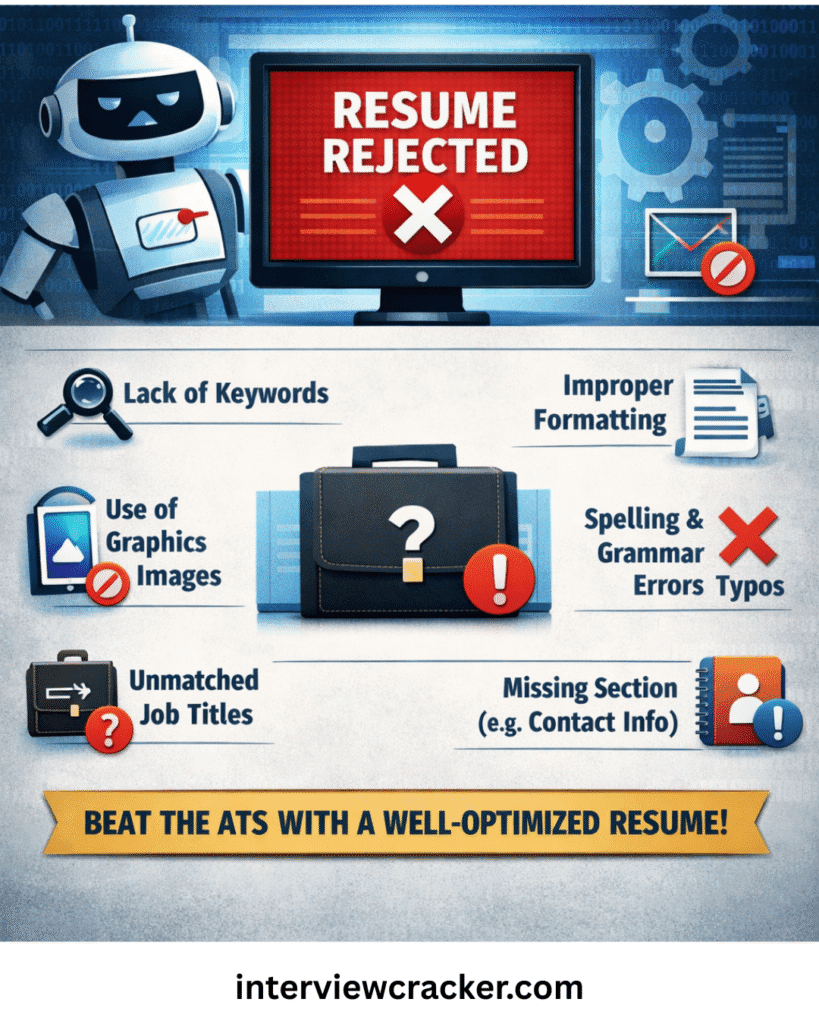
3️⃣ Your Resume Format Is Not ATS-Compatible
ATS systems struggle with:
Tables
Text boxes
Columns
Headers and footers
Graphics and icons
If your resume uses a heavily designed template, key information may not parse correctly.
Some ATS platforms misread columns and merge text incorrectly.
Fix:
Use a clean, single-column layout with standard fonts like Arial or Calibri.
4️⃣ You Used Abbreviations Without Expansion
If you wrote:
“Managed CRM”
But the job description says:
“Customer Relationship Management”
The ATS may not connect the two.
Some systems recognize abbreviations. Many do not.
Fix:
Write both versions once:
Customer Relationship Management (CRM)
5️⃣ Your Resume Lacks Measurable Achievements
ATS systems increasingly rank resumes higher when they include:
Percentages
Revenue numbers
Growth metrics
Quantified impact
Example:
❌ Responsible for sales growth
✅ Increased regional revenue by 38% within 12 months
Metrics strengthen keyword relevance and improve ranking.
6️⃣ You Didn’t Tailor Your Resume
Sending the same resume to every employer reduces your match rate.
Each job description has different keyword emphasis.
If one company values “project management” and another emphasizes “stakeholder communication,” your resume must adapt accordingly.
Fix:
Customize your resume for each application.
Why “One Resume for All Jobs” Fails in 2026
In earlier years, candidates could use one resume for multiple applications.
That strategy no longer works.
Each job description has:
Different skill emphasis
Different terminology
Different tool requirements
Different leadership expectations
For example:
One company may prioritize:
“Cross-functional collaboration”
Another may emphasize:
“Stakeholder management”
Even though both phrases sound similar, ATS treats them as separate keywords.
Sending the same resume reduces your match score dramatically.
Tailoring does not mean rewriting your entire resume.
It means:
Adjusting job title alignment
Reordering skills
Updating bullet phrasing
Matching terminology exactly
Small adjustments can increase match score by 20–30%. Always extract repeated phrases directly from the job description (JD) before updating your resume.
7️⃣ You Used the Wrong File Format
Some ATS platforms prefer .docx over PDF.
While most modern systems accept PDFs, certain older systems parse Word files more accurately.
Fix:
If not specified, use .docx format.
Hidden Formatting Issues That Break ATS Parsing
Many resumes get rejected due to invisible formatting errors.
Common issues include:
Text copied from Canva or design tools
Unusual fonts
Symbols instead of bullet points
Images containing text
Icons for phone or email
Some ATS systems cannot read icons properly.
For example:
If your phone number is next to a phone icon instead of plain text, it may not parse correctly.
Similarly, resumes with two columns can cause:
Job titles merging with company names
Dates appearing in wrong sections
Skills misclassified
Always test your resume by:
Copying all text into Notepad
Checking if structure remains intact
Ensuring logical flow
If text appears scrambled, ATS likely reads it incorrectly.
8️⃣ Your Skills Section Is Too Generic
Listing:
Leadership
Communication
Teamwork
Is not enough.
ATS prioritizes technical and role-specific keywords over generic soft skills.
Fix:
Include industry-specific terminology and tools.
9️⃣ You Included Keywords Without Context
Keyword stuffing can hurt your ranking.
Example:
Python, Python, Python, Python
Instead, use:
Developed scalable applications using Python and REST APIs, improving deployment efficiency by 25%.
ATS systems now evaluate context.
🔟 You Applied Too Late
Some ATS systems rank early applicants higher.
If a role receives hundreds of applications quickly, recruiters may review only the top-ranked candidates.
Fix:
Apply within the first 48 hours when possible.
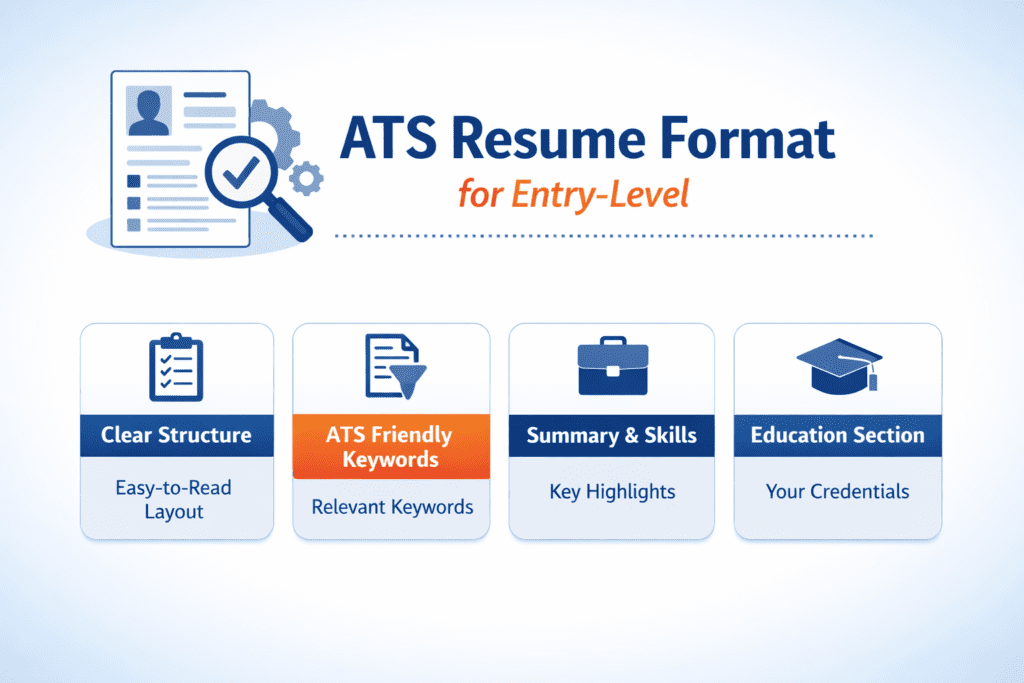
One of the most common reasons resumes fail ATS screening is incorrect formatting. If you are entering the job market for the first time, you can follow this ATS resume format for entry-level to ensure your resume structure works with applicant tracking systems.
How ATS Match Score Actually Works
Most ATS systems assign a percentage score based on:
Job title match
Skill match
Experience relevance
Keyword frequency
Certification alignment
A resume with 75–85% keyword alignment typically ranks higher.
Resumes below 50% may never reach human review.
This is why keyword optimization matters.
What Recruiters See After ATS Ranks You
Many candidates assume ATS makes the final decision.
It doesn’t.
ATS ranks resumes.
Recruiters then:
Sort by match percentage
Filter by experience years
Search by keywords
Review the top 20–40 profiles
If your resume ranks at position 87 out of 300 applicants, it may never be seen.
Recruiters typically review:
First page summary
Job title alignment
Most recent role
Measurable achievements
If your resume lacks clarity in the first 10–15 seconds, rejection probability increases — even after passing ATS.
This means your resume must satisfy two audiences:
ATS algorithm
Human recruiter
Passing ATS is step one.
Convincing a recruiter is step two.
Common Myths About ATS Rejections
Let’s clear up some misconceptions.
Myth 1: ATS Randomly Rejects Resumes
False.
ATS systems follow structured ranking logic based on match criteria.
Myth 2: If You’re Qualified, You’ll Always Get an Interview
False.
Qualification alone is not enough if your resume is not optimized.
Myth 3: Fancy Resume Designs Improve Chances
False.
Design-heavy resumes often hurt ATS parsing.
Myth 4: You Should Add Every Keyword Possible
False.
Relevance matters more than keyword volume
Industry-Specific Reasons ATS Rejects Resumes
Different industries trigger different rejection patterns.
Technology Roles
ATS may reject resumes if:
Programming languages don’t match exactly
Framework versions differ
Tools are outdated
GitHub or portfolio not mentioned
Example:
If JD says “React.js” and resume says “React,” match may reduce. For technical roles, see how keyword structure works in our ATS resume guide for software engineers.
Finance Roles
ATS may filter out resumes lacking:
GAAP or IFRS references
Regulatory compliance terminology
Financial modeling keywords
Excel advanced functions
Precision matters heavily in finance hiring.
Healthcare Roles
Healthcare ATS systems prioritize:
Certification numbers
Compliance terminology
Clinical protocols
Patient safety standards
Missing licensing details can trigger automatic rejection.
Sales Roles
Sales ATS screening often checks:
Revenue metrics
Quota percentages
CRM systems
Territory management
Resumes without measurable revenue figures rank lower..
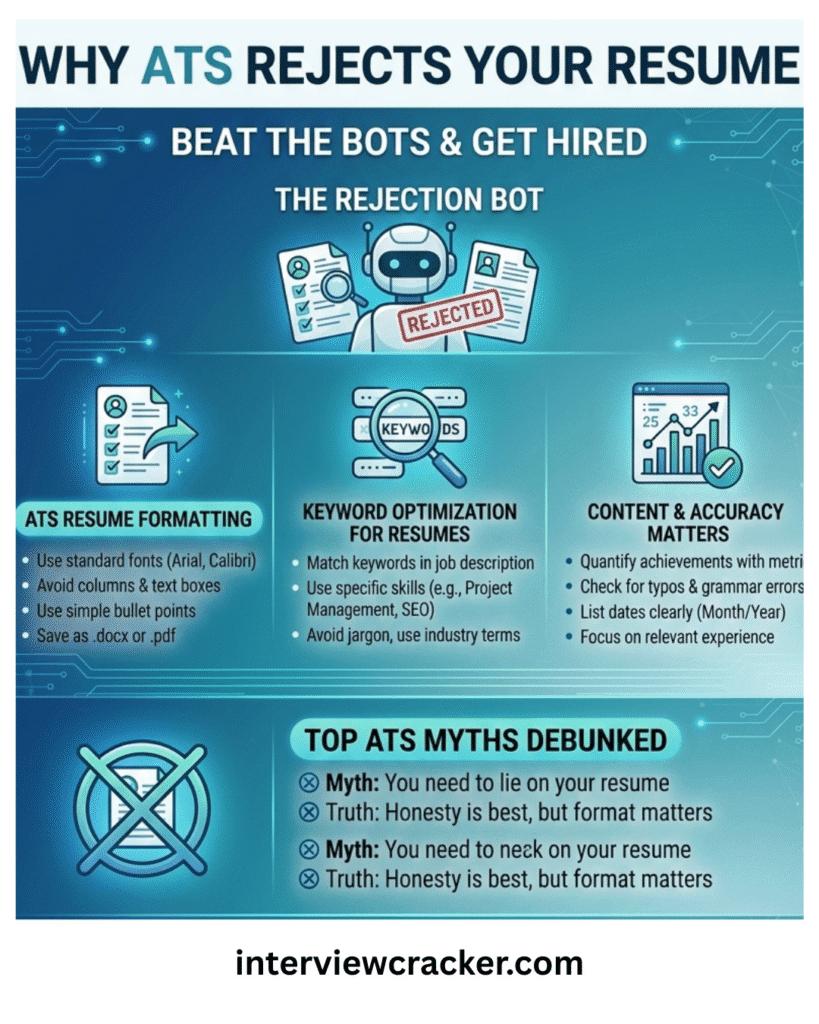
Advanced Resume Optimization Strategies That Increase Match Score
Once you understand ATS basics, you can apply advanced tactics.
1. Use Keyword Variations Strategically
If JD says:
“Project Management”
Include both:
Project Management
Managed cross-functional projects
This strengthens contextual relevance.
2. Place High-Value Keywords Higher
ATS sometimes weighs earlier content more heavily.
Include:
Core job title
Primary skill keywords
Industry terminology
Within first half of resume.
3. Optimize Your Professional Summary
Your summary should contain:
Exact job title
Years of experience
2–3 primary skills
1 measurable achievement
This increases keyword density early in document.
4. Align Years of Experience
Some ATS filters reject resumes if years of experience do not meet minimum requirement.
If JD says:
“5+ years experience”
Ensure your resume clearly reflects total relevant experience
How to Prevent ATS Rejection
Follow this checklist before applying:
✔ Match job title exactly
✔ Extract keywords from JD
✔ Include measurable achievements
✔ Use clean formatting
✔ Avoid graphics and tables
✔ Expand abbreviations
✔ Use standard fonts
✔ Save in recommended format
✔ Tailor resume for each job
Using a clean format helps avoid parsing errors, you can create an ATS-optimized resume using a structured resume builder.
Before applying, it helps to understand the technical rules recruiters use when filtering resumes. Review our complete ATS resume optimization guide to improve your match score and avoid common mistakes.
Why ATS Rejections Feel Personal (But Aren’t)
Many qualified candidates assume rejection means lack of ability.
In reality, ATS screening is mechanical.
It does not evaluate:
Personality
Leadership presence
Cultural fit
Potential
It evaluates:
Keyword alignment
Structured data
Measurable relevance
Understanding this removes emotional frustration and shifts focus toward strategy.
The Hidden Advantage: Most Candidates Don’t Optimize
Here’s the opportunity.
Most applicants:
Use generic resumes
Don’t analyze the job description
Ignore keyword placement
Use design-heavy templates
If you optimize strategically, you gain a significant advantage
When to Consider Professional Resume Help
If you consistently face rejection despite qualifications, consider:
Professional resume writing services
ATS optimization audits
Resume keyword analysis tools
Industry-specific resume consulting
High-level roles often require strategic positioning beyond basic formatting.
Executive and senior management resumes especially need:
Strategic language
Leadership framing
Board-level terminology
Financial impact clarity
Resume optimization is now a competitive advantage — not just formatting correction.
Why High-Performing Candidates Still Get Rejected (The Psychological Gap)
One of the most frustrating realities in modern hiring is this:
High-performing professionals often assume their experience will “speak for itself.”
It doesn’t.
ATS systems do not understand:
Leadership presence
Strategic thinking
Cultural impact
Long-term vision
Personal drive
They understand structured signals.
For example, a senior manager might write:
“Led multiple high-impact projects across departments.”
While impressive to humans, this statement lacks structured signals.
An optimized version would be:
“Led cross-functional projects across 5 departments, delivering £3.2M in cost savings through process optimization.”
The difference is not capability.
It is clarity.
ATS systems reward:
Numbers
Specific terminology
Recognized frameworks
Tool familiarity
Compliance references
Many experienced professionals underperform in ATS screening because they rely on reputation instead of measurable positioning.
The modern hiring process requires candidates to think strategically about presentation.
In 2026, resume optimization is no longer about listing responsibilities.
It is about translating experience into structured, searchable signals.
Once you shift from “describing your role” to “optimizing your positioning,” rejection rates decrease significantly.
Final Thoughts
If ATS rejected your resume, it does not mean you are unqualified.
It often means:
Your resume was not optimized
Your formatting blocked parsing
Your keywords didn’t match
Your job title differed
Your achievements weren’t quantified
ATS rejection is a technical issue — not a talent issue.
Once you understand how screening works, you can adapt strategically and increase your chances of getting shortlisted.
In 2026, resume optimization is not optional.
It is part of the hiring process.
Frequently Asked Questions About ATS Resume Rejections
Why does ATS reject qualified candidates?
ATS rejects resumes when keyword alignment, formatting, or job title match does not meet screening thresholds. It evaluates structured data, not potential.
Can ATS reject a resume because of formatting?
Yes. Tables, graphics, columns, and unusual fonts can cause parsing errors that lower match scores.
What is a good ATS match score?
A match score above 70–80% typically improves chances of recruiter review. Lower scores reduce visibility.
Do ATS systems read PDFs properly?
Most modern systems do, but some older platforms parse .docx files more accurately. Always follow employer instructions.
Can spelling differences affect ATS results?
Yes. For UK roles, use British spelling. For US roles, use American spelling. Exact phrase matching matters. If applying in the UK, follow regional formatting and spelling rules explained in our ATS-friendly CV for UK jobs guide.
Does ATS check for employment gaps?
Some advanced systems flag inconsistent employment dates. Clear timeline formatting reduces risk.
Is keyword stuffing dangerous?
Yes. Overuse without context may reduce readability and recruiter appeal. Keywords must appear naturally.
How quickly should I apply to avoid ATS rejection?
Applying within first 24–48 hours increases chances of being reviewed before recruiters stop screening