If your resume is not passing Applicant Tracking Systems ATS, it does not matter how qualified you are. Recruiters may never see your application.
In 2026, most medium and large employers use ATS software such as Workday, Taleo, Greenhouse, or iCIMS to automatically scan, score, and filter resumes before shortlisting candidates.
The good news?
ATS filters are predictable.
If you understand how they work and optimize your resume strategically, you can dramatically increase your chances of getting shortlisted.
This guide breaks down exactly how to beat ATS resume filters step by step.
Before applying, you may also want to test your resume using a free ATS resume checker to identify technical gaps and missing keywords.
Table of Contents
ToggleHow ATS Parsing Technology Actually Reads Your Resume
Most modern Applicant Tracking Systems do not simply scan for keywords — they parse resumes into structured data fields.
Parsing means the ATS converts your resume into database entries such as:
• First Name
• Last Name
• Current Job Title
• Company Name
• Employment Dates
• Skills
• Certifications
If parsing fails, your resume may appear incomplete inside the recruiter dashboard.
For example:
If your resume uses a two-column layout, the ATS may merge text incorrectly, misplace job titles, or fail to detect employment dates.
That can result in:
• Incorrect experience calculation
• Missing skills
• Lower relevance score
To test parsing accuracy:
Copy your resume into a plain text editor
Check whether the structure remains logical
Upload into a free ATS resume checker and verify extracted sections
Recruiters do not manually fix parsing errors.
If your resume is unreadable to the system, it may never move forward.
Understanding parsing mechanics gives you a major advantage over most applicants.
See our complete list of ATS resume keywords by industry to strengthen your application.
What ATS Resume Filters Actually Look For
ATS software does not “read” resumes the way humans do.
Instead, it scans for structured data and keyword relevance.
Most ATS systems evaluate resumes based on:
• Exact keyword match with job description
• Skills alignment
• Job title relevance
• Experience duration
• Formatting compatibility
• Measurable achievements
If your resume does not meet the system’s scoring threshold, it may be automatically rejected.
Understanding this scoring logic is the first step to beating ATS.
How to Extract the Right Keywords from a Job Description
Many candidates struggle not because they lack skills — but because they extract keywords incorrectly.
Here is a structured process:
1. Identify Hard Skills
These are technical abilities:
• Python
• Salesforce
• Financial Modeling
• SQL
• SEO
2. Identify Role-Specific Phrases
Look for repeated terminology:
• Cross-functional collaboration
• Stakeholder management
• Revenue growth
• Agile methodology
Software engineers applying in the US should follow a specialized structure — read our complete guide on ATS resume format for software engineers.
3. Identify Tools & Platforms
ATS scoring often prioritizes tool familiarity:
• Workday
• HubSpot
• AWS
• Tableau
4. Identify Certifications
If listed as “Preferred” — still include them if applicable.
Highlight repeated phrases appearing 2–3 times in the job posting.
These carry heavier weight in ATS scoring.
Then integrate them naturally into:
• Summary section
• Skills section
• Work experience bullets
Never stuff keywords without context — ATS systems increasingly evaluate semantic relevance.

Step 1 — Match Keywords Exactly (Not Approximately)
One of the biggest mistakes candidates make is assuming similar wording works.
For example:
Job Description says:
“Project Management”
Your Resume says:
“Managed multiple projects”
An ATS may not treat those as identical.
To beat ATS:
Copy key skill phrases exactly as written in the job description
Include both long-form and acronyms (e.g., “Search Engine Optimization (SEO)”)
Mirror the job title where applicable
Use industry-standard terminology
Aim to match at least 60–75 percent of the job description language naturally.
You can cross-check alignment using an ATS resume checker tool before submission.
Step 2: Use ATS Friendly Formatting
Over designed resumes are one of the biggest reasons qualified candidates get rejected.
Avoid:
• Tables
• Text boxes
• Columns
• Headers and footers
• Graphics or icons
• Unusual fonts
Use:
• Standard section headings
• Simple bullet points
• Clear chronological structure
• Docx format, which is safest for most systems
ATS systems prioritize clarity over design.
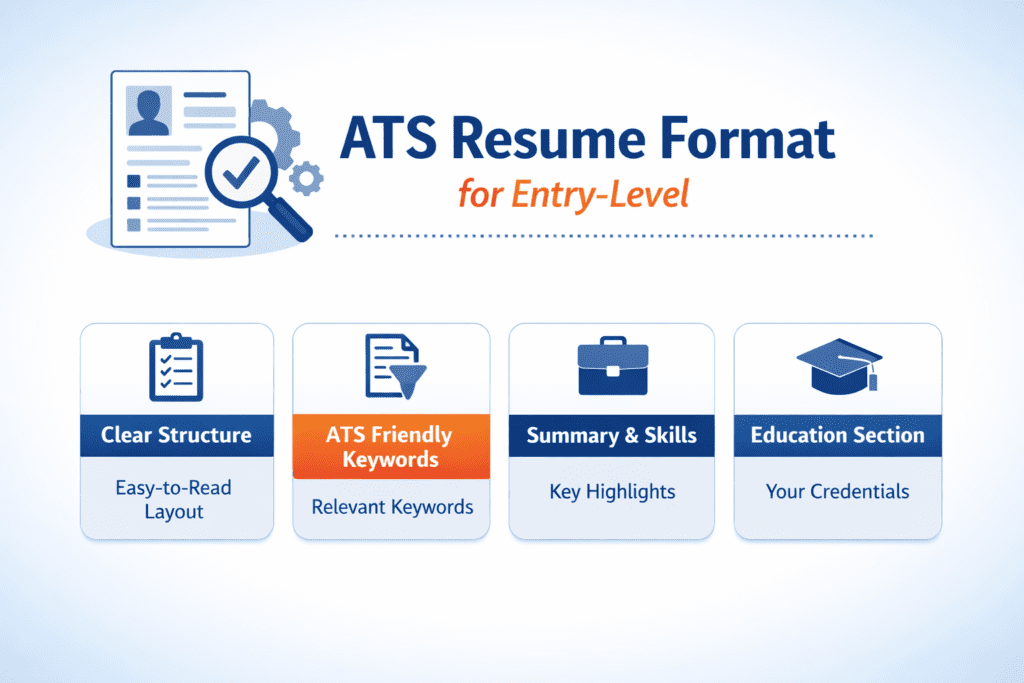
Your resume should be optimized for software first, then humans. For UK-based applications, refer to our UK ATS CV format guide to ensure your CV follows local hiring standards and British spelling conventions. Fresh graduates and entry-level candidates should focus more on skills, certifications, and project work when building an ATS-optimized resume. Here is an example of an ATS-friendly resume format designed specifically for entry-level candidates.
Step 3: Optimize Your Resume for Relevance Scoring
ATS assigns scores based on how closely your resume matches the role.
To improve your score:
• Place important keywords higher in the document
• Add measurable achievements
• Align experience descriptions with job responsibilities
• Remove irrelevant experience
For example:
Weak:
Responsible for sales activities.
Strong:
Increased regional sales by 35 percent within 12 months.
Numbers significantly improve ATS scoring in US job markets. ATS Resume Format for Entry-Level
How ATS Scoring Algorithms Rank Candidates
ATS systems typically assign scores based on weighted criteria.
Although exact formulas vary by platform, scoring usually includes:
• Keyword frequency
• Keyword proximity to job title
• Years of experience
• Education match
• Skills section completeness
For example:
If a job description lists “Digital Marketing” 5 times, and your resume includes it only once, your relevance score may drop significantly.
Some systems also apply knockout filters such as:
• Minimum years of experience
• Required certifications
• Work authorization status
If your resume does not satisfy these baseline conditions, it may be automatically rejected.
That is why tailoring your resume for each application is not optional in 2026.
Even small keyword adjustments can significantly change ATS ranking.
Step 4: Align Job Titles Strategically
If you are applying for: Marketing Manager
But your title says: Marketing Lead
Consider adding contextual clarity: Marketing Lead, Marketing Manager equivalent
This helps ATS recognize title alignment without falsifying your experience.
Job title mismatch is one of the most overlooked ATS rejection triggers.
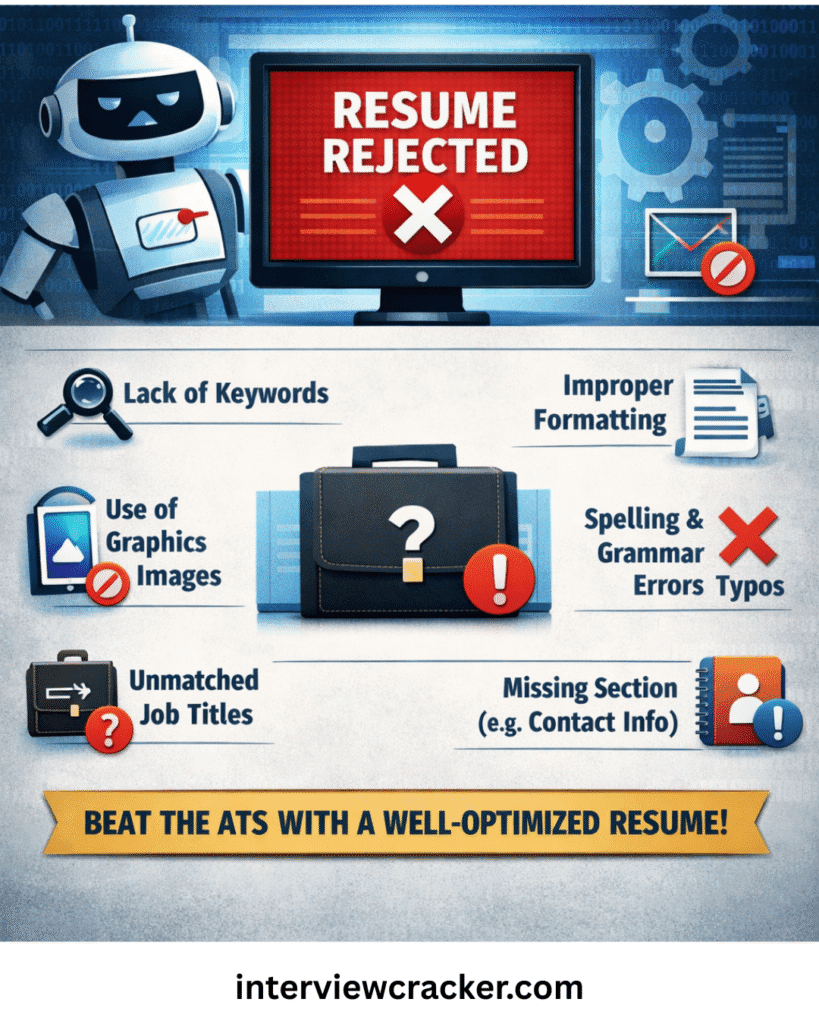
Step 5: Fix Common ATS Rejection Triggers
Even strong resumes get rejected due to technical issues.
Common ATS rejection reasons include:
• Missing core keywords
• Keyword stuffing without context
• Incorrect file format
• Broken parsing from design templates
• Missing essential sections such as Skills, Experience, or Education
• Using images instead of text
If you are unsure whether your formatting works correctly, use a free ATS resume checker to verify parsing accuracy before applying.
Real Example: Before and After ATS Optimization
Consider this example:
Before Optimization
“Responsible for managing client accounts and supporting sales initiatives.”
After Optimization
“Managed 25+ enterprise client accounts, increasing retention by 32% and generating $1.2M in annual recurring revenue.”
Why this works better:
• Includes measurable results
• Uses revenue metrics
• Adds scale
• Improves keyword density
ATS systems prioritize specificity.
Generic statements reduce scoring.
Replace vague phrases like:
• “Helped with”
• “Responsible for”
• “Worked on”
With impact-driven language supported by numbers.
This approach improves both ATS score and recruiter appeal.
Step 6: Tailor Your Resume or CV for US, UK, Canada and Gulf Job Markets
ATS optimization is not identical across countries. The software differs, the terminology differs, and even spelling differences can reduce your keyword match score. Here is what you need to know by region.
United States — Resume Optimization
- Use the word “resume” (not CV) — US ATS systems are built around this term
- Keep to 1–2 pages maximum; US recruiters expect brevity
- Emphasise measurable results: revenue figures, percentages, team size
- No personal details: no photo, no date of birth, no nationality
- Common US ATS platforms: Workday, Greenhouse, Taleo (Oracle), iCIMS, Lever, BambooHR
- US job boards that feed ATS directly: LinkedIn, Indeed, Glassdoor, ZipRecruiter
United Kingdom — CV Optimization
The UK job market has distinct ATS behaviour that most guides ignore. Here is what actually matters for UK applications.
- Use the word “CV” not “resume” — UK ATS systems, recruiters and job boards all use CV terminology
- British spelling is critical for keyword matching: “organisation” not “organization”, “optimise” not “optimize”, “programme” not “program”. If a UK job posting says “organisational skills” and your CV says “organizational skills”, some ATS systems will not count it as a match
- UK CVs typically run 2 pages — this is not a problem; it is the expected format
- Use “Personal Statement” or “Professional Summary” at the top — not “Objective”
- No photo, no date of birth, no marital status — UK law (Equality Act 2010) means these are not expected and may raise red flags
- Right to Work filter: many UK ATS systems include a mandatory right-to-work question. If you do not have UK right to work, some systems automatically reject the application before a human sees it. Always confirm the role’s visa sponsorship status before applying
UK-specific ATS platforms you will encounter:
| ATS Platform | Common In | Sectors |
|---|---|---|
| Eploy | UK mid-market | Retail, logistics, professional services |
| Vacancy Filler | UK public sector | NHS, councils, universities |
| Tribepad | UK enterprise | Transport, hospitality, large employers |
| Recruitee | UK & Europe | Tech startups, scale-ups |
| Taleo / Workday | Global + UK FTSE 100 | Finance, consulting, multinationals |
| NHS Jobs portal | NHS only | All NHS clinical and non-clinical roles |
UK job boards that route into ATS: Reed.co.uk, Totaljobs, CV-Library, Guardian Jobs, Jobsite, LinkedIn UK.
Note: NHS is the largest employer in the UK. If targeting NHS roles, applications go through the NHS Jobs portal which has its own keyword parsing system. Include your NMC, HCPC or relevant registration number prominently — this is a mandatory filter on most NHS ATS applications.
Canada — Resume Optimization
- Canadian English follows British spelling conventions: “colour”, “labour”, “programme” — ensure consistency with the job posting
- Canadian resumes are similar to US format: 1–2 pages, no photo, results-focused
- Right to work and work permit status is increasingly included as an early ATS filter in Canada
- Common ATS platforms in Canada: Dayforce (Ceridian), ADP Workforce Now, Greenhouse, Lever, iCIMS
- Top Canadian job boards feeding ATS: LinkedIn, Indeed Canada, Workopolis, Job Bank (Government of Canada), Eluta
- For Ontario and BC tech roles specifically: Greenhouse and Lever are dominant; optimise accordingly
- Include province-relevant certifications if applicable — e.g. CPA Ontario vs CPA Canada, P.Eng provincial designations
UAE and Gulf Region — Resume Optimization
- Large multinationals and government entities in UAE use enterprise ATS: SAP SuccessFactors, Oracle Taleo, Workday
- Smaller Gulf employers often review CVs manually — ATS is less universal than in the US or UK
- Gulf ATS systems frequently include a visa and work permit status filter — always address this upfront
- Gulf-region job boards: Bayt.com, GulfTalent, Naukrigulf, LinkedIn — these have their own CV parsing layers
- Gulf CVs typically include a professional photo, nationality, and visa status — unlike UK/US formats. Removing these may lower your score on Gulf-specific ATS
ATS Software by Country — Quick Reference
| ATS Platform | Most Common In | Best For |
|---|---|---|
| Workday | US, UK large enterprise | FTSE 100, Fortune 500 companies |
| Greenhouse | US, Canada, UK startups | Tech, scale-up, VC-backed firms |
| Taleo (Oracle) | US, global multinationals | Large corporations |
| iCIMS | US mid-market | Healthcare, retail, manufacturing |
| Eploy | United Kingdom | UK mid-market, all sectors |
| Vacancy Filler | United Kingdom | NHS, public sector, councils |
| Dayforce (Ceridian) | Canada | Canadian enterprise and mid-market |
| SAP SuccessFactors | Germany, global | Multinationals, manufacturing |
| Lever | US, Canada, UK | Technology, professional services |
Industry-Specific ATS Optimization Tips
ATS behavior varies slightly depending on industry expectations.
Technology Roles
• Emphasize programming languages
• Separate tools from frameworks
• Include GitHub or portfolio links
Finance Roles
– Highlight compliance knowledge
– Mention financial modelling tools
– Quantify revenue or cost savings
- For UK finance roles: highlight FCA compliance experience, regulatory frameworks (MiFID II, Basel III), and UK-specific qualifications such as ACCA, ACA, CISI or ICAEW
- UK financial services ATS often screens for FCA-regulated experience as a mandatory filter — state this explicitly if applicable
- For Canadian finance roles: include CPA designation (specify provincial body), IFRS familiarity, and CRA compliance experience
Healthcare Roles
– Include certifications prominently
– List license numbers if applicable
– Emphasize patient volume metrics
- For NHS and UK healthcare roles: include your NMC pin (nurses), HCPC registration number (allied health), or GMC number (doctors) — the NHS Jobs ATS uses these as mandatory filters and applications without them are often automatically screened out
- Include the specific NHS band level relevant to your experience (Band 5, 6, 7 etc.) — UK healthcare recruiters use these in ATS keyword searches
- For Canadian healthcare roles: include your provincial college registration (e.g. CNO for Ontario nurses, CPSBC for BC physicians) and indicate whether you hold a full or provisional licence
Marketing Roles
• Use data-driven metrics
• Include campaign tools
• Highlight ROI and conversion rates
Tailoring your optimization strategy based on industry improves ATS scoring and increases interview probability.
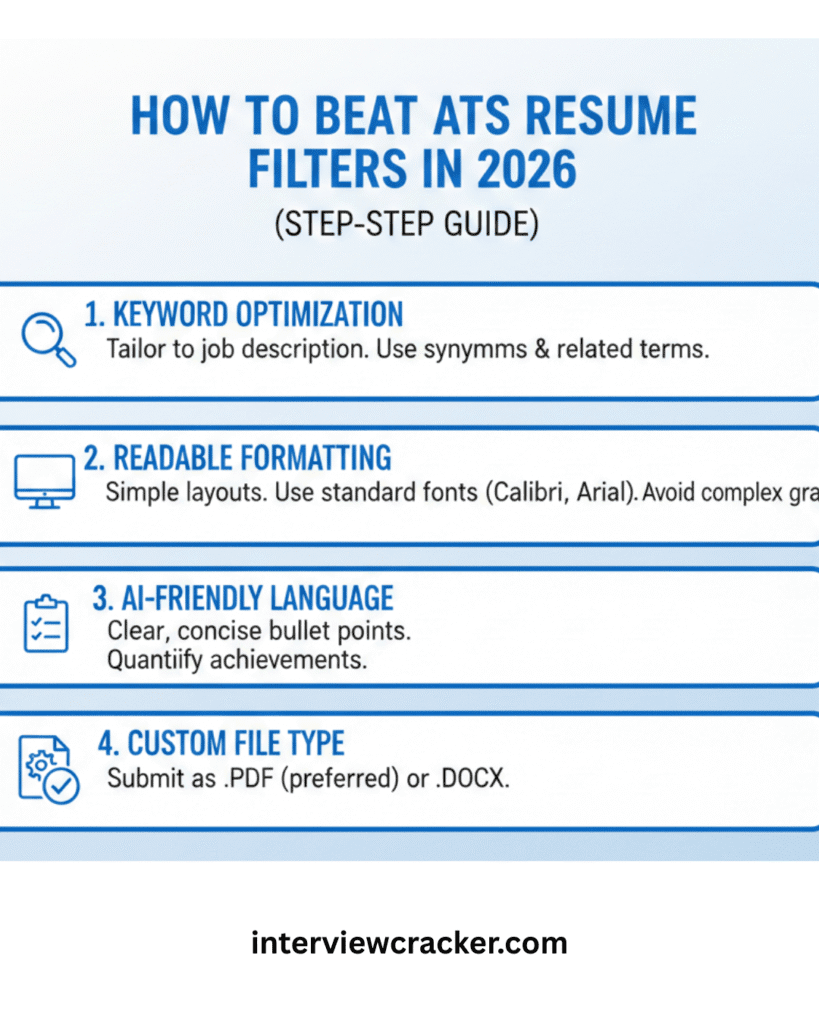
Final ATS Optimization Checklist Before You Apply
Before submitting your application, confirm:
✔ Keywords match the job description
✔ Job title alignment is clear
✔ No tables or graphics
✔ Achievements include metrics
✔ Skills section reflects the job role
✔ Resume saved as Docx
✔ Resume tested with an ATS resume checker
Following this checklist significantly improves your probability of passing automated screening.
If you’re unsure about formatting or structure, consider using an ATS-friendly resume builder that automatically aligns your resume with modern Applicant Tracking Systems. These tools help eliminate parsing errors and ensure proper keyword placement before you apply.
Should You Use an ATS Resume Checker Before Applying?
Using an ATS resume checker allows you to:
• Measure keyword match percentage
• Detect formatting issues
• Identify missing skill variations
• Preview parsing results
While no tool guarantees shortlisting, testing your resume before applying significantly reduces technical rejection risk.
Before submitting important applications, run your resume through a free ATS resume checker to validate optimization.
Conclusion
Beating ATS resume filters is not about gaming the system. It is about understanding how modern hiring technology works.
When you align keywords, formatting, measurable achievements, and job title relevance, you dramatically increase your chances of getting shortlisted.
Optimize smartly.
Test your resume.
Apply strategically.
ATS systems are predictable. Now you know how to beat them.
After your resume passes ATS filters, the next step is preparing for interviews. Practicing with structured mock interview platforms can help you confidently handle screening calls and video interviews once you’re shortlisted.
FAQs
1. How do I know if my resume will pass ATS?
You can estimate your resume’s ATS compatibility by comparing it directly with the job description. Look for exact keyword matches, relevant skills alignment, and clear formatting. The safest method is to run your resume through a free ATS resume checker tool that simulates keyword scoring and parsing accuracy.
2. What ATS score is considered good?
Most career experts recommend aiming for a 60–75 percent keyword match rate. However, some competitive roles may require even higher alignment. The goal is not to stuff keywords but to reflect the job description naturally and accurately.
3. Can ATS read PDF resumes?
Most modern ATS systems can read simple, text-based PDFs. However, complex formatting, graphics, and multi-column layouts may break parsing. When in doubt, use .docx format for maximum compatibility, especially when applying to US companies.
4. Do UK companies use ATS as aggressively as US companies?
UK ATS adoption is now standard practice among large employers, public sector organisations, and financial services firms. Here is the breakdown by sector:
- FTSE 100 and large UK corporates: virtually all use ATS. Workday, Taleo and SAP SuccessFactors are dominant in this space
- NHS and UK public sector: the NHS Jobs portal has its own ATS-style screening with mandatory filters including right to work, professional registration numbers, and DBS requirements. Government jobs through Civil Service Jobs use a similar structured screening system
- UK financial services: firms regulated by the FCA typically use enterprise ATS with compliance-based filters, especially for roles requiring FCA authorisation
- UK SMEs under 250 employees: ATS adoption is lower but increasing rapidly. Many now use affordable cloud-based systems like Eploy, Tribepad or LinkedIn’s built-in ATS features
- UK recruitment agencies: most major UK agencies (Hays, Reed, Michael Page, Robert Half) use their own internal ATS. Getting into their system with optimised keywords makes you searchable for multiple roles simultaneously
The key difference from the US: UK ATS systems place higher weight on right-to-work status, professional registration numbers (NMC, HCPC, FCA authorisation), and qualification equivalency. These are often hard knockout filters, not just scoring factors.
Bottom line: if you are applying to any UK employer with more than 50 staff, assume ATS is in use and optimise accordingly.
5. Why does my resume get rejected even when I’m qualified?
ATS rejection often occurs due to technical issues such as:
• Keyword mismatch
• Missing required certifications
• Incorrect formatting
• Job title mismatch
• Not meeting minimum experience requirements
Even small adjustments can significantly improve scoring.
6. Does keyword stuffing help pass ATS?
No. Modern ATS systems evaluate contextual relevance. Overloading your resume with repeated keywords without proper context can reduce readability and may negatively impact ranking within the system.
7. How many keywords should I include in my resume?
There is no fixed number. Instead, focus on including all relevant skills, tools, and phrases mentioned in the job description — naturally integrated into your experience and skills sections.
8. Should I tailor my resume for every job application?
Yes. Submitting the same resume to multiple job postings reduces your chances of passing ATS filters. Tailoring your resume to reflect each job description increases match score and improves shortlisting probability.
9. Do ATS systems check for employment gaps?
Some ATS systems can calculate employment duration automatically. Large unexplained gaps may lower ranking depending on employer configuration. Address gaps clearly if relevant.
10. Does ATS prioritize recent experience?
Yes. Many ATS scoring systems weigh recent roles more heavily. Highlighting recent achievements and relevant responsibilities improves relevance scoring.
11. Can a strong LinkedIn profile help if my resume fails ATS?
No. If your resume does not pass ATS filters, recruiters may never reach your LinkedIn profile. Resume optimization remains the first priority.
12. Is using an ATS resume checker worth it?
Yes. While no tool guarantees selection, testing your resume helps identify technical errors and missing keywords before submitting applications. It significantly reduces avoidable rejection risks.
13. How does ATS work for UAE and Gulf job applications?
ATS adoption in the Gulf region varies significantly by employer type:
- Large multinationals operating in the UAE (HSBC, Deloitte, Accenture, ADNOC, Saudi Aramco) use enterprise ATS platforms including SAP SuccessFactors, Workday and Oracle Taleo — the same systems used in the US and UK
- UAE government entities and semi-government companies increasingly use structured ATS, often with mandatory visa and work permit status filters as the first screening step
- Smaller Gulf SMEs and family-owned businesses typically review CVs manually without ATS — in these cases, design and presentation matters more than keyword optimisation
- Gulf-region job boards including Bayt.com, GulfTalent, Naukrigulf and LinkedIn all apply their own CV parsing and keyword matching before routing applications to employers
Key Gulf-specific ATS considerations:
- Visa and work permit status is typically a mandatory filter — always specify your current visa status and whether you require sponsorship
- Gulf CVs for local employers typically include a professional photo, nationality, and current location — unlike UK/US formats. Removing these from a Gulf-targeted CV may work against you
- Arabic or bilingual CVs are expected for government roles in Saudi Arabia and some UAE positions; international companies typically accept English-only CVs