ATS Tips for Professionals Moving to Canada — Complete Job Application Guide 2026

ATS Tips for Professionals Moving to Canada

🍁 Moving to Canada for Work — Key Facts 2026

Highest Min. Wage Province

CAD $17.40/hr

British Columbia — ~$36,192/year

Good Salary for Immigrants

CAD $70,000–$100,000

Per year — skilled professionals in major cities

Most Common ATS Systems

Workday · Taleo

iCIMS · Greenhouse · BambooHR

Best City for Net Income

Calgary, Alberta

No provincial income tax · Lower rent

Resume Length for Canada

1–2 pages max

No photo · No DOB · No declaration

Top Job Portal for Newcomers

Indeed CA · LinkedIn

Workopolis · Job Bank · Glassdoor CA

📌 What you'll find below: Why international resumes fail Canadian ATS · Canadian resume format checklist · How to reformat your resume step by step · Keywords by industry · Salary by profession and province · Minimum wage by province 2026 · Best cities for skilled immigrants · 10 FAQ answers

Canada is one of the top destinations for skilled immigrants in 2026 — with 132,200 skilled immigration places in the federal program and minimum wages ranging from CAD $15.00 to $17.40/hour depending on province. But landing a job in Canada as a newcomer requires more than the right skills — it requires a resume that passes Canadian ATS systems, uses Canadian salary terminology, and targets the right job portals.

This guide covers everything skilled professionals need in 2026: how Canadian ATS systems reject international resumes, how to reformat yours, Canadian salary benchmarks by profession and province, the best job portals for newcomers, and which cities offer the best opportunities for your specific background.

Why Your International Resume Fails Canadian ATS Screening

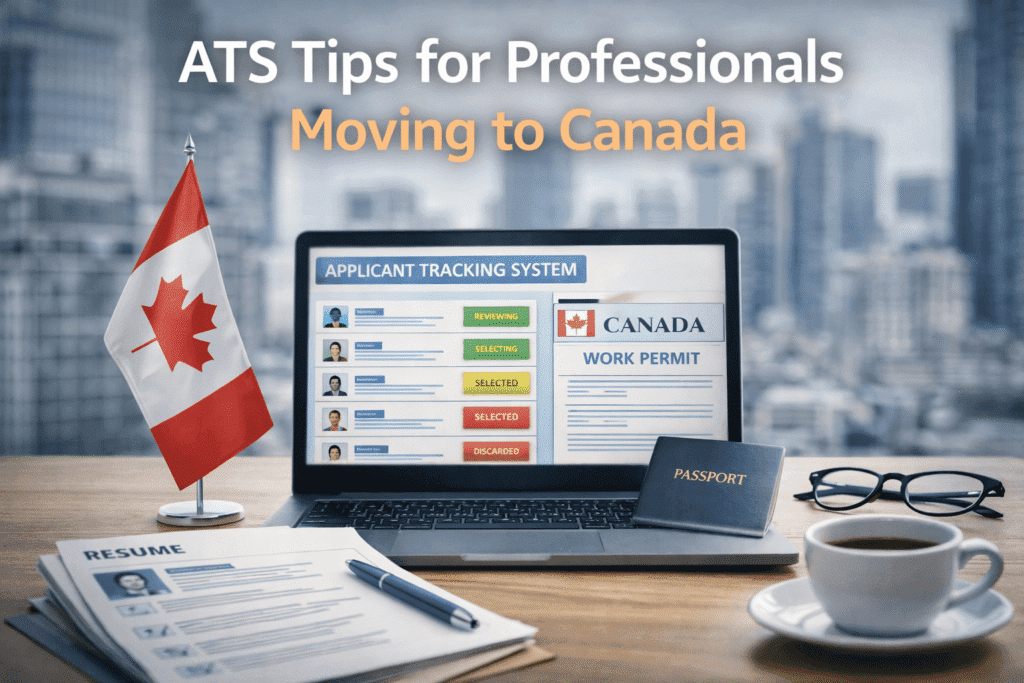
Canadian employers — particularly in Ontario, British Columbia, and Alberta — use Applicant Tracking Systems to screen resumes before a human recruiter ever sees them. The most widely used platforms are Workday, Taleo, iCIMS, Greenhouse, and BambooHR. Each of these systems has specific parsing logic that determines whether your resume is readable, relevant, and correctly formatted.

International resumes typically fail Canadian ATS screening for five predictable reasons.

The first is the objective statement. International resumes almost universally begin with a Career Objective — two to four sentences describing what the candidate is looking for. Canadian ATS systems do not weight objective statements in their scoring algorithms. What they look for is a Professional Summary that uses industry-specific keywords matching the job description. If your resume opens with an objective instead of a keyword-rich summary, you are starting with a lower match score before the recruiter has read a single line.

The second is the format itself. International resumes commonly use tables, columns, text boxes, and decorative borders. Every ATS system handles tables and multi-column layouts poorly. Text inside a table is frequently parsed incorrectly — skills listed in a side column may never be read by the ATS at all. A resume that looks clean and professional in PDF format can be completely garbled after ATS parsing if it uses any of these design elements.

The third is the inclusion of personal information. International resumes routinely include date of birth, marital status, father’s name, passport number, and a photograph. Canadian employment law under the Ontario Human Rights Code and equivalent provincial legislation explicitly protects against discrimination based on age, marital status, and national origin. Including this information does not cause your resume to be rejected by ATS — but it can create unconscious bias when a human reviewer sees it. Remove all personal information except your name, Canadian phone number, email address, LinkedIn URL, and city of residence.

The fourth is the keyword mismatch. International job titles and technical terminology often differ from Canadian equivalents. “Sr. Software Engineer” in India may be called “Senior Software Developer” or “Software Engineer II” in Canada. “Team Lead” in India is often “Engineering Manager” or “Tech Lead” in Canadian job descriptions. If your resume uses International terminology that does not match the keywords in Canadian job postings, your ATS match score drops significantly even if your skills and experience are identical.

The fifth is the absence of quantified achievements. Canadian employers expect resume bullet points to contain measurable results. “Responsible for managing the sales team” scores very low in ATS algorithms compared to “Led a 12-person sales team that exceeded quarterly targets by 28% for three consecutive quarters.” The presence of numbers, percentages, dollar amounts, and team sizes directly improves your ATS score on most Canadian platforms

Use a free ATS resume checker before applying to avoid rejection.

Canadian Resume vs International Resume — Quick Reference

If you have been job hunting with a resume formatted for your home country, this table shows exactly what needs to change for Canadian employers and ATS systems.

Element❌ International Resume (Home Country)✅ Canadian Resume
Length3–5 pages standard1–2 pages maximum
Opening SectionCareer Objective (“I am seeking a role where…”)Professional Summary with role-specific keywords
Personal InformationPhoto, DOB, marital status, nationality, passport numberName, Canadian phone, email, LinkedIn, city only
Bullet Point StyleParagraph descriptions of responsibilitiesAction verb + task + measurable result
LayoutTables, columns, text boxes, decorative bordersSingle-column, clean, no graphics or tables
Skills SectionSoft skills (“team player”, “hardworking”, “dedicated”)Technical tools, certifications, methodologies only
Job Title TerminologyHome country job titles and abbreviationsCanadian job titles — verified against LinkedIn CA postings
Date Format“2019 – 2022” (year only)“Jan 2019 – Mar 2022” (month + year always)
Declaration“I hereby declare the above is true…” section at endNever included — remove completely
ReferencesReferences listed with contact details on resume“References available upon request” or omit entirely

Understanding CV vs resume differences is also important — Canadian employers use “resume” not “CV” for most professional roles outside academia and medicine.

ATS Resume Checklist for Professionals Applying in Canada

Before submitting any application for a Canadian role, go through this checklist. Every item that is not ticked is a potential ATS rejection point.

📄 Format & Length


Resume is 1–2 pages maximum — not 3 or 4

Single-column layout — no tables, text boxes, columns, or graphics

Standard font used — Calibri, Arial, or Georgia at 10–12pt

👤 Personal Information


Removed: photo, date of birth, marital status, nationality, passport number, declaration

Contact info shows Canadian phone number and Canadian city

LinkedIn URL included and profile matches resume content

🎯 Content & Keywords


Career Objective replaced with Professional Summary containing role-specific keywords

Every bullet point: action verb + what you did + measurable result

Job titles updated to Canadian terminology — verified against LinkedIn Canada postings

Dedicated Skills section lists technical tools, software, and certifications explicitly

Soft skills removed from Skills section — replaced with specific tools and methodologies

📅 Dates & ATS Parsing


Every role shows month and year for start and end date (e.g. “Jan 2020 – Mar 2023”)

Resume saved as .docx or clean PDF — not a scanned image or heavily designed template

Resume tested against the specific job description using a free ATS checker before applying

Once every item above is ticked, your resume is ready for Canadian ATS systems. Run it through our Free ATS Resume Checker against each job description before submitting — it takes under 2 minutes and significantly improves your match score.

💸 Moving to Canada? Send money home at the real rate.

Use Wise to receive your CAD salary or send money home at the real mid-market rate — no bank markup, no hidden fees. Trusted by 16M+ people worldwide.

Open a free Wise account →

Canada Salary Guide for Immigrants 2026 — By Profession & Province

Understanding Canadian salary benchmarks before your job search is critical — knowing what to expect and what to negotiate for prevents you from undervaluing yourself as a newcomer. Salaries in Canada vary significantly by province, with Ontario, British Columbia, and Alberta consistently paying the most for skilled professionals.

Profession Ontario (Toronto) BC (Vancouver) Alberta (Calgary)
Software Engineer CAD $95,000–$140,000 CAD $90,000–$135,000 CAD $85,000–$130,000
Registered Nurse (RN) CAD $75,000–$100,000 CAD $72,000–$95,000 CAD $80,000–$105,000
Financial Analyst / CPA CAD $70,000–$110,000 CAD $68,000–$100,000 CAD $72,000–$108,000
Civil Engineer (P.Eng) CAD $75,000–$110,000 CAD $72,000–$105,000 CAD $80,000–$120,000
Project Manager (PMP) CAD $90,000–$130,000 CAD $85,000–$125,000 CAD $88,000–$128,000
Data Scientist CAD $95,000–$140,000 CAD $90,000–$135,000 CAD $88,000–$130,000
Electrician (Red Seal) CAD $65,000–$90,000 CAD $68,000–$95,000 CAD $75,000–$110,000
Secondary Teacher CAD $55,000–$95,000 CAD $55,000–$90,000 CAD $60,000–$95,000

💡 Use our Salary to Hourly Calculator to convert any CAD annual salary to an hourly rate — select CAD and enter standard 37.5 or 40 hours/week.

Canada Minimum Wage by Province 2026

Canada does not have a single national minimum wage — each province and territory sets its own rate. This is critical to understand when evaluating job offers and comparing cost of living across cities.

Province / Territory Minimum Wage (CAD/hr) Annual (40hr/week) Effective Date
Ontario $17.20 ~$35,776/year Oct 2024
British Columbia $17.40 ~$36,192/year Jun 2024
Alberta $15.00 ~$31,200/year Stable — no recent change
Quebec $15.75 ~$32,760/year May 2024
Manitoba $15.80 ~$32,864/year Oct 2024
Nova Scotia $15.20 ~$31,616/year Apr 2024
Saskatchewan $15.00 ~$31,200/year Oct 2024

Key insight: British Columbia and Ontario have the highest minimum wages in Canada. However, cost of living — particularly rent in Toronto and Vancouver — means Alberta (Calgary/Edmonton) often offers better net purchasing power for skilled immigrants despite the lower minimum wage floor.

How to Reformat Your Resume for Canadian ATS

The good news is that reformatting your resume for Canadian ATS is a straightforward process. It does not require you to change your experience — only how you present it.

Start with a single-column layout. Remove all tables, text boxes, columns, and graphics. Use a clean single-column format with standard section headings: Professional Summary, Work Experience, Education, Skills, and Certifications. Use a standard font such as Calibri, Arial, or Georgia at 10–12 point size.

Replace your Career Objective with a Professional Summary. Your summary should be three to five sentences long and contain the exact keywords from the type of role you are targeting. If you are applying for Project Manager roles in Canada, your summary should include terms like “PMP-certified”, “cross-functional team leadership”, “Agile methodology”, “stakeholder management”, and “budget oversight” — whichever apply to your background.

Change your resume length. International resumes are often three to five pages long. Canadian employers expect one to two pages for most roles. If you have more than ten years of experience, two pages is acceptable. More than two pages is considered unprofessional in most Canadian industries outside academia and medicine. Cut older roles to one or two lines. Focus detail on your last three to five years.

Rewrite your bullet points to lead with action verbs and include quantified achievements. Every bullet point should follow this structure: action verb + what you did + measurable result. “Managed IT infrastructure” becomes “Managed IT infrastructure for a 500-person organisation, reducing system downtime by 34% through proactive maintenance scheduling.” This change alone can significantly improve your ATS match score on Workday and Taleo.

Remove the Declaration section. International resumes typically end with a declaration: “I hereby declare that the above information is true to the best of my knowledge.” This is not used in Canada and takes up valuable space that could contain additional keywords or achievements.

Add a Canadian address or at minimum a Canadian phone number. ATS systems and recruiters both use location filters. If your resume shows an local address or phone number, many applicant tracking systems will automatically deprioritise your application for roles that specify “candidates must be eligible to work in Canada.” If you are already in Canada on a work permit or PR, this is simply a matter of updating your contact information. If you are applying from India before moving, use the city you are moving to and note your visa status clearly

Keywords Canadian Employers Search For — By Industry

One of the most important ATS optimisation steps is matching your resume keywords to the language Canadian employers actually use. Here are the most searched keywords by sector in Canada for 2026.

In Information Technology, Canadian employers search for: Agile, Scrum, DevOps, AWS, Azure, GCP, Python, Java, React, Node.js, CI/CD, Kubernetes, Docker, REST API, JIRA, Confluence, full-stack development, cloud migration, and data engineering. If you have experience with these technologies, use exactly these terms — not abbreviations or paraphrased versions.

In Finance and Accounting, the most searched keywords are: CPA, CFA, IFRS, GAAP, financial modelling, variance analysis, month-end close, accounts payable, accounts receivable, reconciliation, ERP, SAP, Oracle Financials, budgeting, and forecasting. Canadian finance employers weight CPA designation very highly — if you are pursuing CPA Canada equivalency, mention it explicitly on your resume.

In Engineering, Canadian employers search for: P.Eng, APEGA, Professional Engineer, AutoCAD, SolidWorks, project management, PMP, Lean Six Sigma, quality assurance, ISO standards, structural analysis, civil engineering, mechanical design, and environmental compliance.

In Healthcare, the critical keywords are: RN, RPN, CNO registration, CRNBC, NCLEX, patient care, electronic medical records, EMR, Epic, clinical documentation, long-term care, acute care, and infection control. Canadian healthcare has specific provincial licensing requirements — always mention your registration status or application status prominently.

In Sales and Business Development, Canadian ATS systems search for: B2B sales, SaaS, enterprise sales, CRM, Salesforce, HubSpot, pipeline management, revenue growth, quota attainment, account management, and business development. Note that the term “BDM” (Business Development Manager) is widely used in Canada as it is in India — your existing terminology will transfer well here.

In Supply Chain and Logistics, high-value keywords include: supply chain management, inventory management, demand forecasting, ERP, SAP SCM, warehouse management, 3PL, vendor management, procurement, and APICS certification.

ATS Tips for Canada

🚀 Preparing for your first Canadian job interview?

Use Merlin AI to research Canadian employers, prep your interview answers for Canadian interview culture, and write a tailored cover letter — free to start.

Try Merlin AI free →

How to Pass Workday ATS — Canada's Most Common System

Workday is used by the majority of large Canadian employers including RBC, TD Bank, Scotiabank, Shopify, Rogers, Bell, Air Canada, and most federal and provincial government employers. Understanding how Workday parses resumes will directly improve your application success rate.

Workday parses resumes by extracting structured data: your job titles, employer names, dates of employment, education details, and skills. The single most common parsing error in Workday is date format. Many resumes often use formats like “Jan 2019 – Mar 2022” or “01/2019 – 03/2022.” Workday handles both of these correctly. What it struggles with is “2019 – 2022” with no month — it cannot accurately calculate tenure and may score your experience incorrectly. Always include month and year for every role on your resume.

Workday also extracts skills from a dedicated Skills section. Do not embed all your skills within your bullet points. Include a dedicated Skills section that lists your technical skills, certifications, and tools explicitly. Workday’s algorithm weights the Skills section specifically in its candidate scoring.

When applying through Workday, you will be asked to either upload a resume or fill in fields manually. Always upload your resume first — then review the auto-filled fields and correct any parsing errors before submitting. Workday frequently misparses other country’s company names and international educational institutions. Check every field.

Always test your resume using a free ATS checker before submitting

Canadian Resume vs. International Resume — Quick Reference

The differences between what works in India and what works in Canada come down to six key areas.

Length is the first difference. Many international resumes average three to four pages. Canadian resumes should be one to two pages maximum.

Personal information is the second. Many international resumes include a photo, date of birth, marital status, and father’s name. Canadian resumes include only name, Canadian phone number, email, LinkedIn URL, and city.

The opening section is the third. Many international resumes use a Career Objective. Canadian resumes use a Professional Summary with keywords.

Bullet point style is the fourth. Many international resumes often use paragraph descriptions. Canadian resumes use concise action verb plus quantified achievement bullets.

The declaration is the fifth. Many international resumes include a declaration at the end. Canadian resumes never include this.

The skills section is the sixth. Many international resumes often list soft skills like “team player” and “hardworking.” Canadian resumes list specific technical tools, certifications, and methodologies — the exact terms that ATS systems search for.

Understanding CV vs resume differences is important for Canadian jobs.

ATS Resume Checklist for Professionals Applying in Canada

Before submitting any application for a Canadian role, go through this checklist.

Your resume is one to two pages long — not three or four. You have removed your photo, date of birth, marital status, father’s name, and declaration section. Your contact information shows a Canadian phone number and Canadian city. You have replaced your Career Objective with a Professional Summary containing role-specific keywords. Your resume uses a single-column layout with no tables, text boxes, or columns. Every bullet point begins with an action verb and includes at least one quantified result. You have included a dedicated Skills section listing technical tools and certifications. Your job titles use Canadian terminology — check LinkedIn job postings in your target city to verify. You have included month and year for every role’s start and end date. You have run your resume through a free ATS checker against the specific job description before applying.

Once you have checked all of these, your resume is ready for Canadian ATS systems. The process of getting your first Canadian job offer takes time — most skilled newcomers report that it takes three to six months of consistent, optimised applications. The candidates who succeed fastest are those who treat their resume as a living document and update it for each application rather than sending the same version everywhere.

Knowing BDM full form and salary helps you target the right roles

Best Canadian Cities for Skilled Immigrants 2026

CityBest IndustriesAvg Rent 1-bedBest For
Toronto, ONFinance, tech, healthcare, mediaCAD $2,400–$2,900Most job volume — highest salaries
Vancouver, BCTech, film, trade, natural resourcesCAD $2,600–$3,200Tech + Pacific gateway — Asia ties
Calgary, ABOil & gas, engineering, constructionCAD $1,700–$2,200Best net income — lower cost of living
Ottawa, ONGovernment, defence, tech, healthcareCAD $1,900–$2,400Federal government jobs — bilingual advantage
Halifax, NSHealthcare, ocean tech, educationCAD $1,500–$2,000Most affordable — fastest PR via NSNP

💸 Earning CAD in Canada? Send money home at the real rate.

Use Wise to transfer your Canadian Dollar salary to India, South Africa, Philippines, UK or anywhere else at the real mid-market rate — no bank markup, no hidden fees. Trusted by 16M+ people worldwide.

Open a free Wise account →

Conclusion

Moving to Canada is a significant transition — and your resume needs to make that transition with you. The experience you built in India is genuinely valuable to Canadian employers. The only barrier is presentation. A resume that clearly communicates your skills in the language Canadian ATS systems and hiring managers understand will get you noticed significantly faster.

Run your reformatted resume through a free ATS checker against each job description before applying. Use LinkedIn actively. Prioritise Indeed Canada and Job Bank. And remember — every Canadian employer was once hiring someone for the first time. Your goal is simply to make it past the ATS so a human can make that decision

Also considering Australia? See our Best Jobs in Australia for Expats 2026 → — covering the 12 most in-demand roles, visa pathways, and state-by-state salary guide.

Frequently Asked Questions — Moving to Canada Job Search

Q: How long does it take to find a job in Canada as a skilled immigrant?

Most internationally trained professionals find their first Canadian job within three to six months of landing, assuming they are actively applying with a properly reformatted resume and networking on LinkedIn. Professionals in high-demand fields like technology, finance, and healthcare in Ontario and British Columbia typically find roles faster — often within six to ten weeks. The candidates who take longest are those who apply with an unchanged home-country resume format without adapting it for Canadian ATS systems.

Q: Do I need Canadian work experience to get a job in Canada?

No — but the perception that you do is one of the biggest myths newcomers encounter. Many Canadian employers actively prefer international experience, particularly in technology, engineering, and finance. What they require is that your resume communicates your experience in a format they recognise. Reframing your international experience using Canadian terminology, quantified achievements, and ATS-friendly formatting is far more effective than worrying about whether your experience is “Canadian enough.”

Q: Should I mention that I am a newcomer to Canada on my resume?

No — do not mention your immigration status on your resume. Include your Canadian city of residence and a Canadian phone number. If you are on an open work permit or have permanent residency, you can note “eligible to work in Canada” in your cover letter if the job posting specifically asks about work authorisation. Your immigration status is not relevant to your professional qualifications and does not need to appear on your resume.

Q: Which Canadian city has the most jobs for skilled immigrants?

Toronto (Greater Toronto Area) has the highest volume of professional jobs for skilled immigrants by far — particularly in technology, finance, accounting, and healthcare. Vancouver is strong for technology and engineering roles. Calgary is the best market for oil and gas, engineering, and project management. Ottawa has significant demand for IT professionals due to federal government contracts. If you have flexibility on location, the GTA gives you the largest pool of opportunities across the widest range of industries.

Q: Is a Canadian resume the same as a resume from my home country?

Almost certainly not — Canadian resumes differ from most international formats in six key ways: length (1–2 pages vs 3–4+ pages), personal information (no photo, DOB, or marital status in Canada), opening section (Professional Summary vs Career Objective), bullet point style (quantified achievements vs paragraph descriptions), the absence of a Declaration section, and keyword terminology (Canadian job titles and tool names vs home country equivalents). See the full comparison table earlier in this article.

Q: What is the best job portal for skilled newcomers in Canada?

Indeed Canada (ca.indeed.com) has the highest volume of job listings and is the best starting point. LinkedIn is essential for networking and recruiter visibility. Job Bank (jobbank.gc.ca) is important for government and federally regulated roles and is mandatory for LMIA-linked hiring. Workopolis lists smaller Canadian employers not always on Indeed. For newcomer-specific support, ACCES Employment and TRIEC offer free placement assistance specifically for internationally trained professionals.

Q: Do Canadian employers verify international degrees and certifications?

Most private sector employers do not formally verify international degrees for mid-level roles — your LinkedIn profile and resume are taken at face value. However, regulated professions in Canada (engineering, medicine, nursing, accounting, teaching) require credential recognition through specific bodies: Engineers Canada, provincial nursing colleges, CPA Canada, and provincial teaching colleges respectively. If you are in a regulated profession, begin the credential recognition process before or immediately after arriving — it can take six to eighteen months and is the most common bottleneck for internationally trained professionals.

Q: Should I include my home country salary on a Canadian job application?

Never include your home country salary on a Canadian resume or application. Canadian employers are not familiar with salary formats from other countries and it can anchor their perception of your expectations incorrectly. When asked for salary expectations in Canada, research the Canadian market rate for your role and city using LinkedIn Salary, Glassdoor Canada, and the Job Bank wage database. Always quote your expected salary in Canadian dollars (CAD) per year.

Q: Is IELTS required for jobs in Canada?

IELTS is required for immigration applications (Express Entry, Provincial Nominee Programs) but is generally not required by private sector employers for job applications. Canadian employers assess your English communication through your resume, cover letter, and interview. If your resume and LinkedIn profile are written in clear, professional English, most employers will not ask for IELTS scores. Government and regulated profession roles may have specific language requirements — always check the job posting carefully.

Q: What is the minimum salary for skilled professionals in Canada?

Canada’s federal minimum wage is CAD $17.30/hour (2026), which equals approximately CAD $35,984/year for a standard 40-hour week. However, provincial minimums vary — Ontario is $17.20/hour, British Columbia is $17.40/hour, and Alberta is $15.00/hour. For internationally trained professionals in skilled roles, entry-level salaries in Canada typically start at CAD $50,000–$70,000/year depending on field and city. Technology roles in Toronto and Vancouver commonly start at CAD $70,000–$90,000/year for entry-level positions.

Before negotiating your Canadian salary, understand what the market actually pays — see our Minimum Wage in Canada 2026 — Salary Guide by Province & Profession → for verified salary benchmarks across every major province.

What is a good salary in Canada for immigrants in 2026?

A good salary for a skilled immigrant in Canada in 2026 is CAD $70,000–$100,000/year for professional roles in major cities. In Toronto and Vancouver, you need at least CAD $70,000 to live comfortably after rent. In Calgary or Ottawa, CAD $65,000 provides a good standard of living. IT, engineering, healthcare, and finance professionals typically earn in the CAD $85,000–$130,000 range. After federal and provincial income tax, a CAD $90,000 salary in Ontario yields approximately CAD $65,000–$68,000 take-home per year.

Which Canadian province is easiest for skilled immigrants to find jobs?

Ontario (Toronto) has the highest volume of skilled job opportunities across all sectors — particularly IT, finance, and healthcare. Alberta (Calgary) is the most accessible for engineering, trades, and energy professionals and offers the lowest income tax (no provincial income tax in Alberta). British Columbia suits tech professionals and those with Asia-Pacific connections. For fastest permanent residency, Nova Scotia and Prince Edward Island have the most accessible Provincial Nominee Programs for skilled workers. Healthcare professionals can find work in every province with critical shortages in rural and regional areas.

🤖 Preparing for Canadian job interviews?

Use Merlin AI to research Canadian employers, tailor your answers for behavioural interview formats, and practise the STAR method — free to start.

Try Merlin AI Free →