Minimum Wage in Canada 2026 — Complete Salary Guide by Province & Profession

Wage in Canada

🍁 Canada Salary — Key Facts 2026

Federal Minimum Wage

CAD $17.75/hr

Effective April 1, 2025 — indexed to inflation

National Average Salary

CAD $63,000–$68,000

Median $63,000 · Mean $68,000/year

Highest Province Average

Alberta — $78,000/yr

Lowest income tax + no PST

Take-Home at $90,000 (Ontario)

~CAD $65,500/yr

After federal + provincial tax + CPP + EI

Highest Min. Wage Province

BC — $17.40/hr

Ontario $17.20 · Quebec $15.75

Best City for Net Income

Calgary, Alberta

Lowest tax + lowest rent vs salary ratio

📌 What you'll find below: Minimum wage by province · Average salary by profession · Federal + provincial income tax rates 2026 · Take-home pay examples · Best Canadian cities for skilled workers · Canada salary vs UAE vs Australia · Wise for CAD transfers · 10 FAQ answers

Canada is one of the top destinations for skilled immigrants in 2026 — with over 132,200 skilled immigration places in the federal program, strong demand across healthcare, technology, engineering, and trades, and salaries that compare favourably to most English-speaking countries. But understanding what you will actually earn — after federal income tax, provincial tax, CPP, and EI deductions — requires more than knowing the headline salary figure.

This guide covers everything: the federal minimum wage and each province’s rate for 2026, average salaries by profession, how Canada’s income tax system works, realistic take-home pay figures at common salary levels, and which cities offer the best balance of high salary and manageable cost of living.

💡 Converting your Canadian salary? Use our Salary to Hourly Calculator — select CAD and enter 37.5 or 40 hours/week for accurate Canadian conversions.

Canada introduced a federal minimum wage of $17.75/hour effective April 1, 2025 — the first time Canada has had a single federal floor applying to federally regulated workers (banking, telecommunications, interprovincial transport, broadcasting). However, each province and territory continues to set its own minimum wage for all other workers, and these rates apply to the vast majority of Canadian employees.

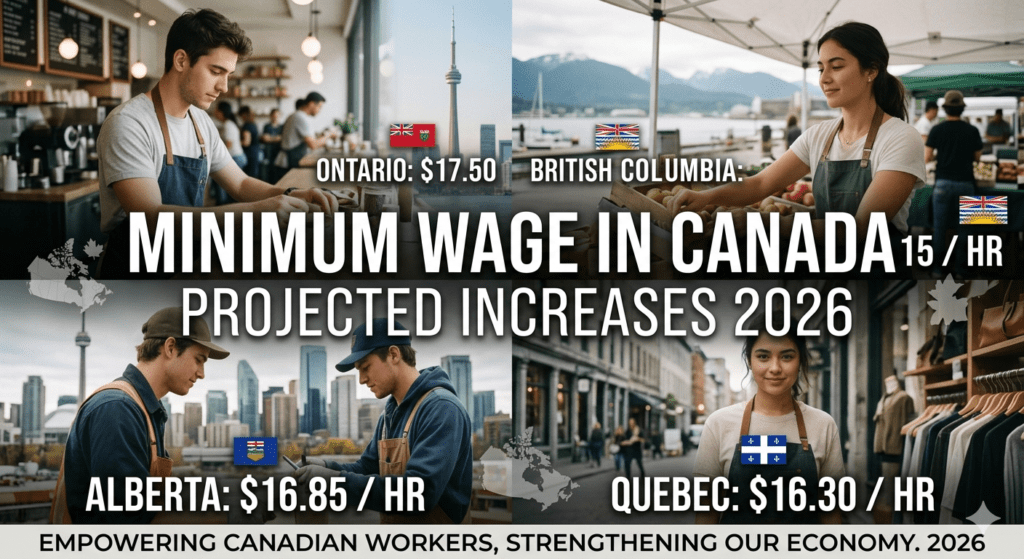
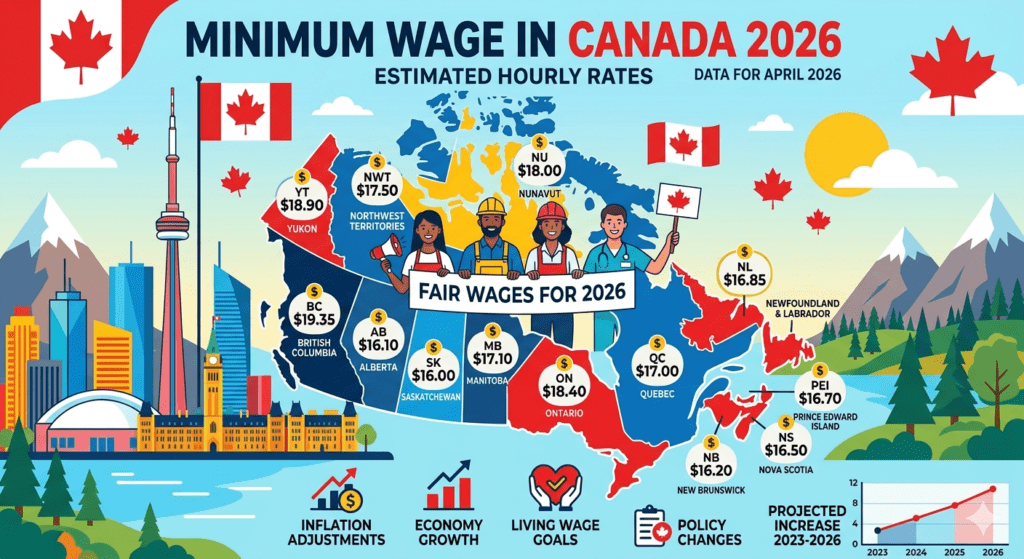
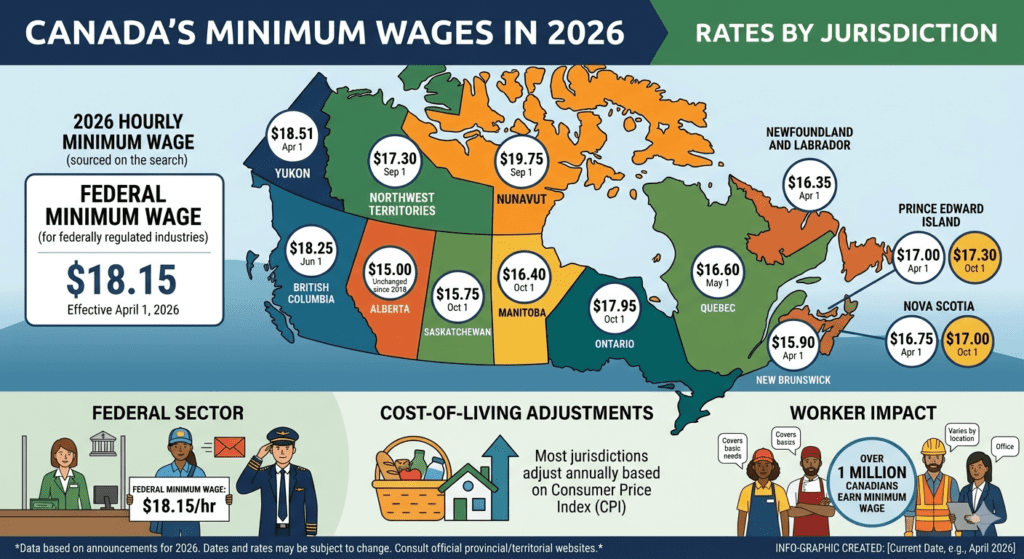
Province / TerritoryMin. Wage (CAD/hr)Annual (40hr/wk)Effective Date
🇨🇦 Federal (regulated workers)$17.75~$36,920/yrApril 1, 2025
British Columbia$17.40~$36,192/yrJune 1, 2024
Ontario$17.20~$35,776/yrOctober 1, 2024
Prince Edward Island$16.00~$33,280/yrOctober 1, 2024
Yukon$17.94~$37,315/yrApril 1, 2024
Manitoba$15.80~$32,864/yrOctober 1, 2024
Quebec$15.75~$32,760/yrMay 1, 2024
Nova Scotia$15.20~$31,616/yrApril 1, 2024
New Brunswick$15.30~$31,824/yrApril 1, 2024
Newfoundland & Labrador$15.60~$32,448/yrApril 1, 2024
Saskatchewan$15.00~$31,200/yrOctober 1, 2024
Alberta$15.00~$31,200/yrNo recent change

Important note for immigrants: Provincial minimum wages apply to most workers in Canada. The federal minimum wage of $17.75/hr applies only to workers in federally regulated industries — banking, airlines, railways, interprovincial trucking, telecommunications, and broadcasting. If you are working for a provincially regulated employer (most jobs), your province’s rate applies.

Average Salary in Canada by Province 2026

The national median salary in Canada is approximately CAD $63,000/year (~$5,250/month before tax) based on Statistics Canada’s Labour Force Survey data from early 2026. The mean (average) is slightly higher at CAD $68,000, pulled upward by high earners in finance, technology, and medicine. Alberta has the highest provincial average at approximately $78,000/year.

ProvinceAverage Annual Salary (CAD)Key IndustriesCost of Living
Alberta$78,000Oil & gas, engineering, constructionModerate — lower than ON/BC
Ontario$68,000–$70,000Finance, tech, healthcare, manufacturingHigh — Toronto rent expensive
British Columbia$67,000–$69,000Tech, film, natural resources, tradeVery high — Vancouver most expensive
Saskatchewan$66,000–$68,000Agriculture, mining, oil, healthcareLow — excellent purchasing power
Quebec$58,000–$62,000Tech, aerospace, gaming, healthcareModerate — Montreal affordable
Manitoba$58,000–$62,000Agriculture, manufacturing, healthcareLow — Winnipeg very affordable
Atlantic Provinces$55,000–$60,000Healthcare, public sector, fisheriesLowest in Canada — best affordability

Canada Average Salary by Profession 2026

Salaries in Canada vary enormously by profession. Technology, healthcare, law, and engineering consistently pay well above the national average. Here are verified 2026 salary benchmarks for the most common in-demand professions:

ProfessionEntry LevelMid LevelSenior Level
Physician / Doctor$150,000+$200,000–$300,000$300,000–$500,000+
Software Engineer$70,000–$90,000$95,000–$140,000$140,000–$200,000+
Data Scientist$75,000–$95,000$100,000–$145,000$145,000–$200,000
Registered Nurse (RN)$60,000–$75,000$75,000–$100,000$100,000–$120,000
Civil Engineer (P.Eng)$65,000–$80,000$80,000–$115,000$115,000–$160,000
Accountant (CPA)$55,000–$70,000$75,000–$110,000$110,000–$180,000
Project Manager (PMP)$70,000–$85,000$90,000–$130,000$130,000–$180,000
Electrician (Red Seal)$55,000–$70,000$70,000–$95,000$95,000–$130,000
Secondary Teacher$50,000–$65,000$70,000–$90,000$90,000–$105,000
Business Development Executive$50,000–$65,000$70,000–$95,000$100,000–$140,000 OTE
Administrative Assistant$40,000–$50,000$50,000–$65,000$65,000–$80,000
Truck Driver (AZ/DZ)$50,000–$65,000$65,000–$85,000$85,000–$110,000

💡 Use our Salary to Hourly Calculator to convert any annual CAD salary above to an hourly rate for Canadian job offer comparisons.
Minimum Wage in Canada

Canada Income Tax 2026 — Federal Rates & Take-Home Pay

Canada uses a progressive income tax system — you pay different rates on different portions of your income, not one flat rate on everything. You pay both federal income tax and provincial income tax on top. CPP (Canada Pension Plan) contributions and EI (Employment Insurance) premiums are also deducted from every paycheck.

Federal Income Tax Brackets 2026

Taxable Income (CAD)Federal Tax RateNote
$0 – $16,1290% effectiveBasic Personal Amount — tax-free at federal level
$16,130 – $57,37514%Reduced from 15% — fully in effect Jan 2026
$57,376 – $114,75020.5%Only on income above $57,375
$114,751 – $158,51926%Only on income above $114,750
$158,520 – $220,00029%Only on income above $158,519
$220,001+33%Only on income above $220,000

Key point: Your marginal tax rate (the rate on your next dollar) is always higher than your effective tax rate (what you actually pay as a percentage of total income). Someone earning $90,000 in Ontario is in the 20.5% federal bracket — but their effective federal rate is closer to 16%, because their first $16,129 is tax-free and the next $41,245 is taxed at only 14%.

Estimated Take-Home Pay 2026 — Common Salary Levels

Gross Salary (CAD/yr)Ontario Take-HomeAlberta Take-HomeBC Take-Home
$50,000~$39,500~$41,200~$39,800
$70,000~$52,800~$55,100~$53,200
$90,000~$65,500~$68,200~$65,900
$120,000~$84,000~$88,500~$84,800
$150,000~$101,000~$107,000~$102,000

*Estimates include federal tax, provincial tax, CPP, and EI. Alberta consistently delivers $2,000–$6,000 more take-home annually than Ontario at equivalent salaries due to its flat 10% provincial rate and lower combined rates at most income levels.

Additional deductions to know:

  • CPP (Canada Pension Plan): 5.95% of earnings between $3,500 and $71,300 — maximum $4,034/year
  • EI (Employment Insurance): $1.64 per $100 insurable earnings up to $65,700 — maximum $1,078/year
  • RRSP contributions reduce your taxable income dollar-for-dollar — one of the most effective ways to lower your tax bill

Best Canadian Cities for Skilled Workers & Immigrants 2026

CityTop SectorsAvg 1-bed RentBest For
Toronto, ONFinance, tech, healthcare, mediaCAD $2,400–$2,900/moMost job volume — highest salaries
Vancouver, BCTech, film, trade, natural resourcesCAD $2,600–$3,200/moTech + Pacific gateway — Asia connections
Calgary, AB ⭐Oil & gas, engineering, constructionCAD $1,700–$2,200/moBest net income — lowest tax + lower rent
Ottawa, ONGovernment, defence, tech, healthcareCAD $1,900–$2,400/moFederal government jobs — stable employment
Montreal, QCTech, aerospace, gaming, AI, filmCAD $1,500–$2,000/moMost affordable major city — bilingual advantage
Halifax, NSHealthcare, ocean tech, educationCAD $1,400–$1,900/moFastest PR via NSNP — most affordable east coast

⭐ Calgary is the best value city for most skilled immigrants in 2026. Alberta has no provincial sales tax, the lowest provincial income tax in Canada (flat 10% — reduced to 8% on first $60,000 from July 2025), and significantly lower housing costs than Toronto or Vancouver. A $100,000 salary in Calgary yields approximately $6,700 more take-home per year than the same salary in Ontario.

Canada Salary vs UAE, Australia & UK 2026 — Which Pays More?

CountryAvg. Professional SalaryIncome TaxEst. Monthly Take-Home
🇦🇪 UAE (Dubai)AED 12,000–20,000/moZero$3,260–$5,440 USD
🇨🇦 Canada (Alberta)CAD $78,000/yr avg~22–28% effective~$4,100–$5,700 USD
🇦🇺 AustraliaAUD $95,000–$100,000/yr32.5% marginal~$3,800–$4,500 USD
🇬🇧 United Kingdom£35,000–£50,000/yr20–40% + NI~$2,800–$4,200 USD
🇮🇳 India₹8–15 LPA (mid level)10–30%~$700–$1,300 USD

Bottom line: UAE offers the highest net take-home for expats due to zero income tax. Canada and Australia are comparable on take-home for mid-level professionals. Canada’s edge is permanent residency accessibility, universal healthcare, and long-term career stability — factors that make Canada the top choice for immigrants planning a permanent move.


💸 Earning CAD in Canada? Send money home at the real rate.

Use Wise to transfer your Canadian Dollar salary to India, South Africa, Philippines, UK or anywhere else at the real mid-market rate — no bank markup, no hidden fees. Trusted by 16M+ people worldwide.
Open a free Wise account →

Canada

🤖 Preparing for Canadian job interviews?

Use Merlin AI to research Canadian employers, prepare STAR-format interview answers, and tailor your resume summary for Canadian ATS systems — free to start.

Try Merlin AI Free →

Frequently Asked Questions — Canada Salary & Minimum Wage 2026

What is the minimum wage in Canada in 2026? Canada has both a federal minimum wage and provincial minimum wages. The federal minimum wage is CAD $17.75/hour (effective April 1, 2025), which applies to workers in federally regulated industries including banking, airlines, railways, and telecommunications. For all other workers — the vast majority of Canadians — the provincial minimum applies. The highest provincial minimum wage in 2026 is British Columbia at $17.40/hour, followed by Ontario at $17.20/hour. Alberta and Saskatchewan have the lowest at $15.00/hour, though Alberta’s lower taxes and cost of living make it highly competitive in real purchasing power.

What is the average salary in Canada in 2026?

The national median salary in Canada in 2026 is approximately CAD $63,000 per year (~$5,250/month before tax), based on Statistics Canada’s Labour Force Survey. The mean (average) is slightly higher at CAD $68,000, pulled upward by high earners in finance, medicine, and technology. The median is a more honest benchmark — it reflects what the middle earner actually makes. Alberta has the highest provincial average at around $78,000/year. Skilled professionals in IT, healthcare, and engineering earn significantly above the national average, typically CAD $90,000–$150,000.

What is a good salary in Canada for immigrants in 2026?

A good salary for a skilled immigrant in Canada in 2026 is CAD $70,000–$100,000/year in major cities. In Toronto and Vancouver, you need at least CAD $70,000 after tax to live comfortably given high housing costs. In Calgary, Ottawa, or Montreal, CAD $60,000–$65,000 provides a comfortable lifestyle. Entry-level immigrants typically start at CAD $45,000–$60,000 and see fast salary growth after 1–2 years of Canadian work experience. Skilled professionals with Canadian credentials or equivalent international qualifications in shortage occupations (IT, nursing, engineering, trades) often start at $75,000–$95,000.

How much tax do you pay in Canada on $70,000?

On a $70,000 salary in Ontario in 2026, you pay approximately: federal income tax ~$9,200, Ontario provincial tax ~$4,100, CPP contributions ~$3,980, and EI premiums ~$1,078 — total deductions of approximately $18,358, leaving a take-home of approximately $51,642/year (~$4,300/month). In Alberta, the same $70,000 salary yields approximately $55,100/year (~$4,590/month) due to Alberta’s lower flat provincial tax rate. Your effective tax rate on $70,000 is approximately 22–26% depending on province — significantly lower than the marginal rate you may see quoted.

Which province has the highest minimum wage in Canada?

The Yukon Territory has the highest minimum wage at $17.94/hour, followed by British Columbia at $17.40/hour and Ontario at $17.20/hour. The federal minimum wage of $17.75/hour applies only to federally regulated industries. For most workers, British Columbia and Ontario have the highest provincial minimum wages. However, Alberta — despite having one of the lower minimum wages at $15.00/hour — often offers better net purchasing power due to no provincial sales tax and the lowest provincial income tax rate in Canada (flat 10%, reduced to 8% on first $60,000).

Is $60,000 a good salary in Canada in 2026?

Whether $60,000 is a good salary in Canada depends heavily on your province and city. In most of Canada outside Toronto and Vancouver, $60,000 is a comfortable salary for a single adult — allowing for rent, daily expenses, savings, and modest lifestyle. In Toronto or Vancouver, $60,000 after tax (~$45,000) leaves limited room after rent ($2,000–$3,000/month). In Calgary, Edmonton, Ottawa, Montreal, or Halifax, the same salary provides a meaningfully higher standard of living. For families, $60,000 as a household income is tight across most major cities — dual income of $100,000+ is the comfortable family benchmark in 2026.

Does Alberta have no income tax?

Alberta does not have a provincial sales tax (PST) — it is the only province in Canada without one. However, Alberta does levy provincial income tax at a flat rate of 10% on income above $60,000, and at a reduced rate of 8% on the first $60,000 (effective July 2025). This flat rate is significantly lower than Ontario (graduated up to 13.16%) or BC (graduated up to 20.5%). Combined with no PST, Alberta residents consistently pay the lowest total taxes among Canadian provinces, making it the most tax-efficient province for employment income.

How much do immigrants earn in Canada in the first year?

New immigrants to Canada typically earn CAD $45,000–$65,000 in their first year, depending on their profession, credentials, and province. This is below the national average, partly due to the time required to get Canadian credentials recognised, build local professional networks, and gain “Canadian experience” that many employers request. Salary growth is typically fast — most skilled immigrants reach or exceed the national median within 2–3 years. Immigrants in shortage occupations (healthcare, engineering, IT, skilled trades) with internationally recognised credentials often start closer to CAD $65,000–$90,000 in their first year.

What jobs pay the most in Canada for immigrants?

The highest-paying jobs in Canada for immigrants in 2026 are: physicians and specialist doctors ($200,000–$400,000+), software engineers at FAANG/major tech companies ($140,000–$250,000), dentists ($150,000–$300,000), lawyers ($100,000–$250,000), oil and gas engineers in Alberta ($100,000–$200,000), and data scientists and AI specialists ($100,000–$180,000). For trades, power engineers, elevator mechanics, and Red Seal electricians in Alberta’s oil sands earn $90,000–$150,000. All of these professions are in active shortage, meaning credentials are being fast-tracked for recognition and employer sponsorship is widely available.

Can you live comfortably in Canada on minimum wage?

Living comfortably on minimum wage in Canada in 2026 is very difficult in major cities but more feasible in smaller cities and rural areas. At Ontario’s minimum wage of $17.20/hour working full-time (40 hours/week), you earn approximately $35,776/year gross, or roughly $28,000–$30,000 after tax — leaving around $2,300–$2,500/month. In Toronto or Vancouver where a one-bedroom apartment costs $2,400–$3,200/month, minimum wage does not cover basic living costs for a single adult. In Halifax, Moncton, Saskatoon, or smaller Alberta cities where rent for a one-bedroom is $1,200–$1,700/month, minimum wage provides a tighter but survivable budget for a single person with careful spending.

Free Guide

Working remotely from UAE, Canada, UK or Australia?

VPN laws · video call tools · getting paid in USD · tax basics · must-have tools

Read the Remote Work Setup Guide

Himani Joshi

Himani Joshi is a Senior Business Manager at Interview Cracker, working at the intersection of careers, hiring, and skill development. She writes about interview strategy, job market trends, and professional growth, helping readers turn opportunities into outcomes. She also writes for HR and hiring professionals, offering insights on recruitment, talent strategy, and evolving workplace dynamics.