 Calculating your Australian salary? Use our Salary to Hourly Calculator — select AUD and enter 38 hours/week for accurate Australian conversions.
 Australia Employment — Key Facts 2026
National Minimum Wage
AUD $23.23/hr
$882.80/week | $45,905/year
Average Full-Time Salary
AUD $95,000–$100,000
Median closer to $76,000–$80,000
Standard Work Week
38 hours
+25% casual loading for casuals
Occupations in Shortage
293 occupations
29% of all assessed roles — Sep 2025
Superannuation (Employer)
11.5% of salary
On top of base — not deducted from pay
Main Expat Visa (2026)
Skills in Demand (482)
Replaced TSS visa from July 2025
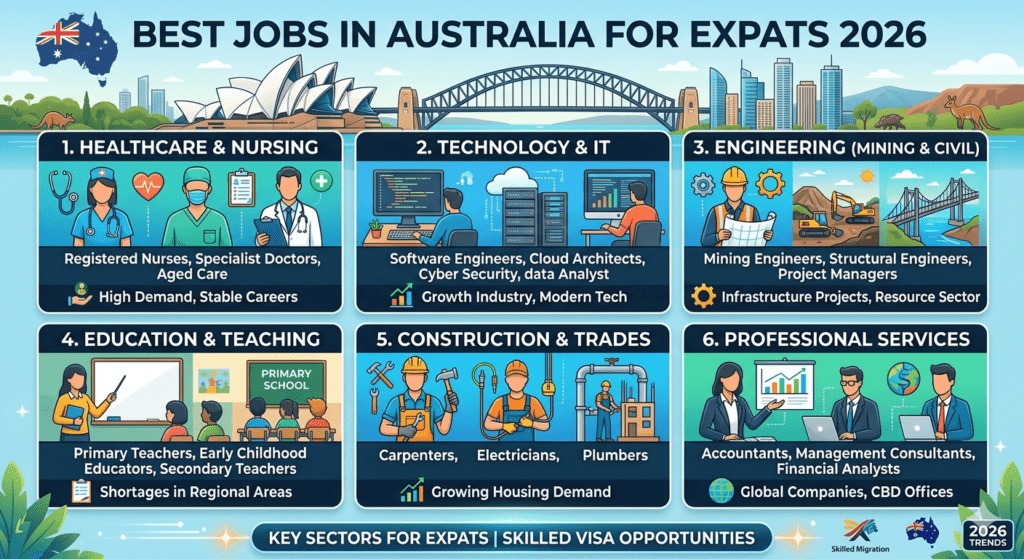
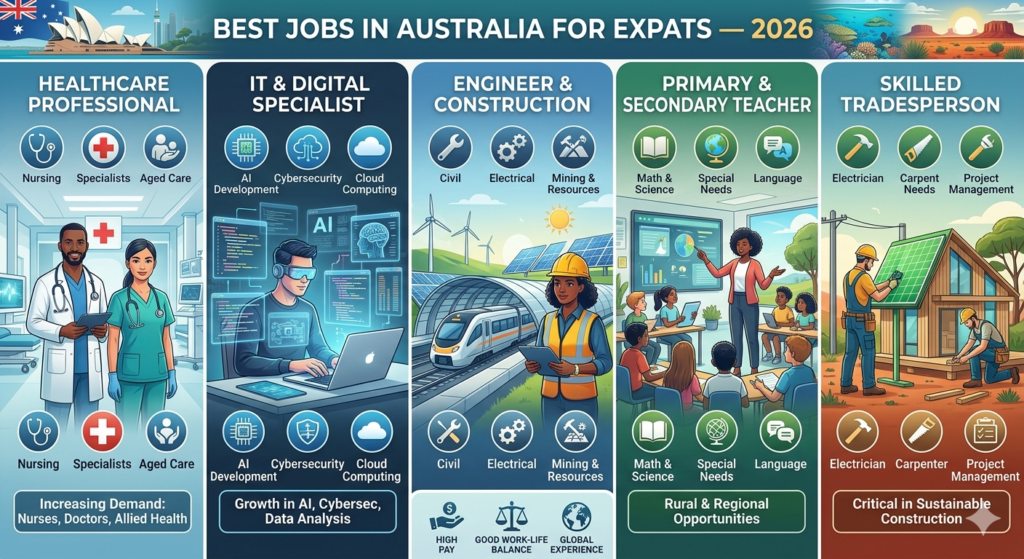
The following roles are the strongest opportunities for expat professionals in 2026 — combining high demand, competitive salaries, visa pathway availability, and strong prospects for permanent residency.
1. Registered Nurse (RN) — AUD $65,000–$120,000+/year
| Shortage status |  Critical shortage — all states and territories Critical shortage — all states and territories |
| Entry level salary | AUD $65,000–$75,000/year |
| Experienced salary | AUD $85,000–$120,000/year |
| Specialist (ICU/ED/Mental Health) | AUD $100,000–$130,000+/year |
| Visa pathway | Skills in Demand (482) → PR via 186/189/190 |
| Skills assessment body | ANMAC (Australian Nursing & Midwifery Accreditation Council) |
| Best states for demand | All states — regional areas offer fastest PR pathways |
Nursing is Australia’s single largest shortage occupation. The ageing population and NDIS expansion have created persistent demand that domestic supply cannot meet. Expat nurses from UK, Philippines, India, Ireland, and South Africa dominate the international intake. Regional nursing roles often come with additional incentives including relocation allowances, accommodation support, and priority state nomination for permanent residency.
2. Software Engineer / Developer — AUD $95,000–$200,000/year
| Shortage status |  High demand — selective shortages in specialisations High demand — selective shortages in specialisations |
| Entry level salary | AUD $70,000–$85,000/year |
| Mid level salary | AUD $95,000–$140,000/year |
| Senior level salary | AUD $150,000–$200,000+/year |
| Contract rate | AUD $600–$1,200/day |
| Highest demand specialisations | Salesforce, Oracle, ServiceNow, cloud (AWS/Azure), cybersecurity |
| Best cities | Sydney, Melbourne, Brisbane |
Australia’s tech sector is projected to need 58,000+ new positions by 2028. The government has formally committed to reaching 1.2 million tech workers by 2030. However, demand in 2026 is more selective than in previous years — generalist developers face competition, while specialists in enterprise software (Salesforce, ServiceNow), cybersecurity, and cloud architecture command premium salaries and fastest visa processing.
3. Civil Engineer — AUD $85,000–$180,000/year
| Shortage status | Critical shortage — infrastructure pipeline is massive |
| Entry level | AUD $70,000–$90,000/year |
| Mid level | AUD $95,000–$130,000/year |
| Senior / project lead | AUD $140,000–$180,000/year |
| Skills assessment body | Engineers Australia |
| Hotspots | Western Sydney, Southeast Queensland, Perth, regional NSW |
Australia’s housing crisis and infrastructure investment have created a construction and engineering boom that will sustain demand well beyond 2026. The construction industry is projected to grow 5.8%, creating 66,000+ jobs by November 2026. Civil engineers with experience in roads, rail, tunnelling, and water infrastructure are among the fastest visa approvals in the engineering category.
4. Electrician (A-Grade Licensed) — AUD $90,000–$200,000/year
| Shortage status | Severe shortage — trades fill rate only 54.3% |
| Standard salary | AUD $90,000–$130,000/year |
| Mining sector (WA) | AUD $150,000–$200,000/year |
| Key requirement | State electrical licence — varies by state, requires local assessment |
| Best paid state | Western Australia — mining sector premium |
Skilled trades are now the hardest category to recruit in Australia — with a fill rate of just 54.3%, meaning employers fill barely one in two trade vacancies advertised. Electricians are among the most sought-after, driven by the renewable energy transition (solar, wind, grid connection) and construction activity. Mining electricians in Western Australia are among the highest-earning tradespeople in the world on a net income basis.
5. General Practitioner (GP) / Doctor — AUD $150,000–$350,000+/year
| Shortage status | Critical — GPs are top shortage in SA, TAS, regional all states |
| GP salary range | AUD $150,000–$250,000/year |
| Specialist surgeon | AUD $250,000–$500,000+/year |
| Skills assessment body | AMC (Australian Medical Council) |
| Regional incentive | Priority PR + financial incentives for regional/rural practice |
6. Accountant / Financial Accountant — AUD $70,000–$180,000/year
| Shortage status | Strong demand — declining accounting graduates creating imbalance |
| Entry level | AUD $65,000–$80,000/year |
| Management accountant | AUD $90,000–$130,000/year |
| Finance manager | AUD $130,000–$180,000/year (up to $180k for businesses up to $100M turnover) |
| Skills assessment body | CPA Australia or CA ANZ |
7. Cybersecurity Specialist — AUD $100,000–$200,000/year
| Shortage status | Critical — ACT/NSW have formally prioritised this role |
| Salary range | AUD $100,000–$200,000/year |
| Top paying roles | Cyber Security Lead, CISO, Penetration Tester, Security Architect |
| Government demand | Very high — Defence, federal agencies, state governments |
8. Truck Driver (MR/HR/HC/MC) — AUD $75,000–$120,000/year
| Shortage status | Acute shortage — intensified by retirements, fewer new entrants |
| MR/HR driver | AUD $75,000–$90,000/year |
| HC/MC long-haul | AUD $90,000–$120,000/year |
| Transport manager | AUD $120,000–$160,000/year |
9. Secondary School Teacher (STEM) — AUD $75,000–$120,000/year
| Shortage status | Critical — maths and science teachers most needed |
| Starting salary | AUD $75,000–$85,000/year |
| Experienced teacher | AUD $95,000–$120,000/year |
| Registration | State-based — NESA (NSW), VIT (VIC), QCT (QLD) etc. |
10. Mining Engineer / Geotechnical Engineer — AUD $120,000–$250,000/year
| Shortage status | High demand — WA dominates, remote roles pay premium |
| Mid level | AUD $120,000–$160,000/year |
| Senior / specialist | AUD $160,000–$250,000+/year |
| Power systems engineer (WA) | AUD $170,000–$200,000/year |
11. Aged Care Worker / Support Worker — AUD $55,000–$80,000/year
| Shortage status | Persistent shortage — ageing population + NDIS expansion |
| Salary range | AUD $55,000–$80,000/year |
| Best entry point | Certificate III in Individual Support |
| PR pathway | Essential Skills stream (SID 482) — strong regional nomination |
12. Data Scientist / AI Specialist — AUD $110,000–$200,000/year
| Shortage status | High demand across finance, healthcare, government, tech |
| Mid level | AUD $110,000–$150,000/year |
| Senior / AI Architect | AUD $150,000–$200,000+/year |
| Fastest growing roles | AI Solutions Architect, ML Engineer, Cybersecurity + AI hybrid |
| Profession | Annual Salary (AUD) | Hourly Rate (38hr) | Shortage Level |
|---|---|---|---|
| Surgeon / Specialist Doctor | $250,000–$500,000+ | $126–$253/hr | Critical |
| Mining Engineer (WA) | $160,000–$250,000 | $81–$127/hr | Critical |
| Senior Software Engineer | $150,000–$200,000 | $76–$101/hr | High |
| Finance Manager | $130,000–$180,000 | $66–$91/hr | High |
| Electrician (Mining/WA) | $150,000–$200,000 | $76–$101/hr | Critical |
| General Practitioner | $150,000–$250,000 | $76–$127/hr | Critical |
| Civil Engineer (senior) | $140,000–$180,000 | $71–$91/hr | Critical |
| Cybersecurity Specialist | $120,000–$200,000 | $61–$101/hr | Critical |
| Data Scientist | $110,000–$170,000 | $56–$86/hr | High |
| Registered Nurse (specialist) | $100,000–$130,000 | $51–$66/hr | Critical |
| Software Developer (mid) | $95,000–$140,000 | $48–$71/hr | High |
| Secondary Teacher (STEM) | $75,000–$120,000 | $38–$61/hr | Critical |
| Registered Nurse (entry) | $65,000–$85,000 | $33–$43/hr | Critical |
| Aged Care Worker | $55,000–$80,000 | $28–$41/hr | Critical |
Australian salaries are typically quoted exclusive of superannuation. This is critical to understand when comparing offers — your total compensation is higher than the salary figure alone.
The Superannuation Guarantee rate in 2026 is 11.5% of your ordinary time earnings, paid by your employer on top of your salary directly into a superannuation (pension) fund. This is not deducted from your take-home pay — it is an additional employer contribution.
Example: A salary of AUD $100,000 means your employer also pays AUD $11,500/year into your super fund. Your total compensation package is AUD $111,500/year — but your take-home pay is calculated only on the $100,000 base, less income tax and Medicare levy.
Australian Income Tax Rates 2025–26
| Taxable Income (AUD) | Tax Rate | Est. Take-Home (after tax + 2% Medicare) |
|---|---|---|
| $0 – $18,200 | 0% (tax-free threshold) | Full amount |
| $18,201 – $45,000 | 19% | ~$38,000/year at $45K gross |
| $45,001 – $135,000 | 32.5% | ~$67,000/year at $100K gross |
| $135,001 – $190,000 | 37% | ~$107,000/year at $150K gross |
| $190,001+ | 45% | ~$129,000/year at $200K gross |
*2% Medicare Levy applies on all taxable income. Estimates only — use the ATO tax calculator for precise figures.
 Earning in AUD? Send money home at the real rate.
Use Wise to convert your Australian salary at the real mid-market rate — no hidden fees, no bank markup. Trusted by 16M+ people worldwide.
Australian employers expect a resume (not a CV) of 2–3 pages maximum. Key differences from international formats: no photo, no date of birth, no marital status, no nationality (illegal to discriminate on these grounds under Australian law). Lead with a professional summary, use quantified bullet points, and always include referee details or note “References available upon request.” See our complete ATS Resume Checker to ensure your resume passes Australian employer screening systems including Seek’s ATS and PageUp.
See our ATS Tips for Professionals Moving to Canada → — many of the same ATS rules apply to Australian employer systems.
 Preparing for an Australian job interview?
Use Merlin AI to research Australian employers, prep interview answers in Australian professional style, and tailor your cover letter for Seek applications — free to start.

Himani Joshi
Himani Joshi is a Senior Business Manager at Interview Cracker, working at the intersection of careers, hiring, and skill development. She writes about interview strategy, job market trends, and professional growth, helping readers turn opportunities into outcomes. She also writes for HR and hiring professionals, offering insights on recruitment, talent strategy, and evolving workplace dynamics.