Global Hiring Companies expanding across borders often face a key decision: whether to hire through an Employer of Record (EOR) or a Professional Employer Organization (PEO). Both models support international hiring, but they operate under different legal and operational assumptions.
This comparison is especially relevant for organizations hiring in the US, Canada, the EU, and the Middle East, where labor laws, payroll rules, and compliance standards vary significantly. Understanding how EOR and PEO models differ helps hiring teams choose an approach aligned with their risk tolerance, entity structure, and speed of expansion. This article explains both options clearly, focusing on how each model functions in a global hiring context.
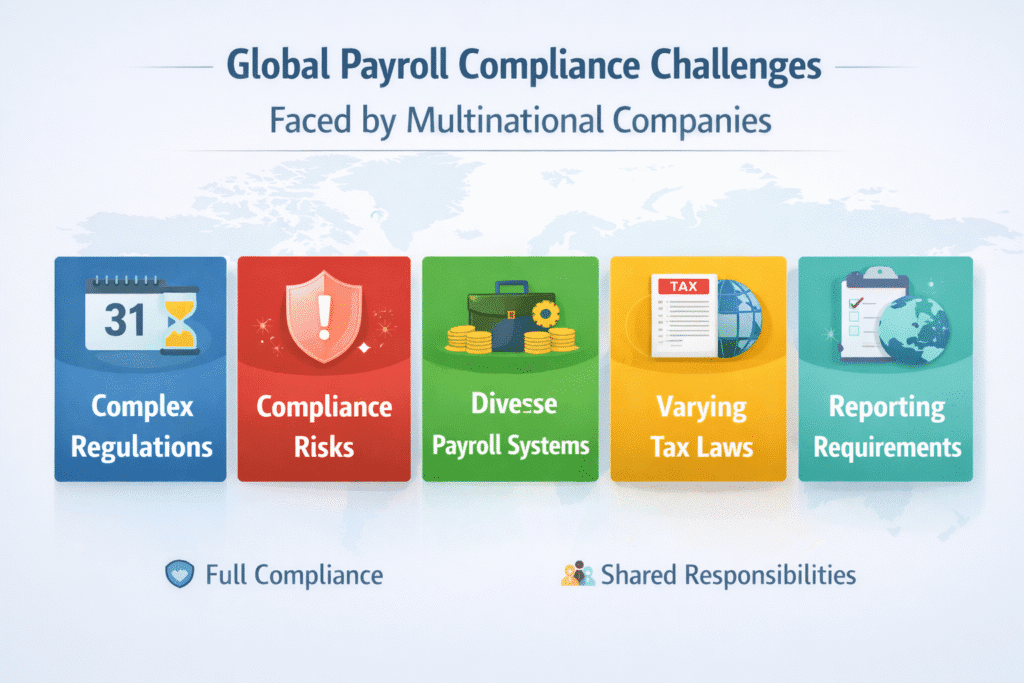
When organizations expand across borders, the distinction between Employer of Record and Professional Employer Organization models becomes critical. Global hiring introduces compliance risks related to employment laws, tax obligations, and worker classification that differ significantly from domestic HR outsourcing arrangements.
Table of Contents
ToggleWhat Is an Employer of Record (EOR)?
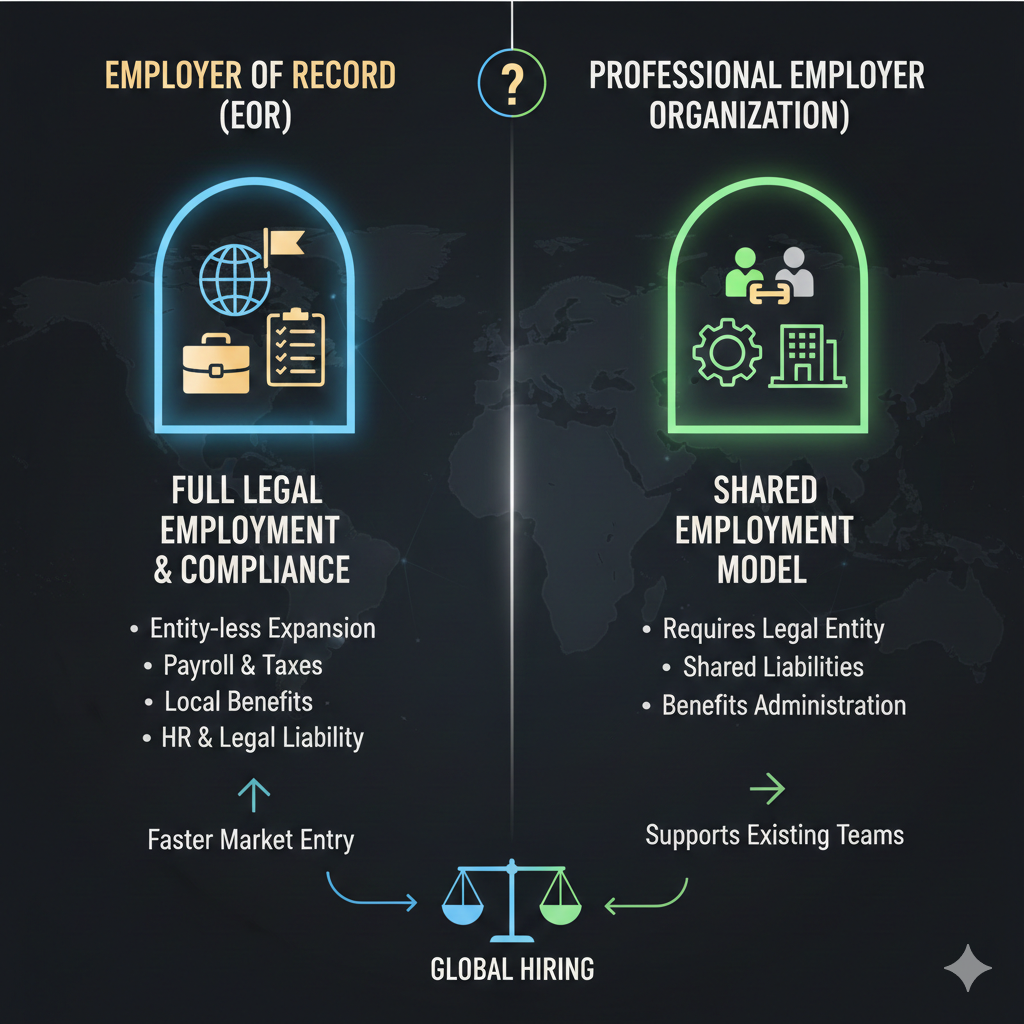
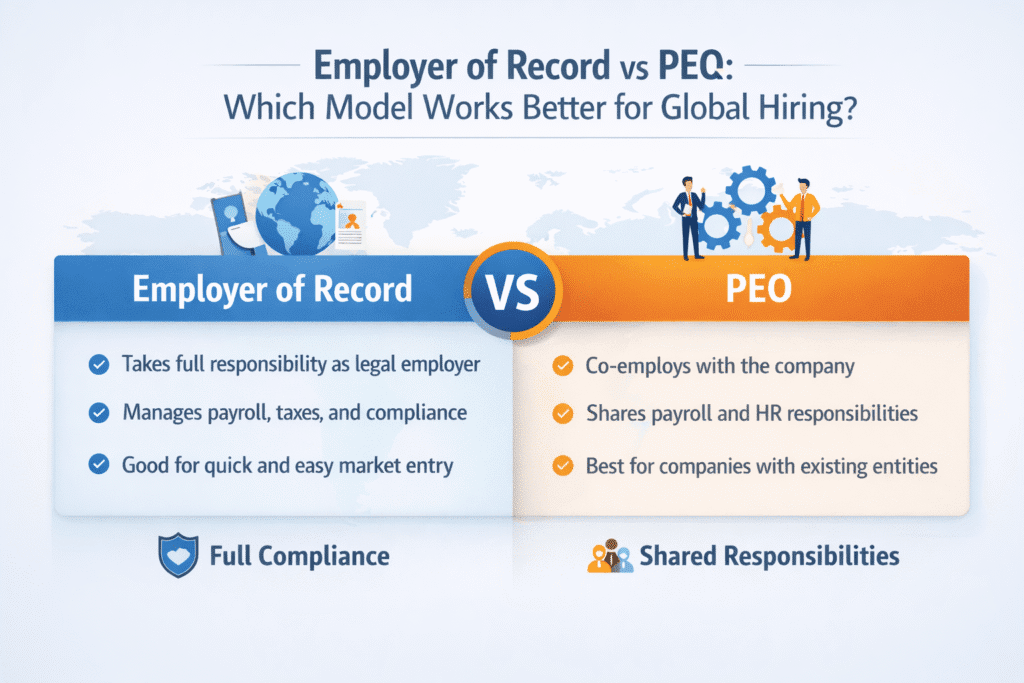
An Employer of Record is a third-party organization that legally employs workers on behalf of a company. The EOR becomes the official employer in the country where the employee is based, handling employment contracts, payroll, tax withholding, benefits administration, and statutory compliance. The client company retains control over day-to-day work, performance expectations, and business output.
EORs are commonly used when a company does not have a legal entity in the target country. This makes the model suitable for rapid market entry or testing new regions without long-term commitments. From a compliance perspective, the EOR assumes responsibility for adhering to local labor laws, including termination rules, social contributions, and mandatory benefits.
What Is a Professional Employer Organization (PEO)?
A Professional Employer Organization operates under a co-employment arrangement. In this model, both the company and the PEO share employer responsibilities. The company must already have a registered legal entity in the country of hire, as the PEO cannot legally employ workers on its own. Instead, it supports HR functions such as payroll processing, benefits administration, and HR policy guidance.
PEOs are often used to streamline HR operations for companies with established local entities. While the PEO provides administrative support, the client company remains the primary legal employer and retains responsibility for compliance risks. This model works best in jurisdictions with stable employment regulations and where the organization plans sustained operations rather than short-term expansion.
Organizations evaluating global workforce models often compare Employer of Record and PEO arrangements based on compliance exposure and operational control.
To understand how EOR models support compliant international hiring, explore our detailed guide on Global Employer of Record Services.
Key Differences in Legal Responsibility and Compliance
The most significant distinction between EOR and PEO models lies in legal accountability. With an EOR, the service provider assumes full employer liability under local law. This includes employment disputes, regulatory filings, and statutory reporting. For global hiring, this can reduce exposure to unfamiliar legal environments.
In contrast, a PEO supports compliance activities but does not replace the company’s legal responsibility. Any errors in contracts, terminations, or regulatory filings ultimately fall back on the employer entity. This difference is critical when hiring across multiple countries with varying enforcement standards. Organizations prioritizing risk reduction and simplified compliance often favor EORs, while those with mature legal structures may find PEOs sufficient.
Cost, Flexibility, and Speed of Expansion
EOR services typically reflect a broader scope of legal and compliance responsibility, as the provider assumes employer obligations in jurisdictions where no local entity exists. However, they enable faster hiring, as companies can onboard employees within weeks rather than months.
PEOs may appear more cost-effective over time, especially for larger teams, but they require upfront investment in entity setup and local legal support. Flexibility is lower, as exiting a market involves formal entity closure processes. For organizations evaluating new regions or hiring small distributed teams, speed and adaptability often outweigh cost considerations.
Choosing the Right Model for Global Hiring
Selecting between an EOR and a PEO depends on hiring goals, geographic scope, and internal capabilities. Companies without local entities, or those expanding into multiple jurisdictions simultaneously, often find EORs more practical. Organizations with established subsidiaries and consistent hiring volumes may prefer PEOs to optimize HR administration.
It is also common for companies to use both models in parallel, depending on the country and hiring stage. Understanding these distinctions supports informed decisions and prevents compliance gaps. Understanding these distinctions helps organizations design hiring strategies that align with compliance obligations, workforce governance, and long-term expansion goals.
Choosing Between EOR and PEO for Global Hiring
The choice between an Employer of Record and a PEO model depends largely on how employment liability and compliance responsibilities are managed. For organizations hiring internationally, understanding which entity assumes legal employer obligations is essential for reducing regulatory and operational risk. These global hiring models are often considered by organizations expanding into regions like the UAE, where local employment structures differ from domestic markets.
For a broader perspective on modern workforce planning and compliance, see our guide on HR and Hiring: Global Workforce Strategy, Compliance, and Talent Management.
Conclusion
Employer of Record and PEO models both play important roles in global hiring, but they serve different organizational needs. An EOR offers speed, simplicity, and reduced legal exposure when entering new markets without entities. A PEO supports HR efficiency for companies with existing legal structures but requires greater compliance ownership. Evaluating factors such as risk tolerance, expansion timelines, and operational maturity helps determine the better fit. Rather than viewing one model as universally superior, companies benefit from aligning the hiring approach with their broader international workforce strategy.
Recent Posts

Himani Joshi
Himani Joshi is a Senior Business Manager at Interview Cracker, working at the intersection of careers, hiring, and skill development. She writes about interview strategy, job market trends, and professional growth, helping readers turn opportunities into outcomes. She also writes for HR and hiring professionals, offering insights on recruitment, talent strategy, and evolving workplace dynamics.