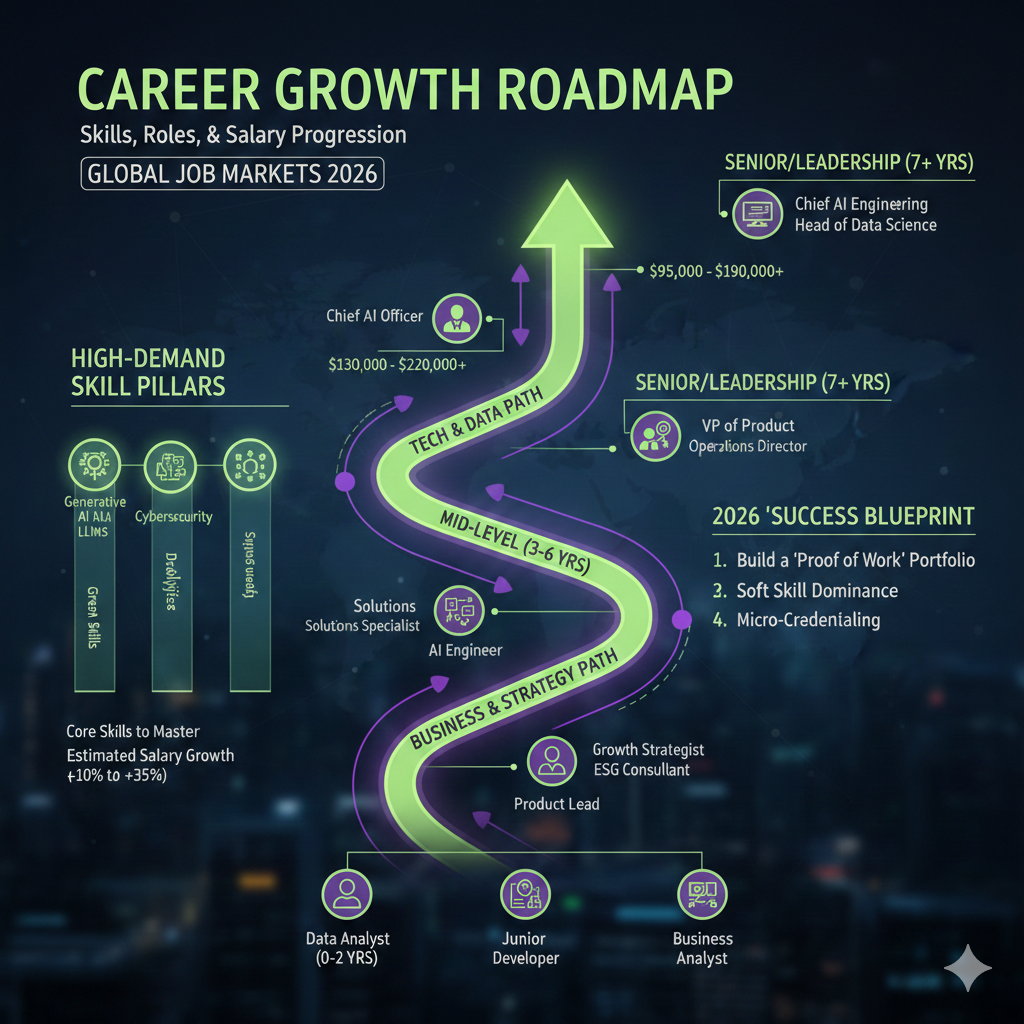
Career growth is the structured progression of skills, roles, and compensation over time. In global job markets such as the United States, Canada, Europe, and the GCC, career advancement is shaped by skill demand, role complexity, and business impact rather than job titles alone. A clear career growth roadmap helps professionals understand how careers typically evolve from entry-level roles to leadership positions and how salary progression aligns with responsibility.
This guide explains career stages, in-demand skills, role transitions, and earning potential across international markets. It is designed for professionals, job seekers, and HR teams who want practical clarity on long-term career planning in competitive global workplaces.
Table of Contents
ToggleUnderstanding Career Stages in Global Job Markets
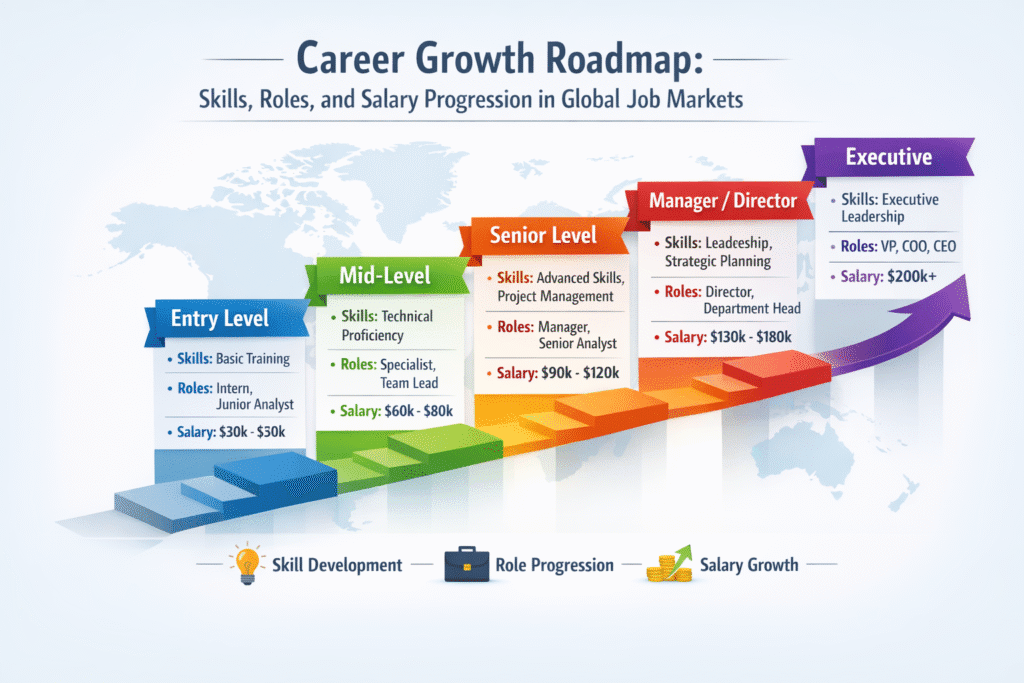
Most professional Career Growth Roadmap follow defined stages, regardless of geography. Entry-level roles focus on execution and learning. Mid-level positions emphasize ownership, specialization, and collaboration. Senior and leadership roles shift toward strategy, people management, and business outcomes.
In markets such as the United States and Canada, career stages are often formalized through job titles and performance bands. Progression is closely tied to measurable impact and results. In contrast, GCC markets like the United Arab Emirates often place additional emphasis on regional exposure, stakeholder management, and industry reputation.
According to the U.S. Bureau of Labor Statistics’ Career Outlook, roles projected to grow rapidly are technology, health services, and advanced analytical occupations.
Across the European Union, progression can be slower but more structured, with strong alignment to qualifications, tenure, and compliance standards. Understanding these differences helps professionals set realistic timelines and avoid misaligned expectations when moving across borders.
Skills That Drive Career Advancement Across Regions
Skill development is the most consistent predictor of long-term career growth. Technical and functional expertise matter early, but their relative importance changes over time. Entry-level professionals benefit from mastering core tools, processes, and industry fundamentals.
As Career Growth Roadmap advance, employers globally prioritize transferable skills. These include problem-solving, stakeholder communication, analytical thinking, and adaptability. In international roles, cultural intelligence and cross-functional collaboration are increasingly valued.
At senior levels, leadership capability becomes decisive. This includes decision-making under uncertainty, talent development, and alignment with organizational strategy. In global job markets, professionals who combine domain expertise with business acumen and people leadership tend to progress faster and command stronger compensation growth.
Role Transitions and Career Mobility Patterns
Career Growth Roadmap does not always mean vertical promotion. Many professionals progress through lateral moves that expand scope and exposure. For example, shifting from operations to strategy, or from individual contributor roles to project leadership, can accelerate long-term advancement.
In North American markets, role mobility across companies is common and often rewarded. In European markets, internal mobility within the same organization is more prevalent. In GCC economies, regional mobility and multi-country experience can significantly enhance career prospects.
Emerging economies in other regions also offer opportunities — for instance, tech hubs in South East Asia and Latin America — but practices in major global markets like the US, Canada, GCC, and EU often set benchmarks employers reference worldwide.”
Understanding when to deepen expertise versus when to broaden responsibility is critical. Well-timed role transitions often unlock higher-impact opportunities and prepare professionals for leadership positions without relying solely on title changes.
Salary Progression and Compensation Benchmarks
Salary growth typically follows responsibility, scarcity of skills, and business impact. Early career salary increases are often incremental and tied to performance reviews. Mid-career professionals see larger jumps when changing roles, employers, or geographies.
In global markets, compensation structures vary. Base pay dominates in Europe, while bonuses and equity play a larger role in the United States and Canada. GCC markets often offer tax-efficient packages that include housing or mobility benefits.
Professionals should evaluate total compensation rather than salary alone. Long-term earning potential is influenced by role complexity, leadership scope, and alignment with high-growth industries rather than years of experience alone.
Aligning Career Planning With Market Demand
A Career Growth Roadmap must remain flexible. Industry demand, regulatory changes, and economic cycles influence which skills and roles are valued. Professionals who regularly reassess their trajectory are better positioned to adapt.
High-growth areas such as digital transformation, sustainability, risk management, and data-driven decision-making continue to shape global hiring priorities. Aligning skill development with these themes improves employability across regions.
For organizations, structured career frameworks help retain talent and support succession planning. For individuals, clarity around progression expectations reduces career stagnation and improves long-term satisfaction.
Global Considerations for Long-Term Career Growth
International Career Growth Roadmap require awareness of cultural norms, employment regulations, and credential recognition. Qualifications valued in one region may not transfer directly to another.
Professionals planning global moves should assess language expectations, leadership styles, and market maturity. Building a portable skill set and maintaining a clear professional narrative supports credibility across borders.
A well-defined career growth roadmap balances ambition with market realities. It enables professionals to make informed decisions while navigating diverse global employment environments.
For a broader view on career development, explore our Career Blogs
Frequently Asked Questions
How long does it typically take to move from entry-level to senior roles?
In most global job markets, progression from entry-level to senior roles takes 8–12 years. Timelines vary based on industry, performance, mobility, and market demand. International exposure and skill diversification can shorten this path.
Which skills have the biggest impact on salary growth?
Skills that combine technical expertise with business and leadership capabilities have the strongest impact. Strategic thinking, stakeholder management, and data-driven decision-making consistently influence higher compensation across regions.
Is changing companies necessary for faster career growth?
Not always. In North America, external moves often accelerate salary growth. In Europe and GCC markets, internal progression and regional mobility within the same organization can be equally effective.
How important is international experience for career advancement?
International experience is increasingly valuable, especially for leadership roles. It signals adaptability, cultural awareness, and strategic perspective, which are highly regarded in global organizations.
Should career planning differ between regions?
Yes. Career Growth Roadmap planning should reflect regional norms, promotion structures, and compensation models. Understanding these differences helps professionals set realistic goals and avoid misaligned expectations.
Conclusion
Career growth in global job markets follows recognizable patterns, but outcomes depend on how well professionals align skills, roles, and market demand. A structured roadmap clarifies progression stages, supports smarter role transitions, and sets realistic expectations for salary growth. By focusing on transferable skills, strategic mobility, and regional awareness, professionals can build resilient careers that adapt to changing global conditions.
Industry Collaboration
Interview Cracker develops structured content on career progression, role evolution, and skill development within modern organizations and global job markets.
We occasionally collaborate with industry professionals and domain experts to provide informed perspectives on career planning, leadership development, and long-term growth pathways.